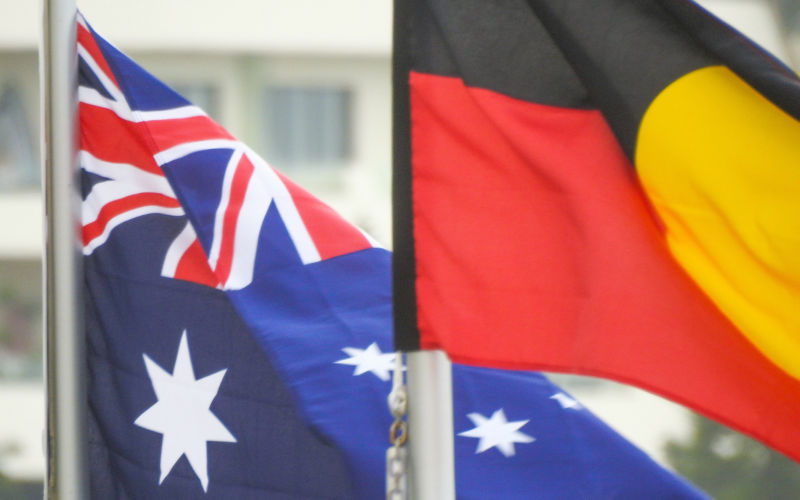
Voice to Parliament: An Australian test of character
_Will Australia today say Yes and agree to alter the Constitution to recognise the First Peoples of Australia by establishing an Aboriginal and Torres Strait Islander Voice? Or will we reject the request made to us by representatives of First Nations communities in the Uluru Statement from the Heart? _
Over recent weeks and months, our writers have given their voice to the collection of articles Pearls and Irritations has published in relation to the Referendum of 14 October 2023, in which Australians will be asked to give their vote to the following question:
_A Proposed Law: to alter the Constitution to recognise the First Peoples of Australia by establishing an Aboriginal and Torres Strait Islander Voice. Do you approve this proposed alteration? Yes/No. _
On which side of history will Australia choose to stand?
Read the full collection here:

**Marguerita Stephens**
Bitter truths: colonisation was not so good for some
These days, Melbournians celebrate the contribution of the Kulin clans to the life of the city. But even as Elders welcome us to the MCG, and clan members, young and old, bring vibrancy to the citys cultural, intellectual and spiritual life, commentators on the Voice referendum report that many voters have little knowledge of the history of this place and its continuing impact on Kulin lives. It is as if a people just walked away and left the place to the invaders.

**Frances Cowell**
The Voice: through the disinformation to the source of opposition
On Saturday, 14 October, Australians will vote on a seemingly inoffensive change to their Constitution. Why is it meeting such opposition? The case of the destroyed site at Juukan Gorge offers a hint. Are Australian mining companies, with such a poor record of respecting the voice of aboriginal communities, the true source of opposition?

**David Absolum**
I am voting Yes, but many No voters support reconciliation
The referendum campaign could use more Why, and less Yes.

**Stephanie Dowrick**
Our Central Land Council overwhelmingly asks you to vote YES
For over half a century the Central Land Council has fought for the voices of Aboriginal people from the heart of our nation to be heard. Our 90-member Council overwhelmingly asks you to vote YES, because we know that when decision-makers listen to our voices we end up with policies that help us, not harm us, and money is spent wisely. - Lesley Turner, CEO, Central Land Council, NT.

**Laurel Clare Lloyd-Jones**
Was the Uluru Statement of the Heart a prophetic vision for Australia?
Prophets nurture and evoke a new way of thinking. They give us images and words which subvert our system and tell us that we havent seen the whole picture yet. Prophets are not just concerned about social change for the sake of social change. They are concerned above all with transformation and freedom of the heart, and then out of that free heart, the prophet says, Listen. The prophet creates a new, freeing consciousness which allows us to hear the divine word and in the midst of that freedom, the prophets plant a promise, an alternative and new vision.

**Humphrey McQueen**
The Voice: How to change the Constitution without asking
Should the Voice be carried, the addition of a mandated power to a piece of paper is no guarantee that a Commission will be set up, or funded. Dutton could ignore Yes. Only voices massed beyond the national gasworks would ensure that the Voice does not go the way of the 1967 amendment granting the Commonwealth the power to make laws for the first peoples.

**Samantha Helps**
This land cries out in final warning
We need an Indigenous Voice to parliament. We need any other voice that will offset the disastrous self-serving notions of the present fools that govern this country. We are all living under the shadows of the illusions of the colonised mind.

**Kingsley Liu**
A Yes Vote just as important to Chinese-Australians as for our Indigenous brothers and sisters
With a population of 1.4 million, Chinese-Australians are the largest ethnic minority community in Australia and our say has weight. From the perspective of that community, an important objective must be playing our part in seeing Australia lift its game to match world standards of acceptance of minorities and particularly of its indigenous peoples.

**Tony Smith**
If you are proud of the Constitution, vote Yes
In 1996 I was fortunate enough to be involved in the Centenary of the 1895 Bathurst Peoples Constitutional Convention.

**John Queripel**
The referendum: So little asked, so graciously, but seemingly too much
Why do so many of my fellow non-Indigenous Australians seemingly have such a deep aversion towards the Aboriginal peoples of this land? Sadly, I am compelled to ask that question as we approach a referendum asking for constitutional recognition of Australias First Nations and an Aboriginal and Torres Strait Islander voice to parliament.

**Bob Carr**
Taking the high ground: let kindness have its day
I lost any reservations about The Voice after seeing a movie.

**Peter Rodgers**
Killing for Country: Another plank in truth-telling
At the heart of David Marrs new book, Killing for Country, is a crucial question. How should we deal with old, ugly secrets within our own families? Should we ignore them as excesses of the past, when and where things were done differently, or should we examine them closely for clues and lessons that might shape our behaviour now?

**Lucy Hamilton**
The Voice reveals the urgent need for truth reforms
The knowledge that the official AEC Yes and No campaign pamphlet sent to every home in Australia was not obliged to be factual is shocking.

**Spencer Zifcak**
The Constitution, sovereignty and The Voice
One question relating to the upcoming referendum on The Voice that has recently come to prominence concerns the question of sovereignty. Who or what is sovereign as the term is applied to the governance of Australia? Is there any such thing as Indigenous sovereignty? Might it be said that in Australia sovereignty is or could be shared? Might First Nations people be sacrificing some part of their sovereignty if a Voice to parliament is endorsed at the referendum? None of these questions affords an easy answer.

**Karla Grant**
Karla Grant explores Norways 34-year Indigenous Voice to Parliament
As Australia nears its referendum, Karla Grant takes a closer look at Norways Voice To Parliament.

**Paul Keating**
Leadership from Paul Keating on recognition of Aboriginal dispossession -1992
Nowhere in the world, I would venture, is the message more stark than it is in Australia. We simply cannot sweep injustice aside. ... the starting point might be to recognise that the problem starts with us non-Aboriginal Australians. It begins, I think, with that act of recognition. ... Down the years, there has been no shortage of guilt, but it has not produced the responses we need. Guilt is not a very constructive emotion. I think what we need to do is open our hearts a bit. All of us.

**Noel Turnbull**
Voice proponents flood the streets of major cities as Australian media battles its cult of forgetfulness.

**Bronwyn Kelly**
Remember Brexit? Australians will regret voting No on the Indigenous Voice
Australians have been able to witness the voter remorse that can arise when a nation votes on a specific question of policy in a referendum that has the potential to set their country on a new course. Referendum questions with that level of significance dont come along very often for democratic nations but when they do the cost of getting them wrong can be far bigger than we might expect.

**Henry Reynolds**
In her recent address to the National Press Club, Jacinta Price resuscitated the seventy years old policy of assimilation constructed by Minister for Territories Paul Hasluck.

**Narelle Bedford**
Why The Voice will lead to better government decision-making
The Aboriginal and Torres Strait Islander Voice to parliament will result in systemic and sustainable change in government decision-making and policy formulation affecting First Nations peoples. Here are four reasons why.

**Vivienne Milligan**
Embedding indigenous advice in government policy key to real change
In discussions of the upcoming referendum on establishing an Aboriginal and Torres Strait Islander Voice, a question often raised is how will it make a difference? This has been difficult for advocates to address because instances of governments empowering our First Nations peoples are few and far between.

**Abul Rizvi**
How I decided to vote in the upcoming Voice referendum
With the date of the Voice referendum now having been set for 14 October, all households will have received a pamphlet outlining the Yes and No case. Australians should understand that these pamphlets have not been officially fact checked. An attempt at fact checking the two cases by The Guardian is worth reading but I found that insufficient.

**Eva Cox**
Avoid the damage of NO: A plea to all women
This is a PLEA to all sensible women (and men) to vote Yes in the referendum because the damages of a No win will move us backward, not forward. We will still need ways of remedying the serious mess of inequities initiated in 1788. The failure of Yes will show the lack of sufficient trust of voters of those whose country this was before colonisation. As a feminist, I hope that womens experiences as the second sex will help us better understand more of the difficulties of first nations descendants!

**Ewan McArthur**
Self-determination is a choice: The Voice Referendum and what follows
The truth is that Aboriginal and Torres Strait Islander people successfully governed themselves for over 60,000 years and Australia need only get out of the way so they can continue.

**Dennis OBrien**
Yes on the Voice is a vote for a better future
Despite their occupation of our continent for over 60,000 years, our Aboriginal and Torres Strait Islander peoples are not recognised in the Constitution, the document on which our nation is founded.

**Henry Reynolds**
The Voice: walking with the Australian people for a better future
For me, indigenous recognition wont be changing our constitution so much as completing it. Tony Abbot, 2015.
Read more articles on matters impacting our Indigenous communities.

The views expressed in this article may or may not reflect those of Pearls and Irritations.
