Hong Kong high-rise renovations a murky, greedy industry – Asian Media Report
December 6, 2025
From Hong Kong’s deadly tower fire and surging renovation graft, to climate-fuelled floods across Asia, record weapons sales, a massive Korean data breach and collapsing Chinese tourism in Japan, this week’s Asian media coverage reveals the region’s mounting pressures and political tensions.
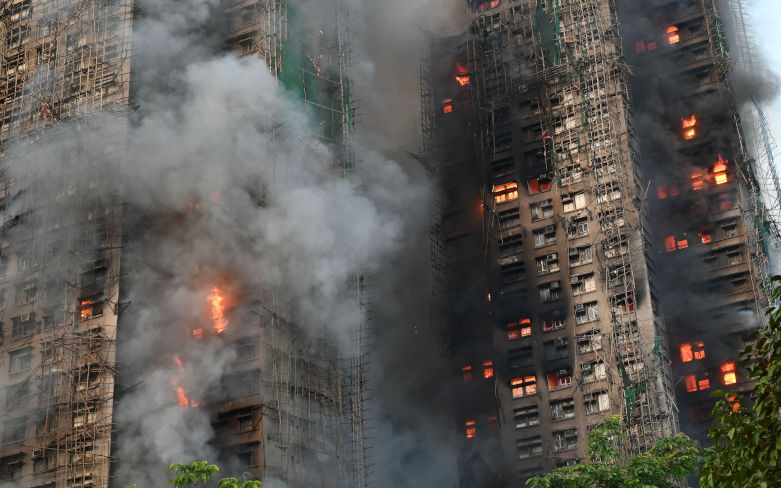
The Tai Po towers tragedy, Hong Kong’s worst fire in 70 years, is a human disaster, with 159 deaths and more bodies yet to be found. It is also a case of an industry, the building renovation business, bedevilled by bid-rigging and ballooning costs, says a South China Morning Post investigative report.
The story describes as feeble the official efforts to rein in collusive conduct.
It says the city is a gold mine for syndicates running the murky and rapacious renovation business, given its ageing stock of high-rise properties.
The impetus to renovate the towers at Wang Fuk Court came from an official edict in 2016. A preliminary tender in 2023 put the cost at HK$152 million ($A29 million); the final estimate last year was HK$336 million ($A65 million), the story says.
“Skyrocketing renovation costs have become commonplace,” the report says. It quotes expert Chiu Yan-loy as saying the high costs included unnecessary work and expensive techniques, from which the industry syndicates could make a profit using low-cost materials.
Final approval must come from a meeting of the owners’ corporation, Chiu said. If the vote was manipulated, by using proxy votes to control the majority, the deal could be sealed simply by buying off enough votes, he said.
A commentary in Nikkei Asia, the online politics and business magazine, reinforces SCMP’s report. It says the inferno exposed a deep rot beneath Hong Kong’s governance – years of corner-cutting, collusion and censorship.
The analysis, by University of Tokyo researcher Athena Tong, says bamboo scaffolding was blamed for the fire, even though it was clear from photos, videos and witness accounts that mesh netting and foam plates were the bigger culprits.
“By focusing on bamboo, these reports risked doing precisely what Hong Kong authorities perfected in the past five years – diverting attention from human responsibility,” Tong writes.
Nikkei Asia says in a separate story that authorities in Hong Kong and Beijing aim to keep a lid on simmering anger over the blaze. Investigators have made a dozen arrests and the Independent Commission Against Corruption says it is conducting a full investigation.
Yet people are asking questions about official accountability: residents have said they were assured of safety after raising concerns and complaints about the project over the past year.
Hong Kong will set up an independent commission, chaired by a judge, to investigate the fire, says Global Times, an official newspaper in China. It says HK Chief Executive John Lee Ka-chiu has pledged the report will be made public.
Asian insurers accept climate change drives risks
The main characteristic of the weather systems that have caused death and devastation across four countries in south and southeast Asia is that they produced an immense amount of rain.
They were not categorised as severe storms, because of their low wind speeds. But they brought very heavy rainfalls, causing flooding and mudslides and the destruction of homes, villages, roads, bridges and communications – and, by midweek, more than 1500 deaths.
Al Jazeera has a detailed report on the causes of the destructive flooding.
The region was hit by three tropical storms – Typhoon Koto, in the western Pacific, Cyclone Senyar, which hit Indonesia so severely, and Cyclone Ditwah, which devastated Sri Lanka.
A common thread was that communities were struggling with the sheer volume of rain, said Steve Turton of Central Queensland University’s environmental geography department. “All around the world where we get these tropical systems, whether you call them typhoons or hurricanes or tropical cyclones, they are producing more rain than they’ve ever produced,” Turton said. “And that’s because of climate change.”
Politicians might argue about climate change but insurers have to deal with the tragic reality.
Southeast Asian insurers believe the industry, governments and business associations have to develop new models that are affordable and offer broader protection, Nikkei Asia reported.
Regional insurers now acknowledge that climate-driven events are no longer episodic but are structural risk-drivers, the story said.
The record rainfall that was dumped on southern Thailand could have been predicted months ago, according to an analysis in Bangkok Post.
The op-ed, by climate scientist Simon Wang, said that in November southern Thailand experienced a familiar weather clash: the northeast monsoon swept down from China and the southwest monsoon often lingered. The two would then collide – sometimes mildly so and sometimes violently.
In a La Nina year, moisture builds up, trade winds strengthen and the monsoon systems intensify. The November collision becomes dangerous, Wang said.
Cyclone Ditwah, which caused death and destruction across Sri Lanka, was only a moderately strong cyclone but it was very slow moving, according to an explainer in The Indian Express newspaper. Slow-moving cyclones have greater potential for damage because they linger, the story said.
Cyclone Ditwah moved almost parallel to Sri Lanka’s eastern coastline, causing damage all the way. It brought exceptionally heavy rainfall over three days in a row (including 400mm in one 24-hour period).
This resulted in landslides, flooding and inundation of the eastern coastal belt. “Most of the losses happened because of that,” the story said.
Gaza, Ukraine wars spur record arms deals
Japan’s arms sale are soaring, according to the latest figures – as are South Korea’s.
An analysis published this week by the Stockholm International Peace Research Institute of revenue earned in 2024 by the world’s top 100 weapons companies showed Japan’s arms sales leapt by 40 per cent, to $US13.3 billion (SA20 billion).
South Korea’s weapons sales rose by 31 per cent, to $US14.1 billion ($A21 billion).
The increase in worldwide weapons sales was 5.9 per cent - to a record $US679 billion ($A1,026 billion). Sales were driven by the wars in Gaza and Ukraine and by rising geopolitical tensions.
A story in The Japan Times said five Japan-based companies were in the leading 100 ranking – Mitsubishi Heavy Industries, Kawasaki Heavy Industries, Fujitsu, Mitsubishi Electric and NEC.
Tokyo is looking to remove some of the remaining historic barriers to the export of lethal defence equipment, the story said.
It said the agreement in August to sell Mogami-class warships to Australia was seen as a model for the future export of entire military systems.
The Korea Herald said South Korea’s four biggest defence companies – Hanwha Group, Hyundai Rotem, LIG Nex1 and Korean Aerospace Industries – cemented their positions in the top 100 arms companies.
Korea now ranked 10th in the world, after the US, China, the UK, Russia, France, pan-European multinationals, Italy, Israel and Germany, the Herald said.
Revenue earned by China’s giant military companies fell slumped by 10 per cent, The Asahi Shimbun reported, as corruption purges affected contracts and procurement.
The People’s Liberation Army has been one of the main targets of Xi Jinping’s broader corruption crackdown, the paper said.
In the US, Lockheed Martin, Northrop Grumman and General Dynamics led the pack, Al Jazeera said. Revenues of arms companies in the top 100 rose by 3.8 per cent to reach $US334 billion ($A505 billion).
For the first time, nine of the top 100 companies were based in the Middle East. They included five Turkish companies and three based in Israel. Revenue for the Turkish companies rose by 11 per cent to $US10.1 billion ($A15 billion). The Israeli companies’ sales revenues increased by 16 per cent to $US16.2 billion ($A24 billion), Al Jazeera said.
Five-month data breach at country’s biggest e-commerce company
South Korea has been stunned by a calamitous consumer data breach at the country’s biggest e-commerce company, exposing almost 34 million user accounts, covering 65 per cent of the population.
The breach, the worst in the country’s history, lasted from 24 June to 8 November before being detected. It involved the leakage of customers’ names, phone numbers, email addresses and shipping addresses.
The company, called Coupang, offers retail and restaurant deliveries and streaming services. It was founded in 2010 and reshaped South Korean retailing with a next-day delivery service called Rocket Delivery. Last year, it earned $US30.3 billion ($A45 billion).
The suspect behind the breach is former employee who had worked for Coupang’s authentication and systems-access management. He extracted the information after leaving the company.
Korean President Lee Jae Myung has ordered a thorough investigation of the leak – and demanded punitive punishment, The Korea Times said. “The scale of the damage is massive… but it is truly shocking that the company failed to detect the breach for five full months after the initial incident,” he said.
Public outrage was mounting, the paper said, intensifying calls for legal action against the company.
But The Korea Herald said many people were uncertain about how to respond to the cybersecurity lapse because the platform was embedded in the daily lives of millions.
It would be difficult for people to walk away overnight from the wide range of services available. “The convenience of … membership outweighs the frustration for many,” the paper said.
An editorial in The Korea Times said that in April SK Telecom disclosed a cyberattack that revealed the data of 27 million customers. The company was fined 134 billion won ($A146 million).
Once a platform grows to a massive size, like Coupang, there is a tendency to reduce cybersecurity investment, the editorial said.
“Business sentiment is that it’s more cost-effective to just pay any fines,” it said.
China keeps up verbal, commercial assaults on Japan
The clash between China and Japan over Taiwan grinds on, with the two countries and South Korea expected to skip a three-way summit scheduled for this month.
The summit has been held nine times since 1999 but Nikkei Asia reported it would not be held this year, quoting a Japanese Foreign Ministry source.
Hotel bookings by Chinese tourists visiting Japan have plunged and hundreds of airline flights cancelled.
China has kept up its verbal assault on Japan. The authoritative Zhong Sheng (Voice of China) column, published by the People’s Daily, accused Japanese Prime Minister Sanae Takaichi of trying to pave the way for Japanese military involvement in the Taiwan Straits.
And Taiwanese Foreign Minister Lin Chia-lung said the dispute could drag on for a year before relations stabilised.
The China-Japan fight broke out last month, when Takaichi suggested that a Chinese invasion of Taiwan could develop into a matter of survival for Japan, leading to the mobilisation of the country’s self-defence forces. China, which regards Taiwan as its own territory, hit back with measures that included advising Chinese people not to visit Japan.
Chinese hotel bookings there have plunged by more than half in recent days, Nikkei Asia said. China is crucial to Japanese tourism. More than 10 million people from mainland China and Hong Kong went to Japan between January and October – more than from South Korea (7.66 million) or Taiwan (5.63 million).
But Chinese bookings dropped by 57 per cent between 21 and 27 November, compared with 6-to-12 November.
Some 1900 flights China-to-Japan flights scheduled for December have been cancelled, South China Morning Post said. It said the figure represented more than 40 per cent of scheduled mainland China flights to Japan for December, citing a report by state broadcaster CCTV.
Global Times, an official English-language newspaper, reprinted the Zhong Sheng column, which took issue with a statement by Takaichi that she was not in a position to recognise Taiwan’s legal status.
This was a deliberate distortion of history, the column said. In 1945, when Japan surrendered at the end of World War II, it had explicitly recognised its obligation to return Taiwan to China.
Lin Chia-lung, Taiwan’s new Foreign Minister, encouraged Taiwanese people to go to Japan and to buy Japanese goods, The Japan Times said. He said Taiwan would show support for Japan through a soft approach.
Note: Taiwan plans to bring down a supplementary defence budget worth almost $US40 billion ($A74 billion), said Japan Today, an online newspaper. It quoted Taiwan’s President, Lai Ching-te as saying the island was determined to defend itself.
Leaders’ state dinners put Chinese cuisine on display
When Richard Nixon visited China, in 1972, he transformed US-China relations and the international geopolitical landscape. An unintended effect of the trip was to put Chinese food on display, making Peking duck famous and changing international perceptions of Chinese cuisine.
Nixon was the first US president to go to China and his eight-day trip was televised across America. This gave millions of people their first glimpses of life behind the so-called “bamboo curtain”. In particular, says a story in the South China Morning Post, the leaders’ elaborate state dinners were a culinary revelation.
“At the heart of this edible diplomacy was Peking duck, its glistening, mahogany skin presented as the height of Chinese culinary art,” the story says. ”The world watched, captivated, as chefs carved the delicate meat tableside, wrapping it in thin pancakes with spring onions and hoisin sauce.
“This was not the simplified, Westernised version of Chinese food many knew. This was the real thing: sophisticated, intricate and deeply symbolic of Beijing’s heritage. The duck… served as a powerful tool of soft power.”
The article, by SCMP food expert Lisa Cam, says the shift was more apparent in the US, where Chinese food had been Americanised. Anti-Chinese laws of the late 19th century had made employment difficult and Chinese communities turned to opening restaurants.
But the laws also restricted the trade in ingredients. This led to the transformation of traditional dishes into something entirely new – dishes such as General Tso’s chicken and chop suey that are virtually unknown in China.
Peking duck’s history stretches back to the royal kitchens of the Ming Dynasty (1368-1644) and the recipe was kept secret for generations, before spreading to the public, making the dish a centrepiece of Chinese gastronomy.
Peking duck can now be eaten on any day in many restaurants around the world. But the article quotes restaurateur Zhang Xin as saying that is not the case in China. “For us Beijing locals, this is a dish only for the New Year, festivals or big celebrations,” Zhang says.