A better symbol
December 19, 2025
After the Bondi massacre, grief was swiftly overtaken by politics. Public mourning and the misuse of symbols raise hard questions about solidarity, power and what genuinely brings light.
Like most in our country and now around the world, I have been traumatised by the magnitude and consequence of the loss of human life and incalculable suffering on one of our golden beaches. Yet sometimes, when feelings run so deep they can numb us, symbols will release them in ways that words simply can’t.
Last week, at my regular Sunday morning coffee, I mentioned that it was the first day of Hanukkah. The only Jew around the table, I struggled to explain that this was our holiday commemorating the 165 BC Maccabee uprising against Seleucids, the Hellenistic-ruled Syrians who desecrated our Second Temple. A holiday that usually coincides with Christmas, it’s called the Festival of Lights.
Having recaptured the Temple, the Jews took shelter in it, but found only enough oil there to last a single night. Miraculously, the oil lasted for eight. From this comes the nine-branched candelabrum, or Hanukkiah, to differentiate it from the seven-branched one used for sabbath.
We Jews have many holidays, but Hanukkah was a favourite of the Zionists, for Jewish children in the diaspora too, serving as it could as consolation for our missing out on Christmas. With eight presents instead of one and the Hanukkah gelt, coins made of chocolates wrapped in gold paper, it was an eight-day delight.
For all that, in all my life I never could have imagined that one day I would see a Hanukkiah light up the Sydney Opera House.
There weren’t many Jews in the Australia I came to in 1958, and given its White Australia policy, I’d expected there could be trouble for me here. Yet what antisemitism I came across was exceedingly mild compared with what I’d experienced in America. I was amazed to find there’d been a Jewish governor-general, and that a Jew had commanded Australia’s troops in the first world war. In my native US there were neighbourhoods I couldn’t live in, universities and colleges I couldn’t attend (or if so, in strictly limited ‘quotas’), and clubs I couldn’t belong to. I’d been spat on as ‘a dirty Jew’, and a close high school friendship was broken upon our graduation because, as she told me, that in the big wide world Jews and Gentiles could be no longer be buddies.
I’d heard that the Melbourne and Australia Clubs excluded Jews, but only two incidents here revealed a wider prejudice, both related to the small gold Mogen David (Star of David) I used to wear on a chain around my neck. But a son asked me to remove it at his wedding as in his business Jews had a bad reputation, and a handyman working in my unit told me to hide it under my clothing because other tradesmen might be tempted to overcharge or otherwise disadvantage me.
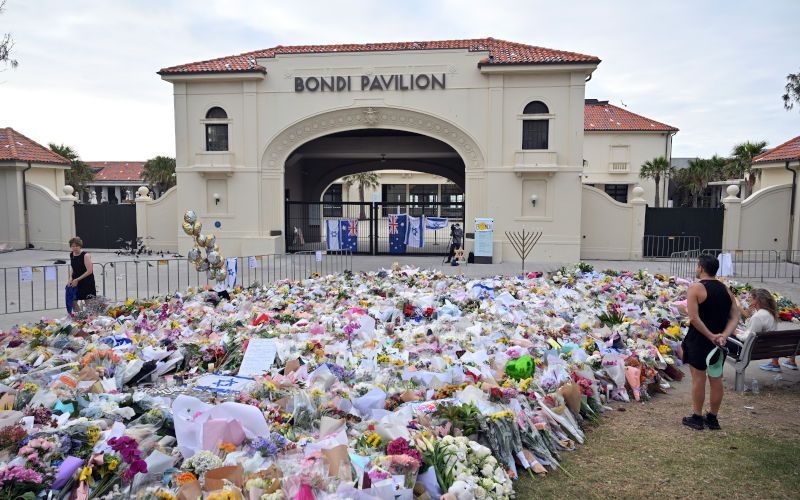
I’ve long since stopped wearing my Mogen David. Yet I still believe in the importance of symbols. They are pathways to our human hearts. The multitudinous floral tributes for the dead left at the site of Sunday’s massacre are also meaningful symbols: when words are inadequate we ‘say it with flowers,’ as the adage goes.
But symbols, too, can turn toxic. An ancient symbol of good fortune, the swastika was appropriated by Nazis who changed its meaning forever. As for the Mogen David, after the Nakba, the ongoing brutal Occupation, and the indiscriminate slaughter of thousands of Gazans in the current genocide, its adoption as Israel’s flag has robbed it of any humane meaning, at least for Jews like me who have realised the dangers accrued in establishing a Jewish-privileged, now openly apartheid state in what is deemed a holy land.
Thus it shocked me to the core on the Monday after the Bondi massacre to see a clip of a woman draped in an Israeli flag, and next, two other women hang one next to an Australian flag on a cyclone fence at the scene of the tragedy. And I write this knowing there are those who would disagree with me, the Jews who persist in speaking for me, as if the community they profess to represent is a monolith, and not the endlessly varied people we are.
Never mind that organisations like the Executive Council of Australian Jewry (EJAC), or the NSW Jewish Board of Deputies produce figures showing an alarming leap in antisemitism since October 2023. Their figures are highly contestable, as are their definitions of what is antisemitic. The incidence of anti-Israel sentiment has increased over the last two and half years, but that isn’t the same as antisemitism. Nor is feeling uncomfortable on hearing the Palestinian side of the story.
Yet the relentless campaigns to silence criticism of Israel, to stifle solidarity with its victims, are so out of kilter with the truth about the Israeli regime that these groups do their fellow Jews no favours, not to mention the state they support unconditionally. Equally frustrating is the attention our governments and traditional media pay them. Distressing beyond measure too is my government’s complicity in supplying Israel with weaponry with which to conduct its abominable genocide in my name.
It was inevitable that after the tragedy in Bondi calls for fighting antisemitism would escalate, too often for crass political aims. Aside from Netanyahu’s calumny, Albanese has been criticised for not implementing the recommendations of his special envoy for combatting antisemitism. Albanese’s mistake, however, was appointing Jillian Segal in the first place. A past president of the ECAJ and ardent Israel supporter, her report recommends an even wider adoption of the contested IHRA definition of antisemitism, and a role for herself in a wholesale program of monitoring institutions and individuals for their compliance. Owing to Israeli propaganda, a wave of McCarthyism these past two and half years has swept people from their jobs, artists from their livelihoods and seen dissidents dragged into courts. It has succeeded in cowing our governments, media and institutions of learning, yet has done nothing to bring about genuine peace in the Middle East, or safety for Jews.
What we need is greater, more nuanced understanding of an age-old European prejudice culminating in the Holocaust, itself giving rise to a militarised Zionist state as refuge for Jews in what had been British Mandate Palestine, but a subsequent hell for its Palestinian inhabitants.
What we don’t need is more censorship, or a would-be commissar’s overseeing a program of indoctrination. What is needed now is enlightenment, the means to promote genuine understanding of our intertwining histories and offer new substance to what has been called the Festival of Lights.
That said, we’ve come some distance since October 2023, when the New South Wales premier festooned the Sydney Opera House with Israel’s flag.
I much prefer his Hanukkiah.