Vulnerability at the heart of Christmas
December 22, 2025
Christmas begins with fragility rather than power. The story of Jesus’ birth places vulnerability, dependence and shared humanity at its centre.
Newman College is one of ten residential colleges affiliated to the University of Melbourne. There are 227 undergraduate and 56 graduate students in residence. Besides the Rector and Provost, the Dean of Studies cares for the academic concerns of the students and the Dean of Students cares for their pastoral and other concerns.
Both Deans were on leave during the year: the Dean of Students on maternity leave, and the Dean of Studies on paternity leave. Into the vibrant student community that is Newman College two infants, William and Harry, have dared to intrude. And they are as fragile and dependent as the students are robust and independent. As the students emerge from the cocoon of school and family and take these further steps towards life and career commitments, William and Harry are very much intent initially on survival and then on growth and development. But all this is contingent on escaping and avoiding the multiple accidents and vulnerabilities that nascent human life is heir to.
Infants are vulnerable. They need care and protection – parents in the first instance, then the extended family, then the protection of the medical profession and other support services. It is the way our humanity works – a generation cares for and protects the next generation.
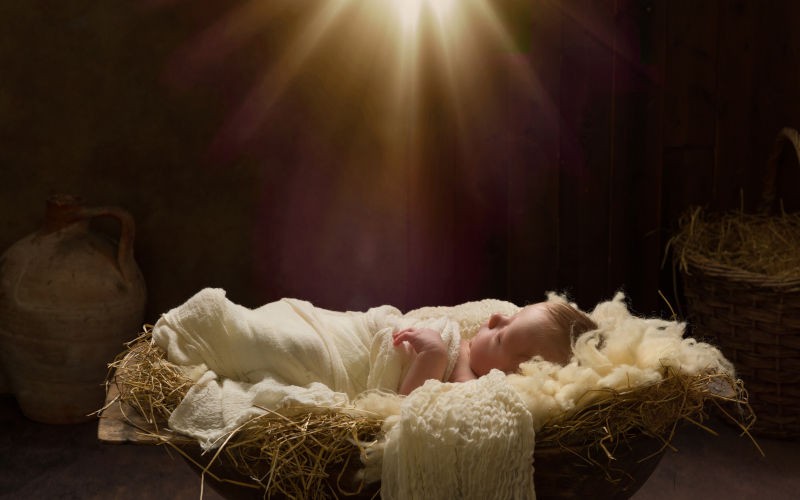
Every baby needs this support. It is an index then of God the Father’s thoroughgoing commitment to our humanity that when his son entered this world that first Christmas, he entered it as a vulnerable human infant needing he care and protection of his parents, Mary and Joseph.
Indeed, that vulnerability at birth was more than a little further compromised. His father, Joseph, and his heavily pregnant mother, Mary, had to travel eighty or so miles from Nazareth to register at Bethlehem. Then there was no room for them at the inn, and they had to lodge in an adjoining stable. There the baby was born and wrapped in swaddling clothes.
Admittedly, there were choirs of angels, adoring shepherds and the gifts of the three wise men, but almost immediately the baby’s vulnerability was exposed to the threat of Herod’s jealousy and ambition. A journey into exile in Egypt was the only escape. When the possibility of his return to his native land became available, his parents had to choose the obscurity and remoteness of Nazareth rather than the historic claims of David’s royal city of Jerusalem.
As an infant and the child of working-class parents, he was too vulnerable to press claims to be the long-awaited Messiah. As a Nazarene, too, his mission was compromised by the ill-repute of his hometown and supposed birthplace.
I suspect that if you or I had been managing Jesus’ incarnation, his sharing in our humanity, we may have tried to limit his vulnerability and enhance his subsequent mission by arranging for him royal, or at least noble, parentage, a birth in appropriately clinical surroundings, and a career where his credentials were acknowledged, rather than doubted, by the religious , and even the secular, authorities.
But that is not the way God the father chose for his son. He chose rather the way of vulnerability because he wanted his son to be fully identified with our humanity. Not, thank God, with the humanity and horrifying vulnerability of the people of Gaza, or in war-torn Ukraine or Myanmar or Afghanistan, but the vulnerability that every one of us may encounter at times in our lives. There is the vulnerability all of us experience as infants. Then there is the vulnerability that some of us may experience if we are unemployed or denied opportunities. Others of us may feel vulnerable when a relationship fails, or a loved one dies , or we meet with an accident, or we slip into mental or physical decline – the multifarious ways in which our humanity is subject to “the slings and arrows of outrageous fortune”.
There are few of us who at one time or another are not subject to the impact of vulnerability, and that is why Jesus, in identifying fully with our humanity, necessarily chose the way of vulnerability, first of all as a baby in a stable in Bethlehem, then as a fugitive in Egypt, then as an itinerant preacher in Judaea and Galilee and finally, betrayed by one of his closest companions, as a condemned criminal, rejected by his own people, in the crucifixion on Calvary. Bethlehem and Calvery are vulnerability writ large. In celebrating both may we not fail to recognise and embrace the light that they shed on the contingency of our humanity.