Degrowing the economy for people and planet
December 14, 2025
Imperialism, colonialism, racism and ecocide: the four horsemen of capitalism’s apocalypse? Climate change threatens the survival of migratory species, and China continues to dominate the supply of rare earth elements.
Is capitalism able to deliver for people and planet?
One of the more hotly contested issues in economic and environmental circles in recent years is whether capitalism’s need for continuous economic growth, most commonly expressed as endlessly increasing profits and Gross Domestic Product (GDP), is sustainable on a planet with finite natural resources.
On the one hand, staunch supporters of capitalism hold that the market, with varying degrees of government intervention, can rise to the challenge and deliver endlessly increasing prosperity, greater social equity and a sustainable environment. Conversely, some critics of capitalism promote the need for degrowth. This would involve a smaller and stable global economy that would allow all the world’s population to live with reasonable prosperity and much greater equity in a sustainable environment.
Jason Hicklel is one of the best-known writers and advocates for degrowth. In his critiques of capitalism he emphasises that many of the serious problems facing the world are not simply reflections of flaws or mistakes in the delivery of capitalism, but are inherently wired into its DNA. Recently, he has taken aim at capitalism’s historical and continuing use of imperialism, colonialism, racism and ecocide to foster economic growth and highlighted the consequences for societies and the natural environment:
“Imperialism and racism are central to the capitalist world economy. The barbarism is a feature, not a bug. Imperialism is not a side-gig, not an over-reach committed by greedy individuals, it is a structural feature of the capitalist world economy.
“Beginning in the long 16th century, the regions of what today we call the global South were forcibly integrated into the Europe-centred capitalist world economy as providers of cheapened labour, resources and goods. This was an extraordinarily violent process, involving colonisation, dispossession, mass enslavement, and genocide.
“How could anyone possibly justify these horrors? Race. Discourses of white supremacy and racial hierarchy were fabricated by the European ruling classes to dehumanise the majority world, hiving them off from the realm of rights, to provide the ideological scaffolding necessary to justify apocalyptic levels of exploitation and bloodshed in the periphery.
“Racism, like imperialism itself, is not a side-show to capitalism but a structurally necessary feature of it. It is not a standalone problem that can be addressed with a few liberal reforms here and there. It has always been central to capitalism and it remains that way today.
“Overcoming capitalism – in other words, transitioning to a democratic socialist economy – is ultimately necessary to end structural racism and imperialist violence.
“Ecological breakdown is being driven by the capitalist economic system, and – like capitalism itself – is strongly characterised by colonial dynamics.
“This is clear when it comes to climate change. The countries of the global North are responsible for around 90 per cent of all cumulative emissions in excess of the safe planetary boundary – in other words, the emissions that are driving climate breakdown. By contrast the global South, by which I mean all of Asia, Africa and Latin America, are together responsible for only about 10 per cent, and in fact most global South countries remain within their fair shares of the planetary boundary and have therefore not contributed to the crisis at all.
“And yet, the overwhelming majority of the impacts of climate breakdown are set to affect the territories of the global South, and indeed this is already happening. The South suffers 80‒90 per cent of the economic costs and damages inflicted by climate breakdown, and around 99 per cent of all climate-related deaths. It would be difficult to overstate the scale of this injustice. With present policy, we are headed for around 3⁰C of global warming. At this level some two billion people across the tropics will be exposed to extreme heat and substantially increased mortality risk; droughts will destabilise agricultural systems and lead to multi-breadbasket failures; and hundreds of millions of people will be displaced from their homes.
“Climate breakdown is a process of atmospheric colonisation. The atmosphere is a shared commons, on which all of us depend for our existence, and the core economies have appropriated it for their own enrichment, with devastating consequences for all of life on Earth.”
You don’t need to be a socialist to see merit in Hickel’s arguments about the damages inflicted on people and the environment by the embedded structural features of capitalism. I have quoted him at length as I think that he presents an alternative perspective to the one from Bill Gates that I discussed last week.
Comments welcome.
Migratory species threatened by climate change
It’s not only the species that like to stay home that suffer from climate change. Those that migrate by land, air and sea are also suffering. Warmer land and water conditions, extreme weather events, high winds and altered wind patterns, expanded deserts, and shifting water systems – for example – are affecting migratory species in a variety of ways: shrinking and fragmenting habitats at destinations and staging posts, forcing detours that impose higher energy costs, decreasing or moving food sources (e.g., sea grasses), and misalignment of the timing of migration with the abundance of food (e.g. flowering of plants and trees, insect emergence, phytoplankton blooming). All of these threaten the success of survival and breeding. And all are potentially exacerbated by pollution, human developments and the trans-national nature of migration that leads to fragmented governance and uneven conservation effort.
A few illustrations:
- European swallows migrating to Africa face expanded deserts and disrupted wind patterns that impose higher energy expenditure.
- Shorebird nesting in the Arctic is misaligned with insect emergence due to generalised global warming and unexpected cold snaps.
- Warming seas and fewer prey are forcing dangerous detours for North Atlantic right whales and putting pressure on Mediterranean dolphins.
- Plus, it’s a two-way process. Migrating megafauna help to maintain environmental sustainability by fertilising soils, dispersing seeds and enhancing carbon storage.
There’s an urgent need to identify the migratory species that are most at risk from climate change and the interventions needed to support them, particularly where multiple nations are involved, and to improve the inclusion of Indigenous Peoples and their traditional knowledge in decision-making.
Hordes moving south for the North American winter
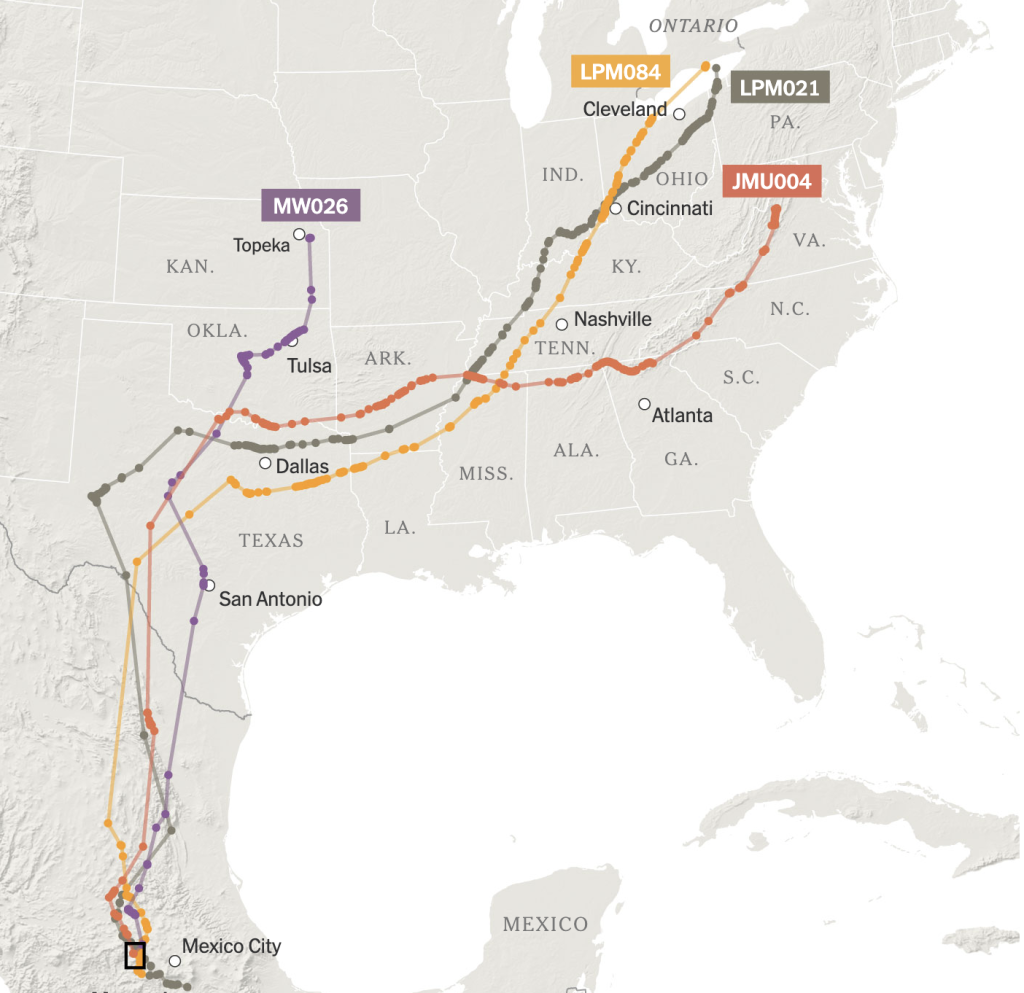
The tracks in the map above show the paths taken by electronically tagged individuals migrating south between mid-September and mid-November this year. Any guesses what the animal is? Its numbers have been in very serious decline in recent years.
China’s dominance of rare earth elements set to continue
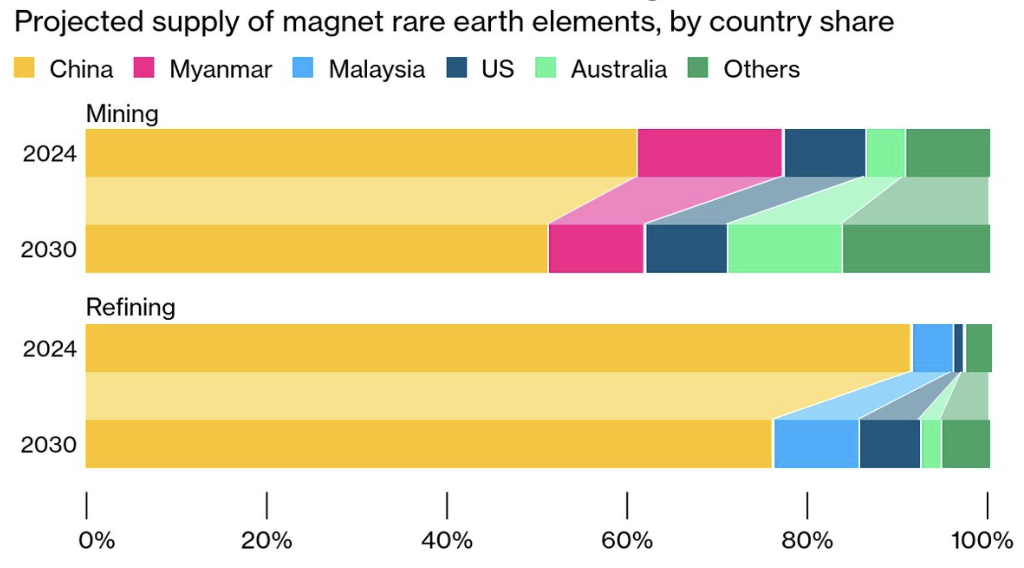
China’s prescience in gaining control of the supply of many rare earth elements essential for the production of green (and other) technologies is well documented. For instance, in 2024 China controlled 60 per cent of the mining and 90 per cent of the processing of the rare earth elements needed to manufacture magnets that are essential for wind turbines.
While some other countries are building their capacity, notably Myanmar and Australia regarding mining and Malaysia and the US with refining, China is projected to still control 50 per cent of mining and 75 per cent of refining in 2030, as demonstrated in the figure below from Bloomberg Green Daily on 31 October 2025.
One of the problems for new entrants to the rare earths industry is the very long lead times between discovering a source and starting commercial production, typically 10-20 years. The mining and processing of the rare earths and other critical minerals also tend to be quite dangerous and environmentally destructive. Reusing and recycling elements such as copper and cobalt could dramatically reduce the need for new mines.
Just to clarify, the elements that are included in the ‘rare earth’ category have been decided scientifically and they are the same around the world. In contrast, each country decides for itself which elements and minerals it categorises as ‘critical minerals’ for its development and economy. That said, there is a lot of commonality in the materials defined as critical (e.g. lithium, cobalt, copper, graphite, manganese, silver and the ‘rare earth elements’) and the mining and refining of them is similarly controlled by a few countries, again notably China.
Increased trade protections for threatened species
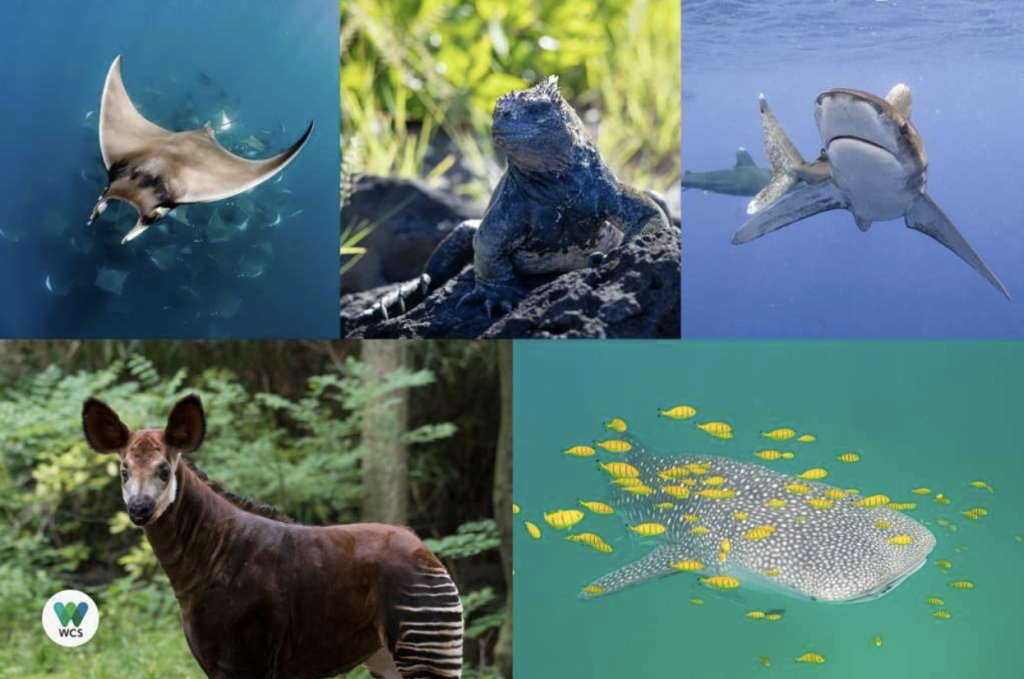
Below are five of the species that were given new trade protections at the recent Convention on International Trade in Endangered Species of Wild Fauna and Flora ( CITES) meeting: clockwise from top left, devil ray, marine iguana, oceanic whitetip shark, whale shark and okapi.
Two species of Australian gecko that are targeted by the pet trade also got stronger safeguards. More details in this two-minute video.
Not so lucky were Kazakhstan’s saiga antelope which roamed widely across the Asian Steppes until infection reduced their numbers by approximately 95 per cent early this century. In the last 10 or so years, numbers have climbed back to around a million. Unfortunately, saiga horns continue to be used in Chinese traditional medicines and it is still legal for them to be commercially traded, albeit with some restrictions.
Bear bile and rhino horn products openly on sale in Laos
Despite international commitments and domestic laws, illegal wildlife products are easily available in Laos.

Advert for bear bile products on the side of a shop where they can be bought in Vientiane.
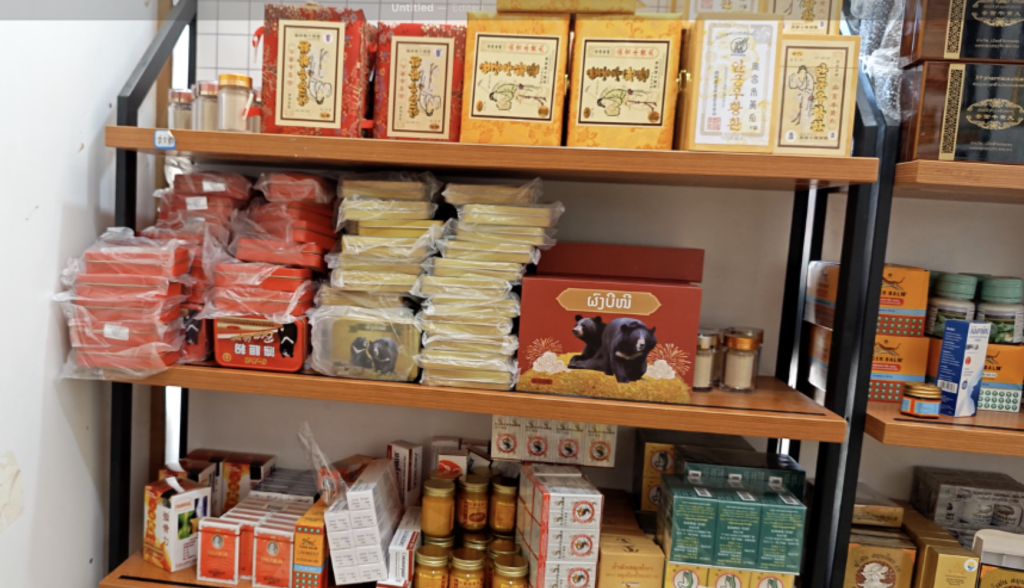
North Korean rhino horn products on top shelf and locally produced bear bile products on the second in a shop in Vientiane.