Global campaign amplifies call for the release of jailed Palestinian leader Barghouti
December 3, 2025
An international campaign is calling for the release of Palestinian political figure Marwan Barghouti, arguing his freedom could reshape Palestinian politics and revive peace efforts.
Despite two decades behind bars, Marwan Barghouti remains Palestinians’ most popular leader. Supporters say his release could revive peace efforts and heal political fractures, while Israel insists he is a convicted murderer and rejects clemency
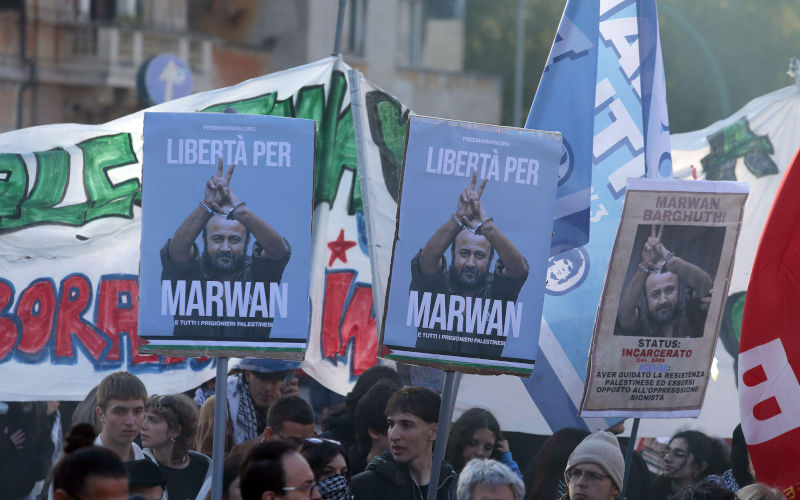
The #FreeMarwan campaign was launched by his family in the West Bank with support from UK-based civil society groups. Murals reading “Free Marwan” have appeared on London streets, coordinated by Creative Debuts – a global art platform – and a large public art installation recently went up in Barghouti’s home village of Kobar, in the West Bank.
A letter signed by international political and cultural figures is expected next week, calling on Israel to release what they describe as “Palestine’s most popular leader.”
A senior leader in the Fatah party and a long-time advocate of a two-state solution, 66-year-old Barghouti has spent more than two decades in Israeli prisons. Despite his incarceration, he remains, according to successive opinion polls, the most popular Palestinian politician in both the West Bank and Gaza.
An October poll from the Palestinian Center for Policy and Survey Research found that despite plummeting support for Fatah and its current leader and president of the Palestinian Authority, Mahmoud Abbas, Barghouti is the most popular political figure in the Palestinian sphere, capable of defeating Abbas as well as the now deceased Hamas leader Ismail Haniyeh.
His supporters argue that his release could reshape the fractured Palestinian political landscape and potentially revive a credible peace process. US President Donald Trump told _Time_ magazine last month that he was considering whether to push for Barghouti’s release, a remark that drew immediate speculation about renewed American involvement in the matter.
Israel, however, insists that he is a convicted murderer and has repeatedly rejected calls for clemency. He was excluded from the hostage/prisoner release deals negotiated with Hamas during the Gaza war. Several Arab mediators told _The Times of Israel_ earlier this month that they raised the issue directly with Israeli officials during negotiations, but that the requests were dismissed outright.
Barghouti rose to prominence during the first intifada, when he was jailed and later deported to Jordan for leading attacks against Israeli forces in the West Bank. After returning to Israel in the 1990s, he became a key advocate of the Oslo Accords, though his stance shifted following the collapse of the 2000 Camp David talks and the outbreak of the second intifada.
Israel has accused him of directing attacks against Israelis through Fatah’s militant factions during his tenure as the party’s leader in the West Bank, charges he denies.
He was arrested again in 2002 and later convicted of five murders in a trial criticised for legal flaws.
Barghouti remains a polarising figure: hailed by many Palestinians as a pragmatic leader and resistance symbol, but viewed by Israel and others as a terrorist.
Even from prison, Barghouti has remained influential, mediating between Hamas and Fatah and winning an election to Fatah’s leadership in absentia. Supporters portray him as a “Palestinian Mandela,” a unifying figure with broad public legitimacy.
The #FreeMarwan campaign asserts that Barghouti’s prolonged imprisonment – marked by repeated solitary confinement, sharply restricted access to family and lawyers, and, according to his legal team, multiple beatings since 2023 – poses a barrier to any future political reconciliation. The International Committee of the Red Cross, barred from visiting him in recent years, has said the prohibition violates international norms.
Barghouti’s wife, Fadwa, in what it said was her first-ever interview with Israeli press, told _The Times of Israel_ earlier this month that she believes her husband represents “a future of peace and stability.” She also rejected depictions of him as a mastermind of terrorism, insisting he remains committed to a negotiated two-state solution based on the 1967 lines.
“He still envisions peace on this land and a better life for everyone on it,” she said, adding that his physical and mental health were deteriorating after years of isolation.
A similar global campaign was launched in 2013. South African anti-apartheid veteran Ahmed Kathrada inaugurated the ‘Free Marwan Barghouti and All Palestinian Political Prisoners’ campaign from Nelson Mandela’s former cell on Robben Island, a symbolic gesture that cemented comparisons between the two men.
Supported by the Ahmed Kathrada Foundation and an international committee that included several Nobel Peace Prize laureates, the initiative framed Barghouti’s imprisonment as part of a broader struggle for political rights under occupation. That campaign saw events across South Africa and beyond, underscoring Barghouti’s long-standing status as a global symbol for many supporters of Palestinian liberation.
The Ahmed Kathrada Foundation joined the new campaign last week. In a social media post, the organisation wrote that Israel continues to detain Barghouti because he “represents unity, leadership and hope for the Palestinian people,” urging supporters to join a rally at the Mandela statue in Pretoria.
The gathering took place on Saturday next to a statue of Mandela, as South African activists and protesters held up his photograph in a show of solidarity.
As cease-fire negotiations continue, the question of Barghouti’s future hovers once more at the centre of debates over what a post-war Palestinian leadership, and a possible path to renewed diplomacy, might look like.
Republished from Hareetz, 30 November, 2025