
How to navigate the Support at Home maze
December 13, 2025
Australia’s revamped aged care system was supposed to streamline access and improve support. Instead, older people are confronting long waits, rising costs, confusing assessments and opaque rules that too often leave them without the help they need.
Will you or someone you know need aged care in the years ahead? If so, read on.
This guide is about how to access aged care at home, not in residential care. It is necessarily simplistic. This guide is needed for many reasons, not least because the new arrangements are unnecessarily complicated and confusing. The new aged care rule book is now more than 700 pages long.
Step one
There is only one way into aged care no matter what service you need or where you live in Australia. It is called My Aged Care.
The My Aged Care website was meant to make it easy to access the system, a veritable one-stop shop. In practice, a recent independent review found that many older Australians struggle to navigate it, leaving them unable to access the support they need, when they need it.
Get help navigating the system if you can.
Step two
Undergo an aged care assessment. Under the new arrangements, no one can access aged care without undergoing the centralised assessment process. The first step is to apply for assessment via My Aged Care online or by phone.
There are over 100,000 ahead of you on the queue so it’s a good idea to start the process well before you need it.
You will be contacted by an assessor within weeks to months to arrange the assessment. The government has contracted out assessment to private assessment agencies and state government assessment teams across Australia. Assessors are all meant to be qualified health professionals but not all are.
Assessments are meant to be conducted with you in your own home and you can have a family member or friend with you. However, there are already reports of assessors conducting the assessment over the phone and without a support person present. You have the right to ask for an assessment in your own home.
The government has mandated that all assessors use one standard assessment tool called the Integrated Assessment Tool (IAT) and all of your information is recorded in My Aged Care. The IAT is the same tool used for reassessment when your needs change.
Step three
Wait to hear the outcome of your assessment in a Notice of Decision letter.
There are a range of possible outcomes:
Support at Home (SAH)
If eligible for SAH, you will be approved for one of eight different SAH funding levels for ongoing services. These eight levels currently range from $10,731 to $78,106 per year. But be aware of the fine print. Ten per cent of your package will be automatically deducted as payment for a Support at Home provider to manage your package. More importantly, the figures being quoted include your own contributions, which can be as high as 80 per cent in some cases (see below).
In addition to ongoing support, you can also be eligible for three ‘short-term pathways’:
- Assistive Technology-Home Modifications – one-off grants for assistive technology currently ranging from $500 to $15,000 in a year and a lifetime cap of $15,000 for home modifications to make your home safer to live in.
- Restorative Care – funding of about $6,000 for nursing and allied health care for up to 16 weeks to help you with rehabilitation and reconditioning after you have had an accident, an injury or been unwell.
- End of Life – one-off funding of up to $25,000 over 12 weeks to support you to stay at home at end of life should you wish to do so.
You can be approved for both ongoing funding and a ‘short term pathway’ as well as both AT-HM and Restorative Care at the same time and there are provisions in some circumstances to extend a pathway if required.
Commonwealth Home Support Program (CHSP)
If you are not deemed eligible for SAH or you do not want to receive SAH, you can be approved for CHSP and referred to providers of your choice. You have the right to make a choice. CHSP providers are largely not-for profit community organisations such as Meals on Wheels and community transport, and state and local government services such as neighbourhood centres and community nursing.
If referred to CHSP, you work directly with the provider to agree on the services you need and on your contribution towards the cost. In some cases, the CHSP provider may decline to accept you because they assess you as being too complex for them. In that case, ask to be referred to another provider. Agreements about CHSP are documented in a written service agreement between you and your CHSP provider.
Ineligible
The final possible outcome of the assessment is that you are deemed not to need aged care.
How assessment outcomes are determined
After you are assessed, your assessment information is fed into a computer algorithm to determine the services and the level you will be offered. When the IAT system was designed, it had the capacity for an assessor to override the algorithm if a qualified clinical assessor thought that the algorithm delivered the wrong outcome. This was changed when the rules were finalised and assessors are not allowed to overturn the algorithm. This new system is being described as #RoboAssess.
If you feel that the services you have been approved for will not meet your needs, you can ask for a review of the decision. But the only way you can do this is to write a letter and send it by snail mail within 28 days to the Department of Health, Disability and Ageing. Not surprisingly, the Department is reporting that they have only a handful of appeals.
This step is where the government has created a conflict of interest for itself. Assessment is meant to be independent of government but the only way you can appeal is to write to a government department where your case will be handled by a public servant. Only after you have gone through that step can you appeal to the Commonwealth Administrative Appeal Tribunal.
An easier option (unless you have been classified as not eligible) is to decline the services you are offered, apply for a new assessment and start the whole process again. Alternatively, and especially if you have been classified as not eligible but believe you should be, getting help from an independent advocate is worth trying, to assist with your appeal. Contact the Older Persons Advocacy Network.
Step four
There are waiting lists for almost everything after you have been assessed so expect to wait at this stage too. Wait lists of more than a year for a package in some regions are not uncommon. This is another reason why the earlier you apply the better.
If you can manage with less than six hours a week and do not need someone to organise your services for you, ask to be referred to CHSP. It is mostly delivered by non-profit services and is generally very good as well as usually being much cheaper.
Step five
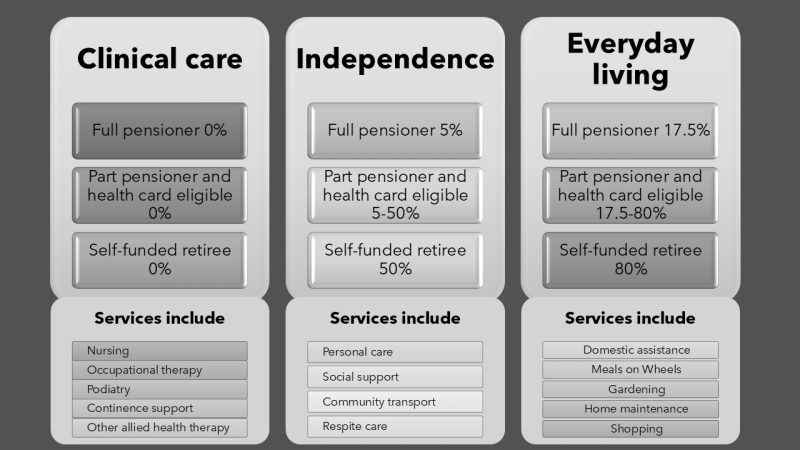
If you are approved for SAH, My Aged Care will link you to Services Australia for an income assessment. That will determine how much you pay. You will be charged different percentages depending on how the service is classified (clinical, independence or everyday living) and whether you are a full pensioner, a part pensioner or a self-funded retiree.
As an example, personal care includes assistance with showering, dressing, assistance with medications and the like. It is classified as an Independence service. If it takes an hour each day for personal care assistance, a full pensioner can expect to pay $5 a day or $35 week while a self-funded retiree will pay $50 a day or $350 a week. Add domestic assistance, meals and community transport and Support at Home costs per week are soon adding up to levels that are unaffordable for people on limited incomes. Be warned.
You have the right to refuse SAH and to be referred to CHSP instead if you cannot afford the SAH fees.
Step six
You will be asked to select a SAH Registered Provider of your choice. This is a bit like choosing your own surgeon. Most people have no idea.
You can search for a SAH provider online through My Aged Care. Be aware that there are now increasing reports of predatory practices by some providers including high pressure telemarketing and cash bonuses to sign up. Ask your family, friends and health providers for advice and help.
Your SAH provider will manage and coordinate all of the services you are approved to receive and 10 per cent of your package will be automatically given to them for that purpose.
The services you need may either be provided by the SAH provider which manages your package, or by associated providers or a mix of the two. All services other than those provided by the SAH provider are provided by other organisations called Associated Providers. For example, if you need meals, community transport, help with showering as well as wound care, your Support at Home provider may engage four different associated providers. In theory, you will get a say in what associated providers they engage. In practice, many SAH providers will simply engage the associated providers of their choice for ease of administration.
On top of the fee that the associated provider will charge, the SAH provider can charge an additional 10 per cent fee if you select your own associated provider. That is a further 10 per cent that comes out of your package. The SAH provider cannot charge an additional 10 per cent if you agree to the associated provider they select.
Glossary: the devil is in the detail
Grandfathered: A person is ‘grandfathered’ if they were approved for or receiving a Home Care Package as at September 2024 when the legislation was introduced. ‘Grandfathered’ means that you will be no worse off financially than you were before SAH started. Grandfathered does not mean that you will get the same hours. Because hourly rates have jumped under SAH by up to 40 per cent, you will pay the same but you may get less services.
Hardship waiver: There is provision to apply for fees to be waivered or reduced on the basis of hardship. You can only apply after you are already in the system. The hardship form is 16 pages long. It is clearly designed so that our most fragile citizens are not capable of completing it.
Lifetime cap: There is a lifetime cap on what you will be required to pay. It is currently $130,000. It covers both home and residential care but excludes residential care capital charges. This is helpful for those with the means to pay $130,000 before the cap kicks in. It is of no use if your immediate issue is that you cannot afford to both buy groceries and pay for SAH this week. Many people will die before they reach the lifelong cap.