Gaza and the unravelling of the post-war world
December 9, 2025
The war on Gaza exposed deep cracks in international law, Western power, and the institutions meant to enforce them. From global protests to shifting alliances, a different world order is now taking shape.
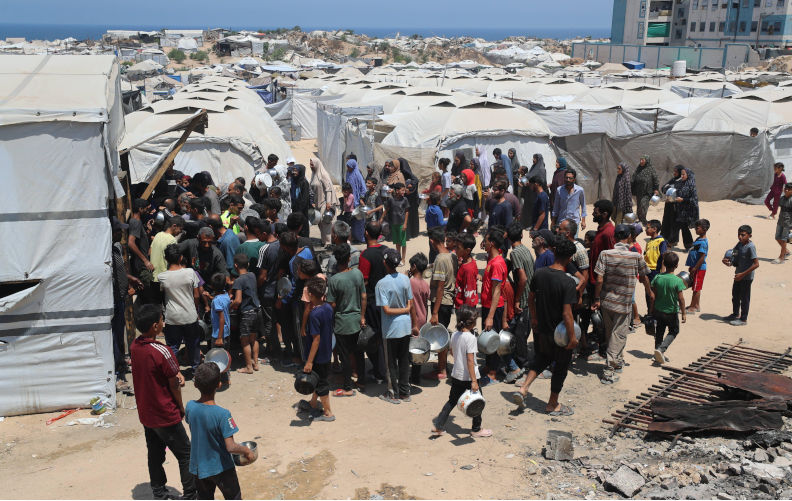
From the first moment the Israeli war of extermination against Gaza erupted in October 2023, it became clear that the world was facing an event that exceeded the boundaries of the region and even the boundaries of the Palestinian tragedy itself. Israeli practices, along with international complicity and the granting of full immunity to an occupying power, exposed the fragility of the global system established after World War Two.
Has the era of Western dominance come to an end, and is Israel, unintentionally, pushing the existing global order toward a faster collapse?
The beginning of this collapse lay in the profound moral rupture created by the genocide in Gaza. The global system built on the language of protecting civilians, prohibiting aggressive wars, and upholding human rights was stripped of its ability to enforce these principles.
The events in Gaza revealed that these ethical principles were little more than promotional slogans. Millions witnessed the genocide in real time, creating a historical precedent that made old deceptions impossible and turned the silence of international institutions into evidence of complicity.
The international legal system collapsed when confronted with the actions of Israel and its allies. The International Court of Justice issued five provisional measures in a year and a half to halt the genocide, and Israel ignored every one of them. The International Criminal Court pursued Israeli officials only to see its prosecutor threatened and pressured to the point of potential removal. The Security Council became a captive of the United States veto. The General Assembly voted by an overwhelming majority to demand a ceasefire, yet its resolutions carried no binding force and thus changed nothing.
All of this confirmed a stark reality. International law today is no longer a universal framework. It has become a tool applied only to weaker states, while major powers such as the United States, Israel, and Russia operate without consequences.
As trust in international institutions collapsed, global public rejection expanded. The world witnessed the largest protest movement of the twenty first century. For the first time since its establishment, Israel faced a deep global social rejection that transcended political, ethnic, and religious boundaries.
This popular movement did not remain symbolic. Concrete actions began to disrupt governments and force companies to reconsider their policies. Naval flotillas departed from several countries to break the blockade. Labor unions halted arms shipments bound for Israel. Major companies faced widespread boycotts that cost them billions. Universities suspended investments in companies tied to the occupation under student pressure. The global BDS movement returned with unprecedented momentum. Human rights organisations pursued anyone complicit with Israeli crimes.
All of this coincided with the unraveling of the Israeli narrative in the media. Social media platforms, especially TikTok, amplified Palestinian voices and provided direct visual content that could not be manipulated.
At the same time Israel expanded militarily across the region, carrying out attacks in Lebanon, Syria, Yemen, Iraq, Iran, the Sinai Peninsula, and even Doha. The rhetoric it relied upon – existential threat and national security – ceased to convince. Each new bombing created civilian victims and deepened Israel’s image as a state acting without restraint. In this way Israel shifted to a constant source of regional threat, hastening the likelihood of a broader explosion.
This landscape opened the door to a wider global transformation. The countries of the Global South announced a collective rejection of the United States position. More than two thirds of the Group of Seventy Seven plus China voted against Washington at the United Nations. China became the primary mediator in the region. Russia tied Gaza and Ukraine together in its rhetoric, accusing the West of supporting both the Ukrainian nationalists and the Israeli leadership, forming a discourse that reshaped international relations. The United States thus found itself losing control of three things at once: Ukraine, China, and the Middle East. Washington lost the ability to manage the international system and shifted from a global leader to a power forced into constant reaction.
As this erosion continued, cracks began to appear within the domestic politics of Western states. Popular rejection of the genocide became part of electoral campaigns. Parties that supported Israel lost in several countries. The rise of Zohran Mamdani to the position of mayor of New York became an example of how the Gaza war moved from the streets to the ballot box.
In the digital sphere the shift was even deeper. Independent media, content creators, and mobile phone reporters shaped public perception. Israel’s narrative of being the only democracy in the Middle East collapsed under thousands of hours of footage that revealed the truth without embellishment. Western governments could no longer manufacture media consensus as they had for decades. Gaza became the first war in history in which the public, not governments, defined the truth.
These accumulating elements created a new global moment. We are entering a world shaped by new rules, led by multiple power centres, and one in which societies possess a greater ability to influence political outcomes.
It is a world where the Israeli exception is no longer tolerated and where the West can no longer impose its narratives or its priorities.
Israel, which for seven decades stood as a protected pillar of the global system, has become one of the forces contributing most to its unraveling. It did not do this alone. The United States shared in the arrogance of power, the dismissal of international law, the protection of policies that amounted to extermination, and the suppression of dissenting voices. But Israel served as the spark that exposed everything at once: the fragility of institutions, the hypocrisy of values, the failure of the Western model, and the shifting balance of global power.
Today the global order stands in its weakest condition since World War Two. The fractures are not temporary but structural. The global public is no longer merely angry but engaged. Rising powers such as China, India, Russia, Turkey, Iran, South Africa, and Brazil now possess a political weight that imposes itself on the international scene. The West is undergoing a period of losing control. Israel has reached an unprecedented moment in its history, a moment marked by the erosion of its legitimacy, the weakening of its narrative, and the instability of its position within the system that created and protected it for decades.
We are witnessing a fundamental transformation in the shape of the world. One order is dissolving, and another is coming into being. At the centre of this transformation stands Palestine. The new order may not be born tomorrow, but its outlines are now visible. A more multipolar world, less captive to Western dominance, more responsive to the rights of peoples, and one in which Israel cannot continue as a state above the law.
Israel, believing that it was waging a war to secure its existence, has found itself waging a war that hastened the collapse of the global system that made that existence possible. In doing so, it advanced the end of its own era and the beginning of an entirely different one.