Australia’s selective justice on international law is indefensible
December 2, 2025
Australia has pledged to uphold humanitarian law and protect aid workers. But in the face of an ICJ ruling on Gaza, its own anti-terror and accountability laws remain selectively unenforced.
As a lawyer bound by the principle that the law must be applied equally, the recent advisory opinion from the International Court of Justice (ICJ) reveals an indefensible contradiction in Australia’s selective and politically motivated application of its own anti-terrorism laws.
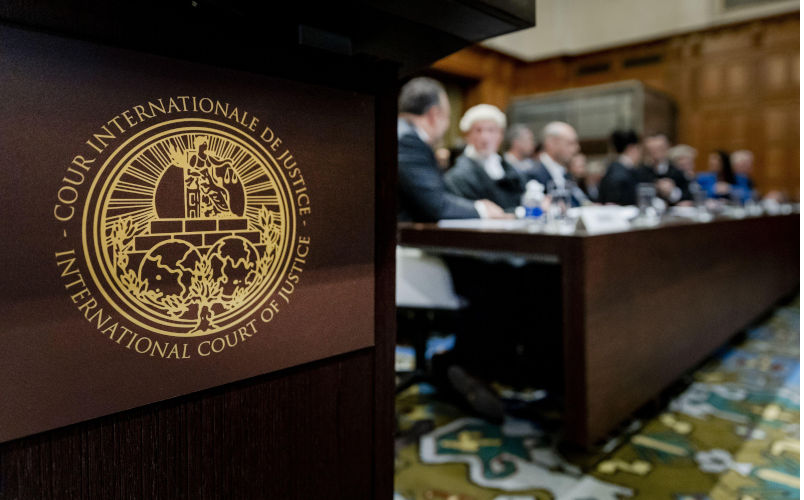
On 22 October 2025, the ICJ delivered a monumental rebuke to Israel, affirming its legal obligations as an occupying power in the Occupied Palestinian Territory and Gaza to facilitate, not obstruct, the work of humanitarian agencies like UNRWA and the International Committee of the Red Cross. In a 200-plus page document, the ICJ expressly rejected Israel’s unsubstantiated security justifications for restricting aid, finding that its actions have deprived humanitarian aid that is “indispensable for the well-being and dignity” of the Palestinian people. This is not a political statement, it is the authoritative legal assessment from the UN’s principal judicial body.
This legal condemnation was released weeks after the Australian government, in a public display, signed the Declaration for the Protection of Humanitarian Personnel (Declaration). The Declaration commits signatories to “take action” and “uphold the principles” of international law, “including international humanitarian law and international human rights law, to champion the protection of all humanitarian personnel, and to preserve the irreplaceable role of principled humanitarian action as a lifeline for all civilians in times of conflict”. The Declaration specifically pledging to:
- Allow and facilitate full, safe, rapid and unhindered humanitarian access for the delivery of humanitarian assistance in accordance with relevant international law obligations;
- Align actions to strengthen protection for international, national and local humanitarian personnel;
- Commit to pursue greater accountability and justice in response to incidents.
It even commits to “assess the potential that exported weapons could be used to commit or facilitate serious violations of international humanitarian or human rights law” and to refrain from authorising such exports.
These are not merely aspirations, they are public commitments to a specific course of action. Yet, in the face of the ICJ’s authoritative opinion that Israel is violating these very obligations, the Australian government’s promises ring hollow.
Where is the action? Where is the accountability?
This hypocrisy is the very essence of selective justice. We criminalise and prosecute an Australian citizen for carrying a Hezbollah flag under our Commonwealth Criminal Code, yet we hear no talk of applying our laws to Israeli, its officials and military implicated in acts that breach the principles the government just vowed to protect. We have laws to punish serious violations or serious abuses of human rights, yet they are disregarded when applicable to a militarily powerful ‘ally’. The government’s declaration commits to “counter misinformation” and “de-politicise humanitarian action”. But its own inaction in the face of the ICJ ruling is the ultimate politicisation, sending a clear message that the protection of humanitarian personnel depends on the identity of the perpetrator.
The legal case is clear. When a state’s military actions, including the interception and seizure of civilian aid vessels in international waters, are designed to enforce an illegal blockade by an occupying power, this meets our own Commonwealth Criminal Code definition of a terrorist act. That is, one done to advance a political, religious or ideological cause which is intended to coerce, influence or intimidate and which creates a serious risk to public health or safety.
The ICJ has provided the legal facts. The government’s own Declaration has provided the ethical and political framework. The only thing missing is tangible action.
The Australian government must honour its signed commitments and align its actions with its legal principles by:
- Formally declaring that the Israeli military’s interception and seizure of civilian humanitarian vessels sailing as part of the Global Sumud Flotilla constitute acts of state terrorism per the purpose of our Commonwealth Criminal Code;
- Immediately sanctioning regimes that target individuals and entities involved in humanitarian operations, as pledged in the Declaration to “ensure accountability”;
- Imposing an immediate arms embargo, as per its commitment to “refrain from authorising” weapons exports where there is an overriding risk of violations.
A war crime does not become legal when committed by an ‘ally’. A signed Declaration does not become meaningful without the intention to enforce it. The ICJ has spoken on the law. The government has spoken of its principles. It is now time for action