Indonesia’s Gaza peacekeeping bid raises more questions than answers
December 2, 2025
Indonesia has offered to send up to 20,000 troops to Gaza as part of an international peacekeeping force. The proposal highlights shifting regional politics – and unresolved concerns about military power, credibility and human rights.
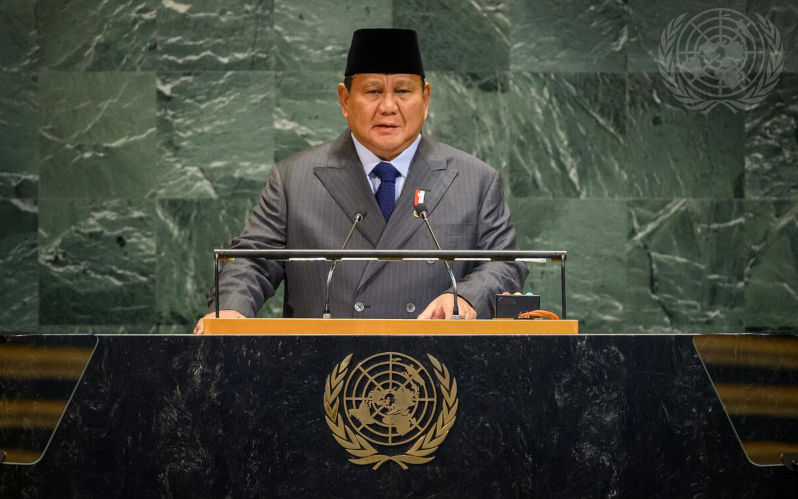
Indonesia’s President Prabowo Subianto wants soldiers from the world’s fourth largest nation to march down the rubble-strewn, hazardous streets of Gaza armed with shovels as internationally applauded peacekeepers. Plans are ready once the UN Security Council says ‘go’.
But would the key players agree with the inclusion of 20,000 blue berets from Indonesia, the nation with more Muslims than any other state?
Last month the UNSC adopted US President Donald Trump’s 20-point peace plan, including “a temporary international force in the enclave …” Thirteen members voted in favour and none against. China and Russia abstained.
The resolution included a transitional ‘Board of Peace’ to coordinate reconstruction and a “temporary International Stabilisation Force to secure border areas, protect civilians and aid operations, secure humanitarian corridors, and ensure the demilitarisation of Gaza, along with other tasks.”
So far, five countries have reportedly volunteered to take part – Egypt, Turkey, Azerbaijan, Pakistan and Indonesia. They’ll have to work “in close consultation and cooperation” with Egypt and Israel.
Although Indonesia claims to be secular, the government is involved in individuals’ personal beliefs. Citizens must have one of six Parliament-approved faiths stamped on their ID cards. Judaism is not listed. Nor is atheism.
In the nation of more than 285 million, about 88 per cent claim they follow Islam’s Sunni sect – the principal ( 98 per cent) persuasion of the Palestinians. The other permitted religions are Protestants (known as Christians), Catholics, Confucians and Hindus, mainly from Bali and the eastern side of East Java.
If Indonesia does send peacekeepers, an astute general should ensure a smattering of other faiths among the troops, but that would still leave the force dominated by the followers of Muhammad. Few speak Arabic, the language of the Palestinians.
Posters on trees and walls in Java demand freedom for their ‘brothers’ in Palestine. Street demos are regular events; none back Israel, a nation that has never had diplomatic relations with Indonesia, so there’s no fighting.
First president Soekarno reckoned the 1948 creation of Israel was “a colonial imposition by Western powers, a perspective aligned with Indonesia’s constitutional mandate to oppose all forms of colonialism.”
The official line remains that Indonesia supports a two-state solution and frequently attacks Israeli policy while sending humanitarian aid. However, there are chinks of light escaping the closed conference doors.
Earlier in May, Prabowo spoke during French President Emmanuel Macron’s official state visit to Indonesia:
“We must acknowledge and guarantee Israel’s rights as a sovereign country that must be paid attention to and guaranteed safety. Indonesia has stated that once Israel recognises Palestine, Indonesia is ready to recognise Israel and open the diplomatic relationship.”
Four months later, Prabowo told the UN General Assembly:
“We must also recognise, we must also respect, and we must also guarantee the safety and security of Israel. Only then can we have real peace,” again stressing the modal verb.
This is startling stuff because until now, inherited hate of Israel has been the driver in all discussions, and the President has a reputation as a hard-liner who thinks concessions make him look soft.
His civilian predecessor, Joko ‘Jokowi’ Widodo, rarely ventured into international affairs in public, preferring the safety of developing domestic people-pleasing projects like toll roads and airports.
In October, Prabowo went to the Sharm El-Sheikh Egyptian beach resort for a ‘Summit for Peace’ meeting of 20 world leaders.
It did little other than ventilating a few cliches; no problems, as missives are always preferable to missiles. Fortunately, it seemed to clear a way for the later Peace Plan.
The Indonesian leader’s office said the summit “underscored Indonesia’s strong commitment to fostering peace, resolving conflicts, and upholding humanitarian values at the global level.”
Scuttlebutt claimed Prabowo would then visit Israel, but the rumours were rapidly defused.
His statements show he’s unafraid of Islamic organisations mustering political power back in Jakarta. That’s largely because he’s sucked minor religious parties into his Cabinet with promises of power, disarming their likely criticisms.
However, a brutal event directly affecting Indonesia needs to be confronted to keep the peace movement moving.
In 2016, a 110-bed Indonesian-funded hospital was built in North Gaza; it reportedly cost AUD $14 million, much of it donated by Muslim organisations led by the conservative and influential Muhammadiyah. It was staffed by 400 locals and volunteers from Indonesia.
The IDF alleged it sheltered fighters and shelled the site, reportedly killing 12 patients.
The administration denied claims of harbouring Hamas, but that didn’t stop the Israelis from taking over the damaged building. This year, Al Jazeera reported that medical equipment had been vandalised and the hospital was closed.
It’s not known if Jakarta will seek compensation.
Early plans for Indonesian peacekeepers suggest leadership by a three-star general heading battalions focusing on health and construction. It will be equipped with choppers, transport aircraft and two hospital ships.
Such a contingent suggests the Indonesians would focus on supervising rehabilitation rather than policing.
The peacekeeping idea has excited Indonesian nationalists keen to have their Republic seen as something better than a global leader in corruption and a world soccer disaster. The thoughtful ones are cautious.
Dr Dino Patti Djalal, a former Indonesian ambassador to the US, deputy Minister for Foreign Affairs and a one-time presidential aspirant, posted on social media:
“Don’t let the TNI be tasked with disarming Hamas. We must prevent a scenario where the TNI could clash physically with Hamas in Gaza, because this would tarnish the TNI’s image at home and abroad.”
We don’t need to wait for the stain – it’s already there. Although domestic polls show the TNI is trusted by the locals, it’s a different story internationally. Other nations might be reluctant to have their soldiers working alongside Indonesians.
In 1999, after the East Timorese voted for independence, the TNI ran a vengeful scorched-earth policy as they retreated. Dutch social anthropologist Dr Gerry van Klinken’s book, Masters of Terror, documents “the brutal operations carried out by the Indonesian army and its East Timorese allies.”
It’s been alleged that currently more than 6,000 Indonesian troops in Papua are secretly running a “phased revolution” in a “war” against independence seekers armed with bows and arrows. We don’t know how much blood is saturating the jungles because the media is banned.
As reported by Pearls & Irritations, Prabowo is militarising the country and putting soldiers into civilian agencies – a trend worrying human rights organisations.
KontraS – the long-standing NGO Commission for Missing Persons and Victims of Violence – said rewriting laws to further empower the military “poses a serious threat to democracy, civilian supremacy over the military, and human rights in Indonesia.”
The Parliament has already passed the laws.
Canberra has said nothing, fearing Jakarta’s wrath if it suggested Prabowo is preparing a military dictatorship. Should an autocracy become embedded, Australia will have to rethink its policies on regional security.
Foreign Minister Senator Penny Wong said the recently signed bilateral treaty “will reflect the close friendship, partnership and deep trust between Australia and Indonesia”.
That questionable trust could evaporate if a despot like the second President General Soeharto takes over.
He grabbed power in 1965 in a genocide that reportedly took more than half a million lives. He stayed for 32 years and died in 2008 as the world’s top kleptocrat, allegedly stealing up to US$35 billion.
He’s now a National Hero.
Despite widespread opposition, he was appointed last month by his former son-in-law, Prabowo, for “ outstanding services in achieving, fighting for maintaining, and contributing to the nation’s independence, as well as realising the unity of the Indonesian nation.”