From partnership to pressure: why India–US ties have frayed
December 11, 2025
The downturn in India–US relations during Trump’s second presidency exposes deeper structural weaknesses in the partnership, from trade and strategic autonomy to diverging political priorities.
In 2016, Indian Prime Minister Narendra Modi proclaimed in Washington that India and the United States had ‘ overcome the hesitations of history’. Despite strained relations during the Cold War, India–US ties had subsequently gone from strength to strength.
There was a high degree of bipartisan consensus in Washington on engagement with India. That consensus was mirrored across the political spectrum in New Delhi, though fringe elements of India’s political elite, such as the country’s communist parties, opposed closer US–India ties. Economic imperatives were a catalyst for India’s shift towards closer alignment with the United States, as a foreign exchange crisis in 1991 and the collapse of the Soviet Union prompted India to reorientate their external engagement.
Progress came to a grinding halt in the second Trump administration. There were several pre-existing fault lines in the India–US relationship. Washington harboured concerns about alleged Indian complicity in assassination plots on Canadian and US soil in 2023 and claims in New Delhi that the US ‘ deep state’ was seeking to undermine India’s government.
In this context, the return of Donald Trump to the White House in January 2025 was welcomed by New Delhi amid expectations of a reset in the India–US relationship. This was rooted in a belief that Trump and Modi maintained similar worldviews as strongman populist leaders that regarded China and radical Islam as existential threats.
Even the introduction of reciprocal tariffs was initially seen as a blessing in disguise given expectations that it would facilitate trade diversion away from China and other countries with China-dependent supply chains. This view was vindicated by reports of Apple shifting production of iPhones for the US market from China to India. It was further fuelled by a conviction that India would be among the first countries to secure a trade deal with the United States involving lower tariff levels than those imposed on China and other emerging economies.
This exuberance was misplaced. The similarities in Trump and Modi’s economic nationalist and protectionist proclivities became liabilities in their relationship. The turning point came with the brief four-day conflict between India and Pakistan in May 2025. New Delhi’s rejection of the Trump administration’s narrative that it brokered the ceasefire soured the relationship.
In August 2025, the United States imposed 50 per cent tariffs on India for its trade imbalance and purchase of Russian crude. New Delhi saw this as a double standard since other countries, like China and Japan, maintain a larger trade surplus with the United States and China and Turkey are also major buyers of Russian crude. Meanwhile, New Delhi remained hesitant to opening its agricultural sector up to foreign competition, as it employs over 40 per cent of the country’s workforce. Tensions were further inflamed by Trump’s social media posts referring to India as a ‘dead’ economy that does ‘very little business’ with the United States.
Yet, the United States is still a key trade, technology and defence partner for India. Both countries are enmeshed in bilateral and multilateral initiatives, and on 31 October 2025, both countries refreshed their 10-year defence framework agreement.
But this does not negate the damage that the India–US relationship has suffered. Trump’s tariffs and immigration policies have fuelled Indian efforts to strengthen domestic demand and diversify its export markets – evidenced by India’s ongoing free trade agreement negotiations with the European Union. Concerns about the weaponisation of the US dollar have also pushed India to internationalise the Indian rupee by increasingly settling bilateral trade in its own currency as a means of reducing its dependence on the western-controlled global financial system.
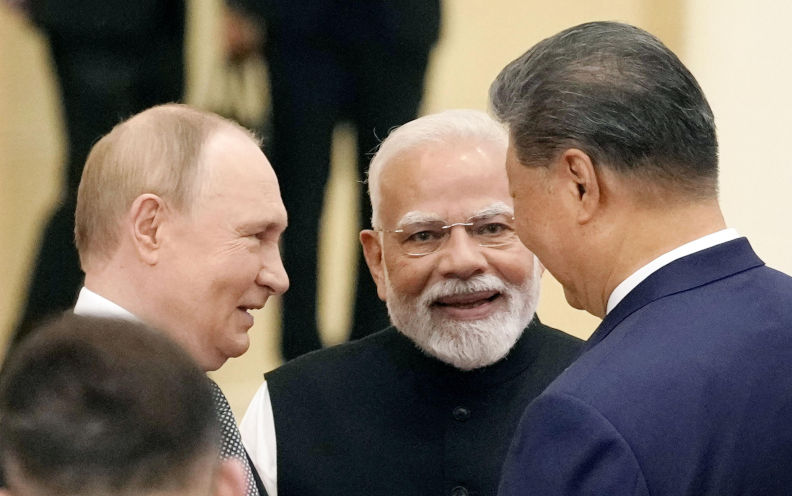
The flare-up of India–US tensions also justifies New Delhi’s longstanding commitment to strategic autonomy by demonstrating the need for India to maintain a diversified foreign policy. This was evident during Modi’s visit to Tianjin in August 2025 to attend the Shanghai Cooperation Organisation (SCO) Summit. Yet, despite Modi mingling with the Russian and Chinese presidents, there was limited evidence of substantive progress in strengthening India–China–Russia cooperation — showcasing the limits of India’s efforts to turn away from the United States.
Significantly, the Modi government chose not to retaliate against the Trump administration’s anti-India statements and actions, whether through retaliatory tariffs or government criticism. Trump and Modi’s conciliatory statements further indicate efforts salvage the relationship. They are expected to reach a bilateral trade agreement with reduced US tariffs on India and a possible drop in India’s dependence on Russian crude oil.
Still, the downturn in India–US relations points to several structural challenges facing the bilateral relationship over the longer term. US engagement with India is undergirded by three key pillars —India’s status as the world’s largest democracy, as a bulwark against China’s rise, and as a global manufacturing hub.
While the Trump administration’s value-neutral worldview has reduced the weight of democracy in US foreign policy, the narrative of relations between the world’s oldest and largest democracies remains a key pillar of the India–US relationship. But promoting democracy has never been a strong component of Indian foreign policy, given India’s primary commitment to principles of sovereignty and non-intervention.
The strategic rationale of the ‘China factor’ in the India–US relationship has lost some of its weight as New Delhi and Washington extend olive branches to Beijing. And New Delhi’s commitment to strategic autonomy makes it reluctant to get dragged into a potential US–China conflict.
On the economic front, India’s dependence on China as a key trade partner and source of components and raw materials erodes the narrative that India is a beneficiary of the push to de-risk or diversify supply chains away from China. India’s economy continues to face structural challenges that inhibit its ambitions to challenges China’s status as a global manufacturing hub.
These developments undermine the three pillars undergirding the India–US relationship and point to broader problems in India’s foreign policy. Many in New Delhi would argue that the Trump administration’s actions have vindicated India’s multi-aligned foreign policy. But India’s efforts to remain equidistant can often be perceived as disengaged, contributing to its lack of strategic indispensability in the international system.
Ongoing India–US negotiations do not discount the possibility of concluding a bilateral trade agreement before the end of 2025, particularly if more contentious issues are deferred to subsequent rounds of negotiation. But this will not negate the damage done to the bilateral relationship.
The key lesson for India from the recent downturn in relations with the United States is that it needs to develop a more proactive rather than passive approach towards its strategic autonomy. Making itself more strategically indispensable to the international system will make India less vulnerable to the whims of the Trump administration – or any other country.
Republished from East Asia Forum, 9 December 2025