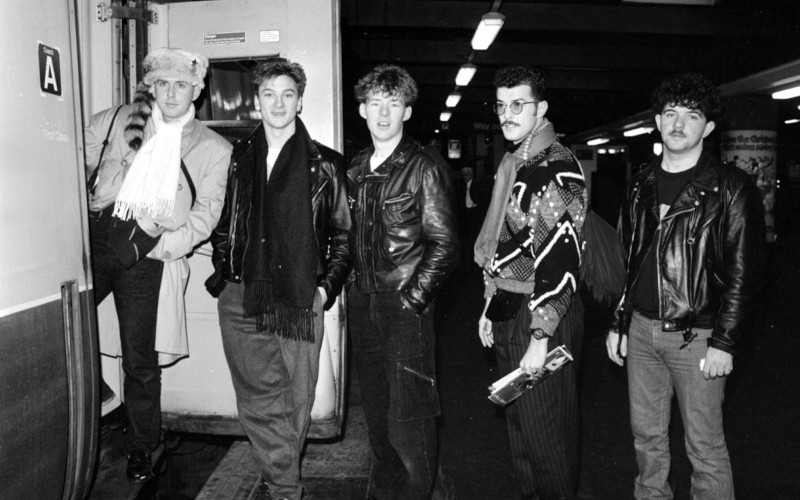
Frankie Goes to Bethlehem: myth, music and the power of love
December 13, 2025
In 1984, Frankie Goes to Hollywood released a reverent nativity ballad that revealed how myth, music and Christmas still speak beyond belief.
In the lead-up to Christmas in 1984, something genuinely unexpected occurred. The most provocatively sexual and politically charged pop band in Britain – Frankie Goes to Hollywood – released The Power of Love, a slow, reverent ballad depicting the Christian nativity without irony or satire.
In the Godley and Creme-directed music video shot outside Jerusalem, the nativity was presented as an unadorned work of art, with no images of the band. Even the single’s cover art reflected the seriousness of intention, featuring Titian’s _Assumption of the Virgin_, a sixteenth century Venetian masterpiece.
In this sense, The Power of Love approached the nativity not as kitsch or Christian propaganda, but as a modern expression of mythos. The Ancient Greeks used the term mythos to name a timeless story that speaks to the imaginative and intuitive part of us that recognises truth when it is felt rather than explained.
Much to the surprise of many music critics, this stylistic leap by the band did not confuse or alienate their audience. Instead, it gave them their third consecutive number one single in the UK, during a season dominated by Band Aid’s _Do They Know It’s Christmas_, a well-intentioned yet paternalistic anthem whose jauntiness left little room for depth or contemplation.
To be fair, Christmas music typically falls into two predictable categories: cheerful Santa jingles or solemn church hymns. Yet The Power of Love arrived in a different register entirely, it was artistic, provocative, contemplative and emotionally sincere.
So what are we to make of this, and why does it matter now?
The public response to The Power of Love shows that the mythic and aesthetic dimensions of Christmas remain powerful, even for those who no longer approach the story through church or tradition. This is striking when we consider how Christmas is often presented today.
In the Australian press, figures like Greg Sheridan write as though the Christmas story must be defended as literal, historical fact. This framework presents a narrow choice: accept the nativity as modern biography or dismiss it as superstition. It is a constricted reading that leaves little room for imagination, metaphor or interior meaning.
Yet the Gospel writers themselves were steeped in these things. Matthew shaped Jesus’ origins for Jewish readers looking for prophecy and lineage. Luke composed a birth narrative for Gentile audiences, emphasising accessibility and divine intimacy. The earliest Gospel, Mark, contains no birth narrative at all – Jesus enters fully adult, at the beginning of his ministry. Ancient biography did not look to childhood for psychological explanation or destiny; that modern perspective began with Freud in the nineteenth century, not in first century Palestine.
Historians widely agree that Jesus was not born in Bethlehem, but in Nazareth, and that Bethlehem entered the story to align him symbolically with the messianic expectation associated with David.
The nativity functions in the realm of mythos – a symbolic truth rather than a literal fact.
As religious historian Karen Armstrong puts it, “A myth was never intended as an accurate account of a historical event; it was something that had in some sense happened once but that happens all the time.” Armstrong’s insight affirms what the Greeks understood: mythos is alive with wonder and recurring inner truth rather than historical verification. The nativity endures not because it is factually proven, but because it continues to reveal something about vulnerability, hope and the possibility of renewal.
This is why the Christmas nativity still resonates with children. They do not treat it as a historical puzzle to be solved. They step into the story. They inhabit it. The nativity lives in them as an embodied form of mythos.
In this sense, the Gospel writers were not failed historians; they were successful myth-makers. To treat the Christmas story as journalism is a peculiar post-Enlightenment preoccupation that has disenchanted Christmas. For most adults in the modern West, the mythos of Christmas has become abstract and incredible, not because the story has grown weaker, but because our art and religion have grown apart.
The Power of Love offers a different approach. Its success suggests that mythic elements of the Christmas story still speak to people, even when religious practice has faded, and that a hunger remains for beauty, wonder and the intuition that something sacred can break into ordinary life. We may not believe as we once did, yet we have not lost the capacity to recognise significance when it is experienced rather than rationalised.
The band’s lead singer, Holly Johnson, understood this intuitively:
“I always felt like The Power of Love was the record that would save me in this life. There is a biblical aspect to its spirituality and passion, the fact that love is the only thing that matters in the end.”
He was not speaking in any traditional Christian sense, but as an artist who understood that meaning is conveyed through mood, symbolism and emotional truth. In this way, Frankie Goes to Hollywood’s song spoke to everyone: believers, lapsed believers, uncertain seekers and those who feel meaning in symbol even when they no longer affirm traditional belief.
The force of the song lies not in its lyrics as prose, but in the union of music and image. Schopenhauer noted that attaching explanatory language to music places scaffolding over something meant to be immediate and intuitive. Lines like “Love is the light that keeps darkness away” gain their power through tone, melodic arc and vocal vulnerability.
By contrast, many traditional Christmas hymns, while sometimes containing striking poetic phrases, lapse into literal assertions of doctrine that can sound faintly absurd to non-believers. Lines such as “Veiled in flesh the Godhead see; hail the incarnate Deity” are declarations rather than invitations. They assert rather than evoke. The Power of Love instead invites a way of knowing communicated through recognition rather than doctrine. This reflects a broader pattern in contemporary Christianity, where the Christmas story is presented as a claim to be affirmed rather than a mystery to be entered.
The modern church continues to tell the Christmas story as though adults require either sentimental comfort or historical persuasion. Yet adults require mythos just as much as children. Music and mythos move beyond linear language and the limits of reason. They live in the depths where sorrow, intuition, longing and recognition coalesce into meaning.
And that may be the key to recovering Christmas in our time. Not by insisting on factual certainty, but by recognising that it remains true in a different register. The Power of Love shows that the meaning of Christmas returns most vividly through the immediacy of music and poetic image, through artists who create rather than dictate, and who relight the ancient story for the modern imagination, restoring to it the power of mythos.