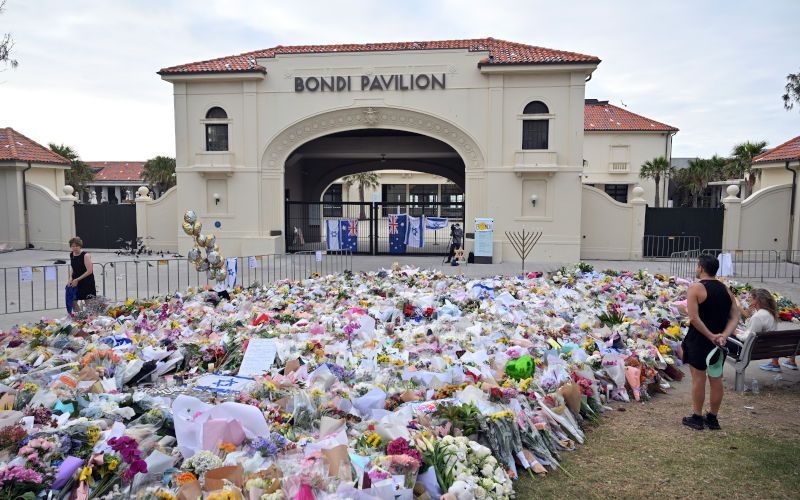
This one’s on Netanyahu, not Albanese
December 22, 2025
The Bondi massacre sits within a wider international context that has reshaped public attitudes to Israel, antisemitism and protest, complicating how grief, fear and responsibility are understood in Australia.
The massacre at Bondi fits so naturally into the context of Israel’s recent wars with its neighbours that one cannot help but wonder why so few in the post-massacre grieving will make explicit reference to it.
This is not to say that a retaliatory and appalling massacre of Jews on a Sydney beach could ever be justified as a legitimate retaliation for the actions of Israel. They can’t, and no one has made any serious attempt to do so. But nor can the Bondi massacre and the sense of siege enveloping Jewish Australians be understood without an appreciation of the dramatic shift of opinion about Israel that has occurred over the past few years. Benjamin Netanyahu, so quick to blame our prime minister Anthony Albanese for appeasement of Palestinians, should have more on his conscience.
Jewish Australians are blaming governments for an increasing sense of public hostility to Jews in general and Israel in particular. They have been finding classic antisemitic tropes invoked in public debate. Been specifically targeted by neo-Nazi groups, and have borne, locally, blame for actions of the Israeli state against the people of Gaza. They have copped flak for what they have done to Palestinians generally. Israel has recently bombed neighbouring nations including Lebanon, Syria, Iran, and Yemen. The conflicts have been occurring since Israel became a state, but until recently, Israel has enjoyed strong support from western countries, including the US, Australia and most of Europe. That support and overwhelming Israeli military superiority (including nuclear weapons) has made successive Israeli governments slow to come to just settlements with the Palestinians it has displaced. And also resistant to pressure even from countries not openly hostile to Israel to work towards a two-state solution, to stop an aggressive settlement program, and to dismantle an increasingly authoritarian apartheid state.
In recent years some Israeli politicians have campaigned for Israel to annex all the lands of old Palestine. Even before October 7, this was leading to increasing criticism and impatience with Israel, and not only from essentially friendly states but from popular opinion around the world.
The massacre of Israelis by Hamas fighters on October 7, 2023, was originally perceived around the world as an unprovoked massacre of innocent civilians, entirely unjustified by any events immediately besetting the people of Gaze. In this it had parallels with Bondi, although the father-son pair who perpetrated the Bondi massacre are not to be compared with Hamas fighters.
Disproportion of retaliation raised indignation with Israel
Prime Minister Benjamin Netanyahu immediately declared war on Hamas and invaded and bombed Gaza. Nations such as Australia (and Britain, France, Canada and other countries in Europe) “understood” Israel’s response and were initially understanding about the disproportion of it.
That disproportion developed until the number of Gazans who died exceeded 60 times the fatalities of the October 7 massacre. Almost the whole city of Gaza was levelled by bombing campaigns. Public buildings such as hospitals and schools were bombed on the allegation that they were concealing Hamas militants. Israel closely controlled entry and exit of Gaza, including denying access to outside journalists, and withheld supplies, fuel and power. Soon they were accused of a deliberate policy of starving the population and of engaging in a conscious program of ethnic genocide. International legal bodies, including the International Criminal Court issued warrants for the arrest of some Israeli figures, including Netanyahu for alleged war crimes, and the International Court declared the genocide allegations credible.
The international reaction and even the domestic reaction inside Israel was enormous. The ferocity of the response went on and on and entirely undermined claims of self-defence. Very quickly, the October 7 attacks came to be seen not as a stand-alone attack on innocent Israeli women and children, but within the context of a long-running struggle between Palestinians and Israelis over Palestinian rights, an ultimate two-state solution to land now under virtual Israeli control and long lists of grievances stretching back until the beginning of the 20th century. Terrorism, including against women and children, was argued to be a legitimate form of resistance to an overwhelmingly powerful occupying state. Its history in the land extended beyond periods of intense intifada activity, which had included suicide bombings, hijackings, hostage taking and armed raids, all the way back Jewish terrorism setting the scene for the creation of the state of Israel nearly 80 years ago.
Israel fairly quickly squandered much of the moral credit and advantage it had had in the immediate aftermath of the October 7 massacre, rapes and hostage taking. Around the western world, students showed support for the Palestinian struggle. Many did even in Israel itself. Foreign governments, including Australia, tried to rein in the scale and extent of static student protests, including occupations. It is important to remember that Anthony Albanese and Penny Wong, criticised now for taking too little action to protect Jewish Australians, were under considerable pressure from the left of centre of Australian politics, particularly by the Greens, for seeming to be favouring Israel rather than Palestinian rights. Labor emphasised its support for a two-state solution and an end-up settlement of Palestinian claims, but it was also supplying arms to Israel, despite denials, and seeking to restrict demonstrations by the Muslim community (which is about eight times the size of the Jewish community). Jewish groups were complaining of feeling unsafe on Australian campuses, and about the need for protection at synagogues, Jewish schools and preschools.
Much criticism of Israel was wrongly called antisemitism
There were strong and bitter words said in debate. But many ordinary members of the community understood very well the distinction between criticism of the Israeli government and criticism of Jews because they were Jewish. Indeed, many people in the Jewish community itself were strongly critical of the Netanyahu government and thought that it was prolonging the war because Netanyahu was in political trouble, and would, in any event, face serious corruption charges once the war ended.
The public debate also involved people who were strong critics of Zionism – a political movement that had campaigned for a Jewish state (under the slogan ‘a land without people for a people without land”) resisting arguments that international creation of Israel implied respect for Palestinian rights. Many Jews, in Israel or elsewhere, are not Zionists. Significant lobbies try to conflate Zionism with Israel itself.
For many Muslims taking part in demonstrations or engaged in the public square, the argument was about justice for the Palestinian people. But with Israel a frequent military meddler in the politics of its neighbours, the hostility to Israel has extended to questioning its very right to exist as a state in the region. This is not, of itself, mere antisemitism but a lament that Jewish settlement was a colonial imposition by Britain and France without much in the way of regard for the rights of the people who actually lived there.
Britain and France promised Zionists a Jewish state in the middle of WWI, in breach of promises they had also made to Arabs about independence for military help in fighting Turkey. Israelis complain that its neighbours deny their state’s right to exist, as though they want Israelis killed or obliterated. No, they just think they shouldn’t be there, in Palestine. They deny that a colonial outsider can create a state over the heads of an area’s inhabitants, then use its de facto existence as a foundation for oppressing the population. It would be as if Britain had exiled most Irish people from their country then moved in Scots and given them self-government.
Israel’s neighbours, and its non-Jewish domestic population, show practical respect for Israel’s existence. They had little choice. Israel has formidable military power. Some of its neighbours – Jordan, Lebanon and Egypt for example – have practical legal and peaceful working relationships with the state. Other big powers – the US, Russia, Britain and France for example – have working relationships with all the powers in the region. There are massive obstacles to peace in the Middle East, but it does not turn on the meaning of words such as “recognise.”
Jewish Australian lobby groups promote an array of diverse activities, religious, social and political. But they have an anxious eye for the success and security of Israel, even if, or when they are critical of the character of the government of the day. Some Australians, not all Jews, are heavily involved in Israeli politics, including supporting particular parties. Some prominent Jewish Australians have a firm foot in Israel as well and tend to regard all criticisms of Israel, including criticism of the government, as inherently antisemitic and hostile to Jews. Others don’t. But a good many groups that chronicle and record instances of anti-Jewish statements include among them criticism of Israel’s actions over Gaza, and settlement policies.
Some of the focus of criticism on Albanese and Labor, and emotive suggestions that they are “personally responsible” for the Bondi massacre are payback for Labor’s efforts to operate with an even hand. The Opposition is not so judicious. Like the Murdoch media it is uncritically pro-Israel. It’s an interesting judgment given that, as a former National Party Leader, Tim Fischer (pro-Palestinian) used to point out, Australia’s economic future is much more allied with Islamic countries. It may prove to be one with famous Liberal Party judgment calls such as demonising Australia’s one million Chinese Australians as potentially disloyal spies for China. With or without future immigration, Muslim Australians vastly outnumber Jewish Australians. And an increasing number of Jewish Australians are not, as Australia’s Jews prior to World War II were, culturally western European, but rather more of Russian or Eastern European background. Nothing wrong with that of course, but it can mean that some are not readily seen as “people like us” – that is white and assimilated.
Don’t forget the crude neo-Nazi antisemitism. Nor Hanson’s mimicking of its success
Also in the mix are a significant, and growing, number of neo-Nazis who are open in their pure antisemitism, and, in many cases, in their identification with Nazi extermination programs during WWII. In recent times they have seen one of the prime avenues of recruitment as being hostility to immigration, particularly to allowing “people not like us” to come. By that they mean Muslims, Jews, people from the Middle East, India, Asia and Africa (other than ex-colonial types). They want to recreate the White Australian enclave that prevailed until the 1960s, the days before multiculturalism, the melting pot, and the high protectionism of a time when Australia made its own things, if at twice the price of our neighbours.
It is not only neo-Nazis who are pushing this agenda. So is Pauline Hanson, who was very publicly worried about Australia’s going chocolate 30 years ago. There’s now a popular belief that most of Australia’s economic ills – over housing, a manufacturing base and job opportunities for example – could be resolved if the nation rejected having an international student market (once bigger than wheat, beef and minerals) and stopped taking any other migrants as well. With people such as Hanson, and the neo-Nazis making it clear that the ones who won’t be coming will be those who are not white, or from a once-Christian country, one does not have to do much dog whistling about this. A good many Liberals can hardly resist. Not a few Labor politicians make it clear they have the message and are full of corollary promises about deporting those who commit crimes (statistically, migrants are less likely to commit crimes than the Australian born) and exemplary cruelty to asylum seekers.
A decade ago, Australians elected a Liberal government which saw as one of its first priorities the repeal of an anti-discrimination law that criminalised racist abuse. It was, apparently, a restriction of freedom of speech. Then Attorney-General George Brandis, regarded in the Liberals as a moderate, famously explained that “People do have a right to be bigots, you know. In a free country people do have rights to say things that other people will find offensive or insulting or bigoted.” In the new regime the Jewish envoy wants, this may be all too much.
Jewish Australians, here since 1788 have had great success in Australia, and talk about their feeling uncomfortable has to be taken seriously. They may well be more at risk from far-right groups than from Muslim Australians, overwhelmingly law-abiding for all that there are some who will never fit in.
We have mostly moved on from the open racism and anti-semitism of another era
In nativist America, 200 years ago, a top priority was keeping Jews out. And Irish Catholics, who were unlikely ever to be industrious enough, or educable enough to help the US prosper. Even now a fairly openly racist Donald Trump complains there are not enough Scandinavians applying for immigration, and told Somali Americans they were “garbage” he didn’t want in the US.
Only 80 years ago, there were RSL types who wondered aloud whether “southern” Europeans – Italians, say, or Greeks, Turks and the Spanish should really qualify under the White Australia policy. Allegedly such swarthy types lacked the northern European protestant work ethic. The Canberra Times editorialised against admitting more Jewish refugees:
“Where black markets and illegalities flourish, the experience is that Jewish refugees are plentifully in evidence. Australians, particularly ex-servicemen, are finding themselves elbowed away by the money power which the refugee class exercises, and Australians find themselves exploited by all manner of snide business tricks which have been introduced to this country. Moreover, the historically proven experience that Jews are incapable of governing others and unwilling themselves to be governed, is being repeated in the lack of Australian sentiment by this class of immigrant.”
Owner and editor Arthur Shakespeare was not sent to re-education camp, nor charged with sedition or promotion of racial hatred.
Muslim Australians need to be made to feel safe and comfortable too, not least in a world and a region in which some citizens are more hostile, increasingly unwelcoming, and interested in organising confrontations. But some Australians, including some media organisations, think it is open season on them. Muslim Australians, like Jewish Australians, have legitimate interests in social and political outcomes in the Middle East that are of priority equal to Israel’s. Israel’s future, after all, depends on its ultimately making peace with its neighbours and providing justice to the Palestinians.
That’s an end rather better achieved by community cooperation in common goals rather than the severe restriction of civil liberties, demonstrations, snipping the rights of prominent Jews to describe Palestinians as “animals”, cultural commissars at universities and the ABC. And school curriculums on what must be taught about tolerance towards Jews (if not explicitly, Aborigines, or the latest crops of migrants and refugees). Those who resolve their community differences with rifles and shotguns do not tend to have gone to lectures that day.
Republished from _The Canberra Times_