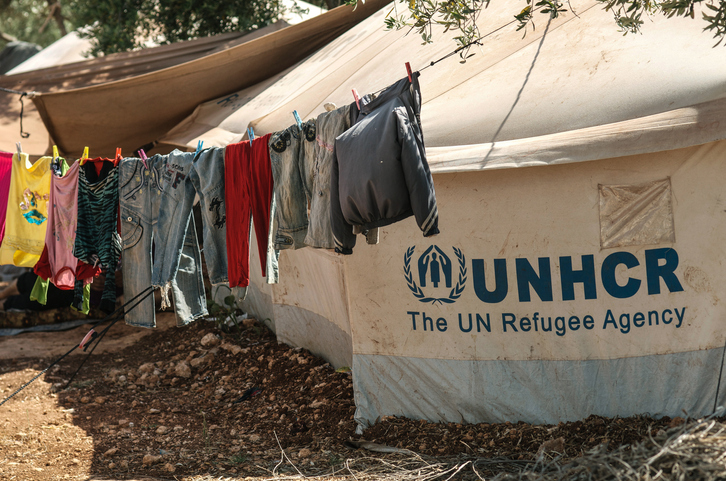
Ellen Hansen: At 75, UNHCR is needed more than ever – but its funding is being cut
December 10, 2025
As global displacement reaches record highs, UNHCR marks its 75th anniversary facing deep funding cuts that threaten its ability to protect refugees and save lives worldwide.
On 6 November, the outgoing United Nations High Commissioner for Refugees, Filippo Grandi, addressed the UN General Assembly for the last time as High Commissioner. In his speech, Grandi responded defiantly to this year’s sharp and unexpected financial reductions. He dismissed the idea that these funding cuts were overdue or that they represented an opportunity for UNHCR to become more efficient by narrowing its focus to only its ‘core mandate’. Instead, Grandi argued that such reductions would hinder UNHCR’s ability to save lives and effectively fulfil its mandate. He concluded with conviction that, “our job is not done, yet; and that this organisation… will endure, until it is no longer needed”.
The UN General Assembly established the Office of the United Nations High Commissioner for Refugees (UNHCR) 75 years ago, on 14 December 1950. Its primary role is to offer international protection to refugees and seek solutions to refugee crises. This includes assisting governments, and, with their approval, private organisations, to support the voluntary repatriation of refugees or their integration into new national communities.
While the language in the founding documents is in parts dated, the purpose remains clear: UNHCR is tasked with protecting refugees internationally and supporting governments in finding lasting solutions to their plight.
UNHCR’s responsibilities were further strengthened through the 1951 Convention relating to the Status of Refugees. This treaty obliges contracting states to cooperate with UNHCR, particularly in the exercise of its mandated functions and its duty to supervise the application of the Convention. Through these frameworks, UNHCR’s essential role in offering protection and facilitating durable solutions for refugees has been solidified and continues to be recognised globally.
UNHCR’s ‘core mandate’ for refugees, asylum-seekers, refugee returnees and stateless people has expanded over the decades to include a (non-exclusive) mandate for internally displaced people who now far outnumber refugees. It has a ‘good offices’ function to assist groups of people outside the mandated functions. UNHCR has also very actively engaged in efforts to address the linkages between the climate crisis on the one hand and forcibly displaced and stateless people on the other.
Is any one of these functions redundant? They are all, unfortunately, in need of more rather than less attention.
Despite the growing needs, the organisation is confronting drastic funding cuts and is likely to end 2025 with USD $1.3 billion less in funds than in 2024. This is a 25 per cent decrease in overall funding, exacerbated by a collapse of unearmarked contributions, which are so essential to fund the less visible, but nevertheless needy, displaced populations as well as to respond quickly to new emergencies. At a total of less than USD $4 billion out of a total 2025 budget of USD $10.6 billion, that is equivalent to the funding received in 2015 when the number of forcibly displaced was half of the 122 million it is today.
At UNHCR’s recent annual pledging conference states demonstrated continued confidence in UNHCR’s work, with early pledges from donors exceeding USD $1 billion. UNHCR’s national partners (including Australia for UNHCR) committed an additional USD $350 million from private donors. These pledges contribute to the USD $8.5 billion budget for 2026 which is focused on protection, life-saving interventions and systems support in refugee-hosting countries.
Nevertheless, the recent sharp reduction in funding as well as an increasing trend towards earmarked funding are deeply troubling. While no one country can or is expected to cover the shortfall left by the cuts, countries can increase or, at a minimum, maintain their contributions and support, in the interests of refugees, but also in their own interests.
Australia’s history with refugees is particular. It was the sixth signatory to the 1951 Refugee Convention, thereby bringing the treaty into force, and was a founding member of UNHCR’s Executive Committee. More importantly, and while its asylum policies have raised concerns, especially in relation to pushbacks, offshore processing and detention, Australia has continued to resettle refugees, asserted its commitment to its legal obligations under the Convention, maintained its funding to UNHCR, and played a significant role in UNHCR’s governance.
Just a few days ago, Australia celebrated the contribution refugees have made to Australian society upon the granting of its one millionth refugee visa since the end of World War II, with the vast majority of those resettled refugees referred by UNHCR. It has established an Australian Refugee Advisory Panel to take into account the views of refugees themselves. In good standing in relation to humanitarian funding and development assistance, Australia is well-placed to help shape the future of refugee protection and assistance.
Notwithstanding Grandi’s legitimate protestations in relation to the funding cuts, efforts to support and to promote refugee protection can lead to greater efficiencies as well as contribute to peace, stability, and prosperity, including in Australia’s neighbourhood. Such efforts which meet the interests of states as well as those of refugees include: the adoption by States of more holistic ‘whole-of-route’ approaches to mixed refugee and migratory movements, in line with Grandi’s ‘panoramic’ rather than ‘myopic’ approach (first mooted by him during his visit to Australia in 2023); increased support to hosting states to allow refugees and other forcibly displaced people to become more self-reliant, thereby reducing the need to take dangerous onward journeys; a commitment to more flexible funding models for UNHCR to carry out its work; an increase in places in refugee and migration programmes to provide additional places for refugees; and, help to refine the distinctive but complementary roles of UNHCR with other United Nations entities, to avoid unnecessary competition and/or duplication.
In an era of increasing rather than decreasing forced displacement, the organisation will endure and its work needed as much as ever.