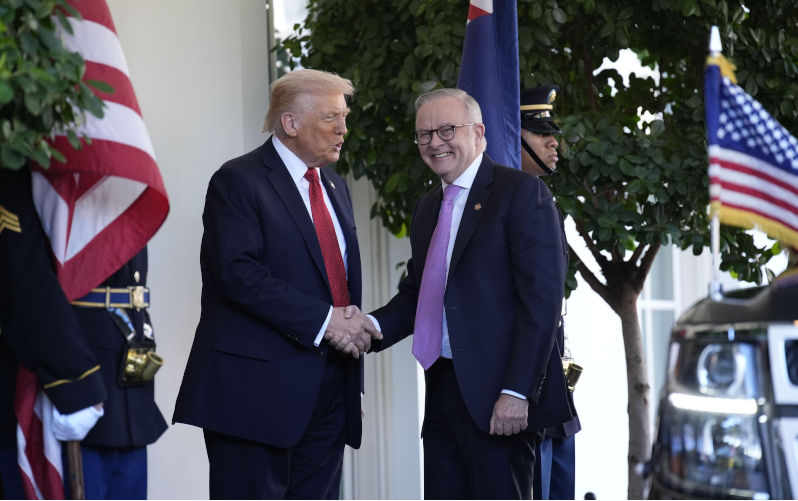
Would Donald Trump pass an Australian Values test?
December 14, 2025
As the Coalition considers adding an Australian Values test to the Character Test, Abul Rizvi asks a simple question: what happens when you apply it to someone whose behaviour is extensively documented – like Donald Trump?
The _Sydney Morning Herald_ is reporting the Coalition is considering adding something like the current Australian Values Statement to the existing Character Test. A useful way of thinking about this idea is to apply it to an actual person – so, would Donald Trump meet an Australian Values test?
The existing Character Test is used for visa applicants of all types including New Zealand citizens, tourists, students as well as permanent visas. The existing Australian Values Statement requires visa applicants to sign up to a set of Australian Values including:
- Respect for the freedom and dignity of the individual – Trump’s use of the Department of Justice to go after his enemies (perceived or otherwise) suggests he has very little regard for the freedom and dignity of the individual.
- Freedom of religion (including the freedom not to follow a particular religion), freedom of speech, and freedom of association – Trump’s contempt for Muslims and the Muslim faith, including his proposed Muslim ban, is well documented and highlights he has little regard for freedom of religion.
- Commitment to the rule of law, which means that all people are subject to the law and should obey it – Trump’s reflexive criticism of judges, judgements against him and his riding roughshod over the US Constitution, highlight that he has no commitment to the rule of law.
- Parliamentary democracy whereby our laws are determined by parliaments elected by the people, those laws being paramount and overriding any other inconsistent religious or secular ‘laws’ – Trump barely hides his contempt for the US democratic system, let alone being able to demonstrate respect for parliamentary democracy.
- Equality of opportunity for all people, regardless of their gender, sexual orientation, age, disability, race, or national or ethnic origin – Trump’s views on women (“ grab 'em by the pussy”), minorities, people with disabilities, etc is well documented.
- A ‘fair go’ for all that embraces:
- mutual respect;
- tolerance;
- compassion for those in need; and
- equality of opportunity for all.
Trump has clearly demonstrated he would not understand the concept of the ‘fair go’. He is only interested in self-interest.
Trump would be odds-on to fail any Australian Values test. A visa decision-maker would need only a few hours research and decision write up to advise Trump he had failed.
But the vast majority of the millions of visa applicants to Australia every year could not be so easily researched. The cost and delay to an already clogged visa system would be extraordinary. For this reason, at the visa grant stage, the Coalition would likely maintain the existing approach of simply requiring them to sign the statement of Australian Values without actually testing this.
Under that approach, Donald Trump would get a visa although he may fail the existing Character Test.
The Coalition may be considering using the Australian Values statement to cancel visas of people already in Australia if they exhibit behaviour contrary to Australian Values. But most people on visas who are in Australia don’t behave as egregiously as Trump or the neo-Nazi whose visa was recently cancelled. The existing Character Test already allows for that although the specific case of the neo-Nazi was not tested in the Courts.
People on visas who do behave in a particularly egregious way but do not fail the existing Character Test would most likely come to attention through the media or through community reports. How many of these would not fail the relevant part of the existing Character Test (ie inciting discord or vilifying a segment of the community) but would fail a Values test is difficult to gauge. Cancellation of visas on a highly subjective values ground would inevitably by appealed and considered by the courts. It is unlikely the government would proceed to visa cancellation on a values grounds without overwhelming evidence.
An Australian Values test could also be applied at the citizenship stage. At that stage, there is more time for citizenship processing officers to consider someone’s behaviour while they have been in Australia (although citizenship processing times have become very long).
Leaving aside the issue of cost and delay, visa processing officers could research an applicant’s online behaviour; interview them and/or add more questions about Australian values to the existing online test (but the test may need to be brought into the physical world to prevent people using AI to answer questions).
If a citizenship applicant fails such a subjective test, they could appeal the decision. On the other hand, the applicant may just resit the test as they are able to do now. That is unless policy was for the person’s permanent residence visa to be cancelled for failing the test (which would be an extraordinary decision if the individual was, for example, the partner of an Australian citizen).
It would be surprising if the Coalition opted to move down this path in a very aggressive way unless pressured do so by One Nation. Small tentative steps would be advisable.
At least to avoid potentially upsetting the US president if he applied for an Australian visa.