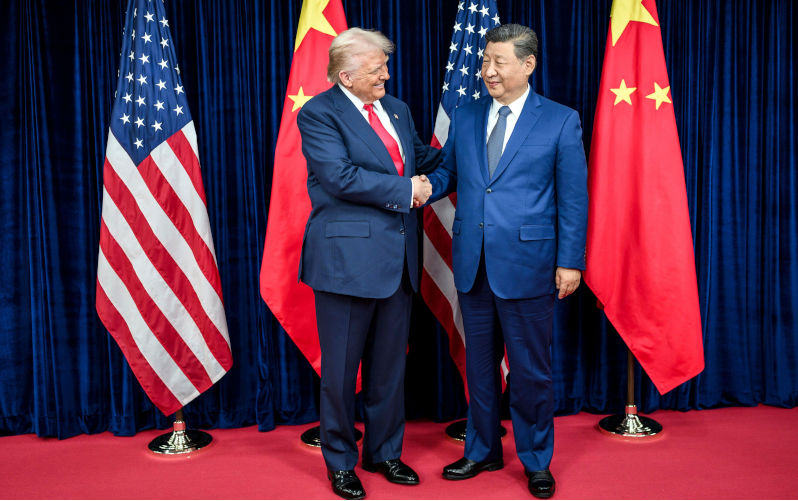
Can Washington still strike a grand bargain with Beijing?
January 20, 2026
A prominent Chinese academic argues the conditions are right for a US–China “grand bargain”. But recent events in Venezuela and the Middle East raise hard questions about what kind of America China is dealing with.
Professor Wu Xinbo, a prominent Chinese academic who regularly comments on Sino-American relations recently published an instructive article in the US journal Foreign Affairs entitled, _The Case For a Grand Bargain Between America and China._
Professor Wu is Dean of International Studies and Director of the Center for American Studies at Fudan University in Shanghai. The introduction of his piece argues that “the conditions are [currently] in place for a grand bargain between China and the United States.”
This is so, Wu maintains, because the two states presently face a third pivotal, modern era turning point. The first of these materialised in 1972, after Henry Kissinger negotiated a breakthrough visit for President Nixon to Beijing, which laid the foundations for US diplomatic recognition of Beijing (in preference to Taipei) in 1979.
Next, came the Clinton administration’s robustly elevated economic engagement with China in the 1990s based on the convergence theory favoured by Washington at that time.
Professor Wu emphasises that the first Trump administration “replaced engagement with competition.” The Biden era saw this estrangement wilfully intensified, with President Biden calling President Xi Jinping a “ dictator” on several occasions.
Now, however, a potential third turning point has presented itself, according to this article, because the second Trump Administration is far less interested in Biden-style ideological grandstanding and notably more focused on securing an agreed “concert of power”, allowing “active coordination between China and the United States” as they each seek to advance their own national interest.
A week is a long time in geopolitics, however. Just a few days after Professor Wu’s article was published, the US visited a wave of bombing, killing, hijacking, kidnapping and planned looting on Venezuela, a primary Chinese partner in Latin America.
Still more recently, the New York Times has reported how the US is surging military assets in the Middle East to prepare for another Israeli orchestrated, major military attack on Iran.
Professor Wu notes, in closing, how, in 2026, leader-summits might be facilitated when China hosts the next APEC meeting in Shenzhen and America hosts the next G20 meeting in Miami. He also mentions that, separately, Trump may visit China and Xi may visit America this year, though we will need to observe how much these visit-decisions may be influenced by recent (and approaching) American banditry in the Caribbean and the Middle East.
Nevertheless, the long-view in this article is well set out (covering the South China sea, Taiwan, trade, monetary and economic tensions, for example) and thoughtfully argued. It repays careful reading.