Gory sausage making at the Labor knackery
January 19, 2026
“Social coherence” is being invoked everywhere, but public trust is fraying. Political panic, rushed laws and weak leadership are deepening division, not repairing it.
The time may have come to retire the phrase “social coherence”. One hardly ever heard of it a few years ago, but as Australian society seems to be atomising by the hour, it is on everyone’s lips. Including those who might seem to be doing most to defeat in public any idea of a common good, national and social identity, and decency and tolerance towards all. The more I hear of it, the less I see.
It is quite true that the phrase seems to contain the germ of what might seem to be a good idea – a nation building and affirming ideal – but on many of the occasions it is trotted out, it seems, in practice, to be achieving the very opposite. As a political idea, its main problem is that many of those most given rhetorically to talking about the need to build social coherence are not very good at making it happen. The fact that intentions were noble doesn’t come into it. Take Anthony Albanese, for example. Included among his social cohesion triumphs are the Aboriginal Voice, a very popular idea for a moment until it severely divided Australians and was humiliatingly defeated. Then, after 30 years of wasted time in action against climate change Albanese got through parliament legislation he claimed had ended the argument once and for all. Now he is again back to taws, with the opposition firmly against emission targets and firmly focused against what most observers regard as a bare minimum national interest. Government is going backwards.
On defence policy, particularly in the past six months of Donald Trump, we have not had unity or social coherence. Or intelligibility, consistency and relationship to our national circumstance. The minister for defence. Richard Marles has his own incoherence problem and seems to think that the reason for blind support of Trump is the international need for rules-based order, as though America provides that. Perhaps Albanese and Penny Wong have reasons they cannot disclose for adopting a slavish defence and foreign policy, increasingly against Australia’s interests in relation to China. But they have failed to explain and justify it to the nation. Nor to reassure Australians who doubt that either the US or the UK can fulfil their nuclear promises over the next 40 years, leaving a serious risk that Australia will have no submarines at all.
Albanese badly mismanaged Australia’s response to the October 2023 massacre in Israel and its prompt embarkation on a disproportionate war against the citizens of Gaza. For too long he failed to listen to public opinion about the size of the slaughter being visited on the people of Gaza, Israeli actions in withholding food and limiting medical and other services. For too long it has seemed to juggle the “problem” or the issue as being one of empathy with Israel and its problems in confronting terrorism. Albanese eventually joined Canada, Britain and most of western Europe in criticising Israel’s war (which international courts had suggested to be genocide and involve war crimes) and in supporting Palestine’s case for nationhood. But he and many of his colleagues always seem to see the conflicts through Israeli eyes, at best adopting the perspective of many Israeli citizens critical of prime minister Netanyahu and his method of prosecuting the war and what now passes for peace.
Critics have been targeting Israel, the IDF and Netanyahu, not Jewishness or Jews. That’s not antisemitic.
Israel’s conduct of the war led to an avalanche of local and international criticism. The overwhelming proportion of that criticism has been focused on the conduct of the state, its defence forces, and its politicians, not because of their Jewish religion or background. Many of the critics, especially semitic people of the Muslim religion, have also been strongly critical of the Zionist movement which had promoted the idea of a “homeland” for the Jewish people plonked right in the middle of where Arabs (and a relatively small number of Jews and Christians had lived for millennia). Their so-called denial of Israel’s right to exist is not a slogan for extermination, but a rallying call against a history of imperial powers settling or planting populations in lands already occupied by others. Their use of the shorthand Zionist is not of itself antisemitic. A definition of antisemitism written by mostly Jewish holocaust scholars and adopted, if in a nonbinding way by more than 30 countries, including Australia, has suggested that criticism of Israel can be antisemitic if it holds Israel to account in ways that would not be used to criticise other nations.
This definition also suggested that being anti-Zionist could be antisemitic in denying Jews a right to self-determination. But criticism of the very idea of the state of Israel in Palestinian homelands is not of itself an attack on the right of Jews to create a state elsewhere. The UN did not consecrate the state of Israel where it was for Biblical reasons. Nor can it be said that the world recognises a general right for people of a particular race or religion to have their own state. Kurds must manage without one at all. So must Yazidis, or Basques, Roma people or Bahai. Scores of states have significant racial minorities of religions different from the majority population.
ASIO, police forces and counter-terrorism agencies have tended to use the definition of antisemitism adopted by the holocaust scholars. That definition itself recommends making allowance for context and common sense. But the Israeli state has tended to claim all criticisms of itself, its defence forces and its politicians as inherently antisemitic, and so, in general parlance do many of the leading public representatives of Jewish Australian groups, particularly those with a strong relationship with Israel. This is used both as a sword to delegitimise critics, and a shield to deflect criticism. Some Australian politicians, and others sympathetic to the pro-Israeli cause speak in a shorthand that contains an imputation that all Muslims are terrorists, as are their political organisations. Likewise, it is readily suggested that major rallies in support of Palestinian statehood, such as the Sydney Harbour Bridge march were in support of terrorism or otherwise inherently antisemitic.
There are, of course, others who are openly antisemitic, whether in terms of considering Jewish people as something other than anyone else, or in terms of imagined characteristics, such as being focused on money, usury, or world power, and sometimes, their alleged domination of the media, banking, and higher education. Pogroms, discriminations, persecutions and often forced conversions and exile have often originated in Christianity and been promulgated by church leaders and civil leaders seeking outside groups to blame for plagues, famines or mismanagement. It reached a peak with the Nazi Holocaust in the 1930s and 1940s, which saw perhaps eight million die, alongside other hated groups such as Roma people. The world’s moral shame over the Holocaust helped create the pressure for an Israeli state, although, as many people of the Middle East point out, they did not volunteer to bear the burden of the world’s reparation. Some of the raw anti-Zionist fury comes from an early (pre-Holocaust) Zionist slogan: A land without people for a people without land, that pretended that Palestine was, as pre-settlement Australia was said to be, a terra nullius. Trump’s open immigration racism an inspiration to preachers of racial hatred everywhere.
Some openly neo-Nazi parties have announced their intention to disband because of the proposed legislation. But it is unlikely that most will stop political activism that is still racist and discriminatory, if not so specifically focused on Jews. It is not racist of itself to want to restrict immigration, but some use their activism on this front to promote ideas that Australia is for whites, or only people of European backgrounds, or that groups such as Muslims should be excluded. Once distasteful around the civilised world, this is now, in effect, the official policy of the Trump Administration, right down to Trump describing the people of some countries as “garbage and human trash". Likewise, many of the nationalist and anti-immigration right wing parties of Europe and the UK are openly opposed to non-European entry into their country.
At just the same time, agents of the Trump Administration are publicly criticising Albanese’s legislation as being inconsistent with free speech. One might have thought that a nation so replete with abuse of law, power and authority might keep its mouth shut, just from shame. One can hardly blame the opposition for adopting such criticism. It will never win a vote, anywhere, even from Friends of Israel, for simply going along with Albo.
I do not doubt that the Royal Commission will find that many Jewish Australians have felt increasingly unsafe and uncomfortable in Australia. Many have felt themselves wrapped into criticism of Israel. The Bondi massacre shows that others have been inspired by their antisemitic backgrounds and, sometimes, their anger at Israel’s actions to kill and hurt innocent Australians. It does not diminish their sense of siege to say that this has been happening in an increasingly hostile world for many other Australians who have found their welcome here more constrained, hostility more open, and sometimes, their exposure to physical attacks and public racism more obvious. Both the Voice debate and the immigration debate have empowered some Australians to express fundamental hostility to people who are different, “alien” or of other cultures. Such sentiments were once confined to the lunatic fringe, open Nazis and the One Nation movement. Now they come, dog-whistles and all, from some mainstream politicians.
And in what is in part a homage to the US gun movement, the accompanying noise about governments trying to disarm the population can be expected to draw racism, antisemitism, and conspiracy theories into the public square.
Albanese has not been able to take charge of this debate. He was behind the eight-ball with his tin-eared rejection of a royal commission and his dogged resistance even after his party machine had abandoned the debate. The opposition is, of course, being opportunistic. It is what oppositions do. It may say something about some of the individuals involved, but high school debating tactics about hypocrisy or inconsistency of the type Albanese has been engaging in do not cut through. Indeed, they delay the government being seen to take charge of the issue, and leave the agenda to be set by others, including the opposition, the anti-government Australia, and others with political agendas. There never was, in fact, a tradition of public silence and getting behind the prime minister after national tragedy and national disaster.
It is likely, moreover, that promises to attend to other forms of discrimination with criminalising legislation after the antisemitism legislation is rammed through will not satisfy many voters concerned about the extra power government is giving to itself, and to police and security agencies. Even the more so, as ministers are forced to deal day by day with deal-making politicians among the Greens and Independents. It will not have the appearance of a government responding with care and deliberation to a grave crisis. It will, rather, resemble the usual sausage making at the Labor knackery. Any old sawdust and scraps in a combination without an abiding principle or flavour and without carefully considered checks and balances on the exercise of enormous power. It won’t look potent, and the perfect answer to the critics. It won’t look like national leadership. It will look like, and be, a mish-mash.
Perhaps one should feel sorry for the powerless Albanese, being swept by a tide and trapped into having to respond rather than take charge. But those reflexively in his favour should remember that he does not lack the power, or the political or public support to be more decisive and more magisterial. Less than a year ago, he won an overwhelming majority at a general election. The accompanying drubbing given the opposition amounted to a mandate to be a leader, not a follower, and not a wimp.
That even now the opposition is a complete shambles underlines the opportunities he is missing, perhaps because he does not know what to do. It has been only on this issue that the Opposition has been running political rings around him. And that has been, in major part, because it has been Josh Frydenburg, not Sussan Ley, who has been calling the shots and orchestrating the daily serve of new public figures (including Labor ones) lining up to criticise Albanese. Albanese may not have realised it, but from the start he needed a royal commission to clear the air.
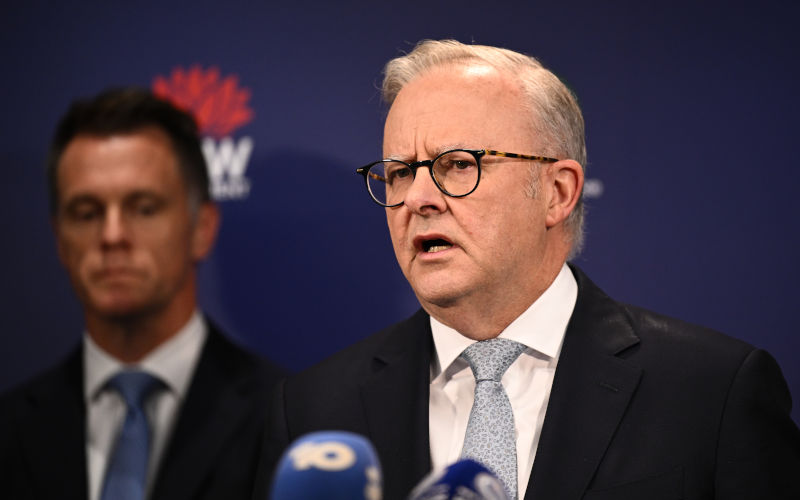
Resistance to a wide-ranging royal commission into the Bondi massacre deprived him of almost any opportunity to capture public opinion on the measures he was proposing, He could have done it with a good speech (provided it was not written by him or his usual national security speechmakers.) He has not played Father of the Nation, or even Chief Mourner. He has not gained stature by standing next to Chris Minns, or Mike Burgess or Sandy Barrett, nor do they have the face, or record to be able to share the national leader’s burden. Labor premiers, indeed, are draining Albo’s standing among voters. Even their own crises and own goals, such as by Peter Malinauskas over the South Australian Writers Festival, hurt Albanese more.
His natural hostility to engage in any sort of public conversation with voters is a major handicap. It is perfectly true that the parliamentary opposition rejected any idea of national unity around his proposals, and, indeed, that they criticised him in a partisan manner from day two of the tragedy. But it is simply too easy to blame the other side for the disadvantage under which he is currently labouring.
Albanese’s position ought to be stronger because the opposition has been a complete shambles since its defeat in the election, and its leader hangs in there only precariously.
It’s not a crisis, even if it has weakened his standing among voters and among colleagues. On form, the Opposition first XI may score a six or two but be unable to bowl anyone out. But Albanese owes it to voters to inspire confidence in strategy and his play. Before he can talk about social cohesion, he must lead with coherence and authenticity.
This piece was originally published in _The Canberra Times_.