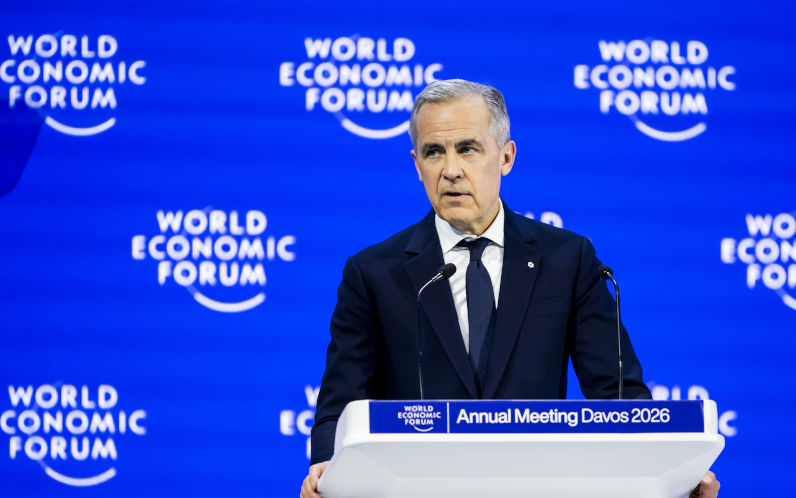
Mark Carney and the middle power moment
January 25, 2026
Mark Carney’s Davos speech argues the world has entered a rupture where great powers use coercion and the old rules no longer restrain them. The challenge for countries like Australia is to face reality, apply consistent standards to allies and rivals, and build collective leverage with other middle powers. _
_
Once in a long while a political speech captures the zeitgeist and says something original, important and worth listening to. Mild-mannered former central banker Mark Carney electrified the audience at the normally somnolent, self-satisfied World Economic Forum by pointing out what’s at stake in a world shaped by great power competition. Even what Samuel Huntington famously called ‘Davos man’ is not immune to a “rupture in the world order… and the beginning of a brutal reality where geopolitics among the great powers is not subject to any constraint.”
Remarkably enough, the language is not dissimilar to that used by Marxist theorist Antonio Gramsci. Writing between the two World Wars, Gramsci described what he called an ‘organic crisis’ characterised by economic instability, a loss of political legitimacy, international political disorder and a breakdown in what we might now call the ‘rules based international order’. It’s not necessary to be a Marxist to recognise that this looks uncannily like the world now.
But it’s one thing to identify the source of a problem and its morbid symptoms, quite another to suggest what might be done to counter them. To Carney’s great credit, he also suggested how ‘middle powers’ could actually act in ways that have long been talked about by the likes of Canada and Australia, but have been notable mainly for their absence.
The first thing to do, Carney argued, is to face reality, however difficult or discomfiting that may be. Although Donald Trump was not mentioned by name, Carney’s speech was clearly intended as the proverbial wake-up call for an ‘international community’ too traumatised by a world upended to speak, let alone act. It will be especially difficult for Australian policymakers to accept that the old order may be gone, and that ‘nostalgia is not a strategy’.
On the contrary, Carney argues that middle powers like Australia must:
“Stop invoking “rules-based international order” as though it still functions as advertised. Call it what it is: a system of intensifying great power rivalry where the most powerful pursue their interests using economic integration as a weapon of coercion.”
This shouldn’t be so difficult for even the most slavish of allies, like Australia, to recognise. After all, Stephen Miller, Trump’s influential Deputy Chief of Staff for Policy recently suggested that the international system is “governed by strength, that is governed by force, that is governed by power”. And yet these are not “the iron laws of the world”, as Miller claimed; the world becomes what we allow it to be.
Faced with such contemptuous disregard for the interests of lesser powers, highlighted most dangerously and egregiously by Trump’s determination to annex Greenland, middle powers really need to demonstrate an overdue sense of solidarity. If ‘middle power’ is to mean anything other than being a sub-imperial sycophant, it should refer to a government capable of taking tough choices in confronting ‘great’ powers in ways that smaller powers are unable.
You might call it leadership, but you might also call it enlightened self-interest. As Carney points out, middle powers are the “countries that have the most to lose from a world of fortresses and the most to gain from genuine co-operation.”
Even more unthinkable for many middle powers is the idea that different great powers ought to be treated in the same way, simply because their interests and world views are likely to have more in common with each other than they do with the lesser lights of the international system. Middle powers need to act consistently by “applying the same standards to allies and rivals”. In other words, don’t “criticise economic intimidation from one direction but stay silent when it comes from another.”
No doubt having the US as an increasingly aggressive and unpredictable next-door-neighbour has focused the attention of Canadians and explains Carney’s recent trip to China as he looks to lessen Canada’s economic reliance on the US and possibly even cultivate new friends. Perhaps we could all take lessons in ‘ hedging’ from our Southeast Asian neighbours.
Playing off one great power off against another looks like a plan, as does cooperating with similarly placed states. As Carney points out, “in a world of great power rivalry, the countries in between have a choice: compete with each other for favour or to combine to create a third path with impact.”
It is difficult to imagine Australian policymakers embracing such ideas, however, despite years of self-congratulatory rhetoric about this country’s ‘ creative middle power diplomacy’. The idea that we might take an even-handed approach when dealing with China and the US, despite the latter’s role in upending the old order, is simply unthinkable. At least China’s leaders talk about the importance of multilateralism and the dangers of great power hegemony. That’s not nothing in today’s turbulent environment.
Carney’s welcome intervention demonstrates a number of things policymakers in Australia might consider. First, we can’t be trapped by the past and illusions about a world order that was always something of a fiction, albeit a comforting one for policymakers incapable of recognising a world that was changing even before Trump appeared. The very least any middle power can do now is to speak truth to power, no matter who is wielding it.
Second, if we’ve learned nothing else over the last year or so, it ought to be that trying to ingratiate ourselves with the Trump regime is an endless fool’s errand that only ends in national humiliation for the supplicant.
Recognising real potential allies who have similar capabilities and concerns ought not to be so difficult. There are potentially quite a lot of them, too. Collaborating with peers and potential partners around the globe might do wonders for Australia’s international reputation and even for our collective self-esteem. If ever there was a moment to be on the right side of history this might be it. Time to stop hiding behind the ‘ national interest’ and start thinking about the collective international variety.