From international law to loyalty and deals: Trump’s Board of Peace play
January 26, 2026
The Trump-led Board of Peace points to a shift away from international law and multilateral institutions toward a system built on loyalty, coercion and financial leverage.
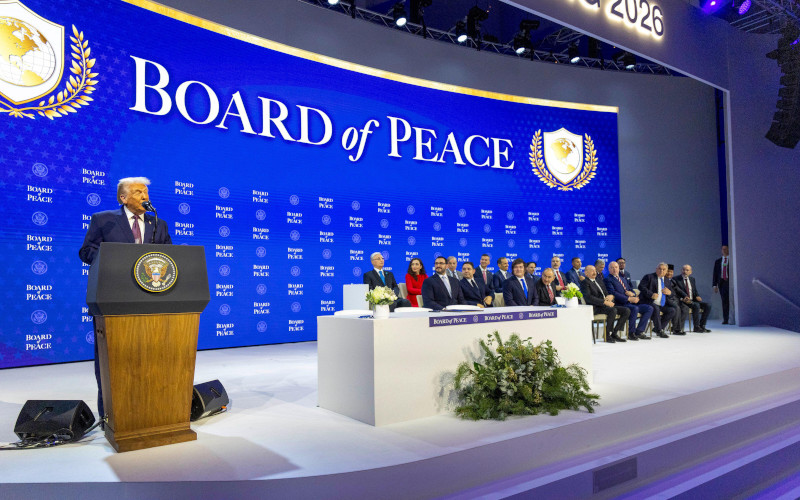
In the aftermath of the ceasefire agreement in the Gaza Strip, the contours of a new geopolitical phase have begun to emerge, led by US President Donald Trump through the announcement of what has been called the Peace Council. This body is not merely a technical administrative committee to oversee Palestinian reconstruction efforts. At its core, it appears to function as an engineered instrument for managing major crises outside the traditional international frameworks in which Washington and Tel Aviv have become legally and morally constrained.
The council represents a hybrid structure that goes beyond the concept of the state, incorporating political and economic levels drawn from the private sector and wealthy elites. Absolute authority is concentrated in the hands of Trump and his inner circle, which includes figures such as Tony Blair, Marco Rubio, and Steve Witkoff, extending to the integration of Benjamin Netanyahu as a central actor despite ongoing international legal pursuits.
The very nature of this council’s composition reflects a systematic American Israeli attempt to establish a parallel order aimed at undermining the system that has governed the world since 1945.
To understand this shift, it is necessary to return to the historical roots that shaped our contemporary world. The United Nations and its institutions – such as the Security Council and the International Court of Justice – emerged as a direct product of the rise of the United States as the dominant power following the Second World War.
That order was built on the Bretton Woods arrangements and the legitimacy of the victors, with international law designed to align with Western interests, ensure the stability of the capitalist system, and at the heart of it all, guarantee absolute protection for the Zionist project that emerged in the same era under the moral pretext of compensation for what became known as the Holocaust and the fight against antisemitism.
For decades, these institutions functioned as instruments of American soft power, used to intervene in the affairs of other states under the banner of human rights and democracy, while granting Israel a functional immunity from any real accountability. However, the past two years of genocidal war in Gaza have triggered a seismic shock within this structure. The founding myths of the international order have shattered against the rock of Palestinian steadfastness and the blatant nature of Israeli violations.
Washington and Tel Aviv have found themselves condemned by the very laws and conventions they created to regulate the conduct of others. International charters have ceased to be protective shields for American interests and have instead become suffocating legal constraints. Today, Israel is no longer merely an entity engaged in a border conflict. It is an entity facing accusations of genocide before the International Court of Justice, with its leaders pursued by arrest warrants from the International Criminal Court.
This transformation has placed the United States itself in the dock on charges of complicity in genocide, which explains its urgent need to dismantle this legal edifice before it collapses upon it.
A deeper analysis of the current reality reveals that American soft power has eroded to a great extent. The principles and values that American universities taught the world for decades – rights, freedoms, and the right to self determination – have now become the primary reference through which the occupation is condemned. Students and young people in the heart of the West have become the main drivers of the global boycott movement and the pursuit of companies complicit in genocide. This value reversal has turned the educational and human rights system in which America invested heavily against it, generating a conviction within the Trump administration that the current international system has become a strategic burden and an existential threat to the Israeli ally, no longer a useful asset in the political game.
From this perspective, the Peace Council emerges as a radical alternative, adopting a logic of replacement and renewal. Trump, with a mindset that does not believe in transnational institutions, seeks to replace international legitimacy derived from multilateral consensus with a contractual legitimacy based on direct loyalty, funding, and deals.
Trump’s invitation to more than 50 heads of state to join this body reflects a desire to build an alliance that grants the United States and Israel room to impose their colonial vision under the label of peace, without fear of a Russian or Chinese veto, and without regard for resolutions of the United Nations General Assembly.
This system is designed to be a post law order, where sovereignty belongs to the strongest and legitimacy is bought and sold.
Trump’s philosophy of commercial realism is clearly evident in the requirement to pay financial sums as membership or continuation fees within this council. This is not merely financial extraction, but a sophisticated political mechanism aimed at cutting off funding sources for United Nations bodies, foremost among them UNRWA.
States that join the council will find themselves unable to pay their contributions to both traditional international organisations and the new council at the same time. Since the real centre of decision-making will have shifted to Trump’s council, funding will inevitably flow in its direction. This implies a clinical death for UN organisations through the drying up of resources, to be replaced by a body managed with the mentality of holding companies that recognise neither the historical rights of peoples nor justice, but only the direct interests of shareholders.
From a strategic standpoint, this council reproduces the concept of the veto in a more unilateral and extreme form. By concentrating decision-making in the hands of Trump and his close circle, rival major powers such as China and Russia are marginalised, as are even traditional European allies.
This new form of unipolarity does not recognise a balance of power, but rather coercive dictates.
Accordingly, this transformation will inevitably lead to unpredictable global repercussions, foremost among them an accelerated fragmentation of NATO. In the absence of stable principles within the new council, direct geopolitical ambitions will prevail, including Trump’s openly stated desire to control Greenland and his treatment of Europe as a financial burden rather than a strategic ally.
Europe will not easily relinquish its national security or sovereignty, just as it has so far refused to hand Ukraine over to Russia, placing the continent on a collision course with new American orientations.
Threats to impose massive tariffs of up to 200 per cent on countries such as France in the event of noncompliance with this new system reflect the nature of the coming phase – one of coercive diplomacy and economic blackmail. These fundamental changes may push Europe, in an attempt to defend its survival, toward a return to older arrangements, perhaps based on strengthening a federal identity or even aligning with Russia to form a parallel Eurasian pole to the Peace Council. The rise of the right in Europe and continued American pressure could give rise to a new European Union seeking to establish a parallel council that rejects absolute subordination to Trump, opening the door to major power conflicts marked by high volatility.
In this turbulent landscape, the likelihood of a black swan event remains strong, whether in the form of a sudden economic collapse, an unexpected popular uprising in areas of strategic influence, or even a military development that upends the table. Ending the current international order, bypassing its laws, and circumventing its constraints is tantamount to walking through a geopolitical minefield.
The attempt to subject the world to an unconstrained Zionist American dominance may grant Israel temporary protection, but it places the United States in a historic dilemma. The world cannot long endure a system devoid of even a minimal degree of justice and clear rules. Ultimately, Washington and Tel Aviv may find that their effort to dismantle the international system in order to shield themselves from accountability has produced entirely opposite results, confronting them with crises deeper than their capacity to contain and hastening the end of the era of absolute hegemony.