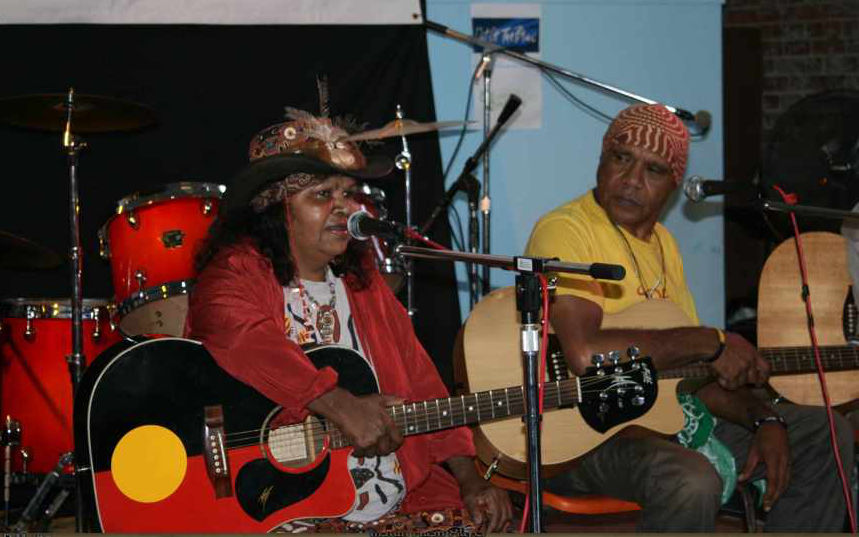
Rivers Flow: Reflections on the Songs of Archie Roach and Ruby Hunter curated by Kim Scott
January 28, 2026
A thoughtful collection of reflections reveals how the songs of Archie Roach and Ruby Hunter continue to carry truth, memory and responsibility across generations.
While it would be easy to baulk at the difficulties potentially involved in a Gubba reviewing a book by Indigenous writers, the risks seem worthwhile to ensure that this marvellous volume of 200 pages from Fremantle Press gets the recommendation it deserves.
In his introduction Kim Scott trusts that by choosing some examples from among the 26 writers to illustrate the aims of the volume, he causes no offence. I must make the same plea for understanding. The writers share the statement that they honour and respect the custodians of the lands from which the writings came, and I do the same as I sit on unceded Wiradjuri country. And while it is common practice to assume that a review is a piece of critical writing, I have no desire to judge these poets and authors and claim no qualification or right to do so.
In the unlikely event that any Australian has not heard of the songwriting and performing couple Archie Roach and Ruby Hunter, these reflections include playlists. _Took the Children Away_ from the Charcoal Lane album is among the most moving and powerful Australian songs of all time. Yarian M Tji, dirtsong and Ngarrandjeri Woman have proven inspirational for Indigenous people yearning to connect with country, and thus to themselves.
While it is difficult to make an objective selection from this collection, I personally found some writings particularly powerful. Among the ten poems, Dakota Freier’s Star-Filled Lakes which refers to ‘The Place Where I Grew’ has special appeal: ‘black ducks scatter on Wallaga Lake/ and more bodies than names fill a cemetery/ because on that day/ he came to sing/ his starry voice/ filled up that lake/ his name/ was Uncle Archie’.
Graham Akhurst’s Paradise references ‘From paradise’ and ends: ‘hope is in the truths/ and blood that binds us/ Archie sang truths/ and we sing along’.
Ali Cobby Eckermann in A Child Was Born Here after the song of that name, says: ‘even in the beauty of this land/ amid the rhythm of our ancient songs/ there is the fear of silence …. the songman reveals the story/ every place is a birthing room/ all coolamons are filled with kin/ do not excavate these lands/ the newborn cannot wail forever/ we can feel the fear of silence’.
Among the short stories, there is an emphasis on people dealing with homelessness, social alienation, addiction and targeting by police. Claire G Coleman’s Be Never Alone references ‘Down City Streets’ and tells the story of Maggie, an Indigenous woman sleeping rough. Maggie has her own problems and remains withdrawn until she sees a young girl being harassed. Finding that the girl has no family and perhaps seeing an earlier self: ‘This is my home’ Country says through Maggie. ‘Let’s find somewhere together. I will look after you’. And just for a moment, Maggie thinks she hears Country say in the voice of all her ancestors, ‘and we will look after you’.
Several reflections are moving and offer rare insights. The contributions of musicians Gina Williams and Lou Bennett seem highly relevant. Gina Williams valued Archie for many reasons, but perhaps most of all because he was a storyteller, a role of great importance in Indigenous lives. ‘Archie’s voice and his truth became ours, he was finally telling our story as we knew it, not as it was told by the establishment’. She says that we should be a nation of ‘truth listeners’.
Lou Bennett remembered making notes for herself, Emma Donovan and Shellie Morris singing backing for Ruby in the Black Arm Band. Then just a few months after Ruby died, Archie asked that they sing Ruby’s songs. First Nations peoples feel a responsibility to share and care for songs, especially those written from life experience. Songs are a ‘sacred gift, a blessing and a lifelong obligation’. When Archie asked them to sing Ruby’s songs, he was expressing trust and acknowledging they were mature enough to carry her songs.
There are several strong themes throughout these reflections. One is coping with the loss of a parent, which is a severe impediment to connection with ancestors. Another theme is political frustration. Afterglow by Jeanine Lean tells of ‘Love in the Morning’. The song became an anthem of hope in the days after Mabo and the Redfern speech but turned into a kind of lament after the election of the Howard Government in 1996, when ‘secrecy, denial and dissembling’ became the norm.
Terri Janke in The Eagle’s Voice referencing ‘Dancing With My Spirit’ explores the depression which hit many activists when the Voice referendum failed. Jess takes to the bush and then refreshed, returns to her tasks knowing that the eagle would always be there to guide her.
Another is the difficulty seeking one’s identity when land, culture and family have either been stolen or else devalued and discouraged. The advice here is to look within and find the strength which has been bestowed by your ancestors.
That the music of Archie Roach and Ruby Hunter has inspired such a volume is a tribute to them, but as several writers comment, others keep their memories and their spirits alive. The rivers where Archie and Ruby were born and their confluence provides an encouraging metaphor for the way that truth and compassion and healing can run through society.
The messages of the songwriters are hugely important and so are the writings prompted by their works.
_Rivers Flow: Reflections on the Songs of Archie Roach and Ruby Hunter curated by Kim Scott_ is published by Freemantle Press.