"Go ahead – make my book list": slings and arrows, and Eastwood
January 17, 2026
Shawn Levy’s Clint Eastwood biography captures the contradictions of a screen icon — and the craft behind a career still shaping popular cinema.
Clint Eastwood, 95, has embodied two great but contradictory maxims.
His essential on-screen technique has followed the teachings of Jack Kosslyn, his second acting coach from way back in the 1950s: “Don’t just do something; stand there!”
And the core of his half-century of movie-making dovetails with the oft-quoted advice of Hawthorn’s breakthough triple-premiership coach John Kennedy: “Don’t think; just do!”
Shawn Levy neatly details both faces of the icon in the latest of many Eastwood biographies: _Clint. The Man and his Movies_ (Mariner Books, released July 2025).
At almost 500 pages, it’s perhaps 50 (if not 100) too many, detailing faithfully the plots and the takings of each of Eastwood’s scores of movies as well as giving a sample of published reviews as well as the author’s own take.
But it is the way that Levy explores Eastwood’s choices – personal and especially professional – that is the great strength of the book, leaving the feeling that the great man has been under-rated, for varying reasons, across all seven decades (so far) of his acting and directing careers.
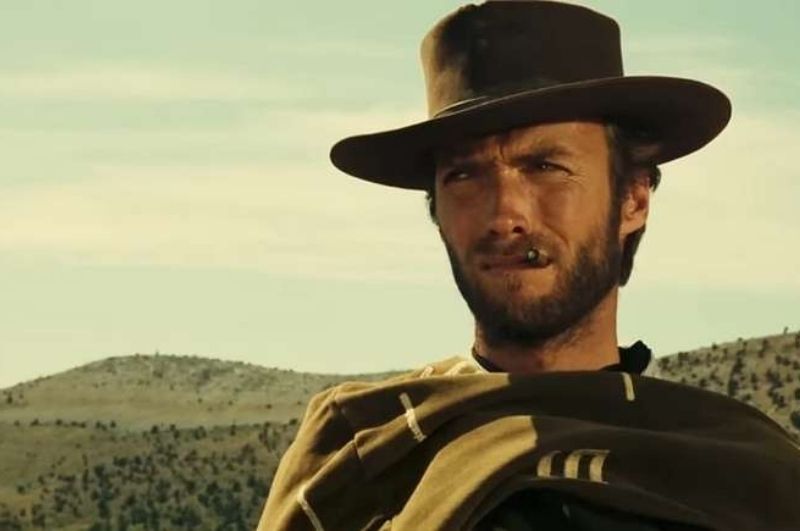
Early on, there is a comparison with John Wayne, to many the cinematic apogee of the American male. Eastwood knocked the one-dimensional Wayne off top spot in the Quigley poll of moneymaking stars way back in 1972, with “The Duke” never returning. Eastwood did this after the release of Dirty Harry, which was of course his third screen persona after Rowdy Yates in Rawhide and “The Man with No Name” in the Sergio Leone trilogy of “spaghetti Westerns”.
There was little love lost between the pair, it seems, Wayne writing to Eastwood, turning down an offered role but also taking the opportunity to swipe at him for his depiction of the townsfolk in High Plains Drifter (1973).
Wayne wrote: “That isn’t what the West was about. That isn’t the American people that settled this country”. Eastwood recalls, “I said, ‘You’re absolutely right’. It’s just an allegory, and it wasn’t intended to be the West that’s been told hundreds of times over.”
Later, Levy records Eastwood taking on the film Tightrope (1984): “It was altogether dark and seamy, deliciously so, and it represented a departure in mood and image from even his most violent Dirty Harry films or Westerns. As Clint said proudly, “John Wayne would never have done Tightrope.”
Eastwood’s pictures attracted considerable criticism over the years for their depiction, and alleged endorsement, of violence – something the walk-in fighter never shied from.
Levy writes “Clint would always claim [Dirty Harry] was more about vengeance than bloodlust, but the two emotional states aren’t mutually exclusive”.
Levy concludes, “If it’s propaganda, it’s entertaining propaganda; if it’s sadism, it’s candy-coated sadism; if it’s fascism; it’s the kind of fascism that finds otherwise broad-minded people nodding along, unconsciously, until (unless), abashed, they catch themselves.”
While Levy goes into some detail of Eastwood’s complex personal life and his seemingly endless cast of partners, it is his coverage of the director’s treatment of sexual relationships on screen that is far more absorbing.
“One of the signature aspects of Clint’s touch in [High Plains Drifter] is the stranger’s rape of the town’s apparently only unattached woman,” Levy writes. “It’s awful and needless and tells us nothing about the characters and too much, perhaps, about the filmmaker.”
Consider also a scene from The Rookie (1990) in which Eastwood’s veteran cop character is raped by “a dragon lady” while he is tied to a chair. Levy records, “It’s curious that a man who has directed and appeared in so many films that address the subject of rape depicts himself as a victim of one while being sued by his romantic partner of over a decade [Sondra Locke].”
So, is he a misogynist or just a product of his times (born 1930, remember)?
How about neither and something from entirely the other end of the scale?
After Sudden Impact (1983), the fourth of five Dirty Harry pictures, film professor Tom Stempel argued that Eastwood “may be not only one of the best, but the most important and influential (because of the size of his audience) feminist filmmaker working in America today”. The professor made a thorough survey of the women in the films: hippies, murderesses, rape victims, cops, young girls, old women, even two Native Americans, Levy noting, “all depicted and cast with detail and care and performed, in many cases, with more power and authority than the male roles in the same films”.
The professor concluded Eastwood suffered a lack of intelligent criticism because he worked in “popular genres with a non-flamboyant directorial style”.
Remember this is all a decade before The Bridges of Madison County (1995), where he played the dignified and caring romantic lead (opposite Meryl Streep), having been sought by Steven Spielberg for the part, the director saying, “It was not based on the other characters Clint has played. It’s because I know Clint personally – the part of Clint that friends of his know well but have never seen acted.”
The man himself of course put it succinctly: “I’ve been that guy.”
The above are only a handful of the 83 pictures that Eastwood has either acted in or directed (often both), and they don’t touch on his great pictures from this century. Think Mystic River, Million Dollar Baby and Gran Torino, just for starters.
He has taken on movies that others wouldn’t touch. Sure, having his own company helped, but he’s put his reputation on the line again and again with various passion projects in between the hits, and he’s done it in his seventies, eighties and nineties.
He films fast, often getting the cameras to roll for a “rehearsal” that turns out to be enough. The players don’t tense up that way, you see. Same goes for shouted calls of “Action!” - replaced on Eastwood sets in the late 1990s when he realised, “You can just start in and say, ‘Okay, just commence, go ahead’ … That way nobody is getting an adrenaline rush or anything.”
Eastwood’s under-budget, few-takes strategy was found unamusing by Dame Judy Dench in J. Edgar (2011), and confronting by any number of others over the years.
Streep, in Bridges, was amazed, but ultimately loved it.
“His set is the quietest I’ve ever worked on …” she said. “Maybe it’s an actor’s ultimate revenge once he becomes the boss that everything is subservient to that little fragile thing in the centre, the spontaneous moment, the thing, as Clint says, that ‘only has to happen once’.”
This meant, Streep said, that it made “the story seem like it was really happening”.
Could there be higher praise?