There must be an accounting when the music stops
January 13, 2026
After Bondi, public anxiety, political pressure and rising criticism of Israel have collided. As definitions of antisemitism are contested, government judgement, media influence and social cohesion are under strain.
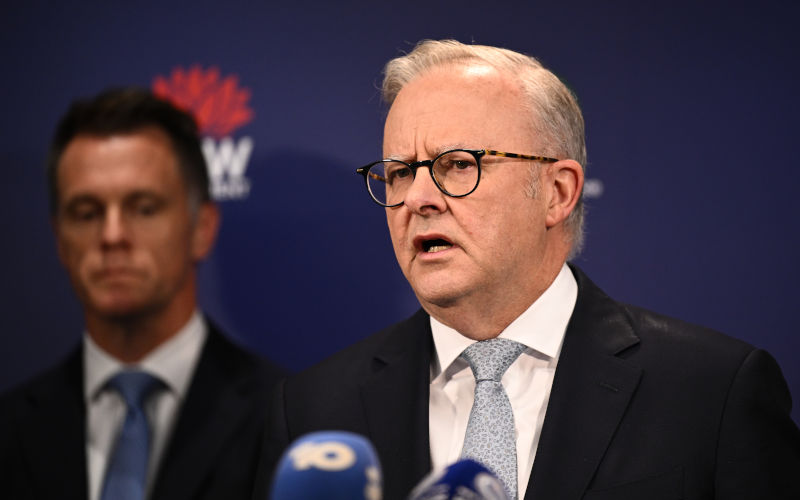
Anthony Albanese is an old-style politician who nurtures his grudges with more attention than he gives to his constituencies. It takes him a long time to forget grievances and political drubbings, and he is rarely one to dispense favours by accident. Especially when he has a record majority, and an opposition still in such complete disarray that he can ignore Labor principles about who its friends are, public principles about sound and accountable government, and as can be witnessed from recent expenses issued, even the good old pub test.
The clash after the massacre became very personal, and words that were said will be remembered by players, particularly active politicians, long after the temperature has fallen. The general population, as much as its Jewish and Muslim Australian components, is very interested in what occurred at Bondi in December and how it came about, and what we must do to avoid recurrences. For some, of course, arguments about antisemitism or Islamophobia are fundamental and never to be forgotten. But it will probably not be causing many Australian votes to switch between the major parties at the May 2027 elections.
I am not suggesting that Albanese would be (argh) antisemitic in his doling out of public money. But he probably figures, correctly, that he owes no one in the Jewish lobbies anything, and that he will get better political value for his dollar by dispensing it elsewhere. In the terms that would be used by a Graham Richardson it would not be so much as what have you done for us ever, but what have you done for us, lately? (I would never, of course, hold up Richo to Albo as any sort of honest broker were it not for the sickening Albanese eulogy for the old crook at his funeral.)
But Albanese will not forget. He may have been bested by those lobbying for a commission. But it did not put him in their pocket. He, and Labor, had invested a lot of money and energy in having manageable amity between ethnic groups. In recent times, things may never have been as matey as they were when Bob Hawke and Julia Gillard were prime ministers, but a good deal of an amicable – if still somewhat at arm’s length – relationship with Jewish Australian and Muslim Australian community groups – had stemmed from events in the Middle East rather than any domestic problems, including terrorism. That was at least until the Hamas massacre of Israeli civilians on October 7, 2023, and Israel’s response with war upon Gaza.
The big increase in the noise came from rising criticism of Israel, not antisemitism.
This immediately led to an increase in the amount of commentary, its importance on the political agenda, the strength and volume of criticism of Israelis and Palestinians by Australian supporters, and the willingness of ethnically uninvolved Australians to have strong views too. The sheer increase in discussion of events must be distinguished from the extent to which comments were antisemitic. This is something we can expect the royal commissioner, Virginia Bell, to focus on. She will take some convincing that an increase in the noise meant a sudden increase in anti-Jewish feeling that can be characterised as antisemitic. Though Bell is not in the least antisemitic, the fact that she has had to judge balances between freedom of speech and necessary restrictions upon it has inspired some of the criticism of her appointment.
But however Albanese spins it in arrears, public confidence in his judgment and his governance has taken a major hit over the past month, particularly among his colleagues, who have hitherto given him considerable leeway. It ended in his ultimate (and entirely predictable) humiliating reversal of a position firmly and defiantly against a royal commission into antisemitism and how the Bondi massacre came to be. He looked particularly vulnerable – more so than at any time since the Aboriginal Voice referendum – and his expression often looked furtive and guilty, as well as tired and exhausted.
He was wrong to think that public anxiety and legitimate concern could be stared down if he held to his original decision, because the claim for an open inquiry was right and irresistible. That was even before there was a clamour of blaming, much of it unfairly cast personally at himself, and disappointment that the only introspection after a significant failure in intelligence was an internal inquiry which could be buried. The pressure for an inquiry did not let up. A good deal of it may have been orchestrated, and many of those in the lynch party, including some past and present Liberals, and the News Ltd organisation may have had obvious extra agendas, including spinning the issue into a campaign against immigration and fear of aliens, particularly Muslims.
Those whose anger and fear intensified after the massacre, and after Albanese’s rejection of an open inquiry, some of the lobbies with whom he had had close working relationships went overboard in criticising him, and his government. There was never a chance that the issue could bring down the government, but some of those managing the campaign, and some of the opposition opportunists began acting as though it could, and was about to happen. A number of players acted behind the scenes to keep matters civilised and to negotiate terms of surrender, but Albanese was given a very firm reminder that he had few friends, even Labor friends, on the issue, and very little credit in the bank with the most active Jewish Australian lobbies. They had gone for broke, and probably themselves much in the way of future capacity to ask for favours from this government.
Albanese won’t forget that some of the lobbies went straight for his throat. It went well past ordinary political to-and-fro.
Many Jewish Australians said that there was a rise in open antisemitism and that they no longer felt safe. They believed the issue was boiling up. The received wisdom is that government was not paying enough attention to their warnings, and that it was, in fact, adding to the sense of siege because it had turned some of its attention to the rights and wrongs of the war against Palestinians in Gaza, allegations that Israel was embarked on a program of genocide, including deliberate starvation of people under continual bombardment. It involved extensive criticism of Israel’s settlement policy, effective apartheid and breaches of human rights, the rights of Palestinians to a state, and the ferocious and intemperate attacks on Palestinians from Israeli ministers from the Prime Minister, Benjamin Netanyahu down.
No one has shown that any of the comments and responses from the Albanese government were antisemitic, and they would have had they been able to point to unequivocal examples. In any event, what Australian government ministers were saying and doing was in line with what an array of first world countries, including Canada, Britain, France and others were doing. Australia’s actions were bitterly criticised by Netanyahu, then and immediately after the Bondi massacre as “weak” and spineless appeasement of Hamas. Many Jewish Australians were themselves very critical of Netanyahu and of his government’s actions before and after October 7, 2023, and well understood the difference between antisemitic attacks on a person or a race because they were Jewish, and strong criticisms of the actions of the Israeli government. Australian (and world) public opinion was changing on Israel. Many Muslim Australians, (who collectively amount to about eight times the Jewish Australian population) were appalled at the slaughter in Gaza, and saw it not in the context of the October 7 massacre but as another chapter in a century old Palestinian dispossession by Israeli settlers.
Perhaps the role of News Ltd in winding up the attacks on Albanese could get passing attention.
Eager News Ltd journalists and advocates were seeking out and publicising antisemitic statements by protesters, including significant numbers of Muslim Australians. Other Muslim extremist activity, by ISIS, al Qaeda and other groups, was often lumped in with demonstrators to suggest that the government was playing with fire in any dealings with Muslim protest about Gaza. The NSW Premier, Chris Minns, often seemed to give the impression, even before the Bondi massacre, that he regarded protests against Israel as being inherently antisemitic, a reason, by itself, for banning demonstrations and treating pro-Palestinian protest as a marked danger and breach of the peace. Meanwhile the Albanese government was under pressure from a widespread perception in the general Australian community as much as among Muslim Australians that leading federal figures, including Albanese and Penny Wong were not neutral. Some of the leaders of the lobbies failed to recognise that pressure, or didn’t care because they wanted everything.
Though Virginia Bell is regarded by some of her admirers as one of a pantheon of lefty feminist heroes, her actual judicial record, on the High Court and NSW Court of Appeal shows her to have been essentially conservative, one never inclined to be markedly out of step with her colleagues, male or female. I have previously pointed out that she was the judge who signed a batch of NSW Police warrants that led to virtually a decade of police political warfare in that state. One big faction (which I called the Capulets) tapped the phones of the Montague faction, in the process ruining the careers of a number of good cops without ever demonstrating anything wrong in their conduct. The chief casualty was Nick Kaldas, later himself to be a Commonwealth Royal Commissioner and international police adviser. By the end of a very good decade for leaks even the NSW Government got tired of the spectacle as political distraction and decided to reach down a generation for the next commissioner. Bell cannot be blamed for the mayhem, but it may have taught her a lesson about signing warrants by the wagonload.
Dennis Richardson will be focused on the screening and judgments by police and intelligence services of those accused of being shooters. He has been warned about not prejudicing a fair trial, but, with a good deal of the report necessarily confidential, can draw general conclusions as well. It now appears certain that his focus will be on the cooperation and information exchanges between ASIO, the AFP and NSW State Police. Personal and professional relationships are in some cases said to be poisonous. One of the personalities involved is likely to be Krissy Barrett, who pulled the plug on NSW Police (and NSW Premier) hysteria over a caravan said to be laden with explosives last year. But in truth, relationships have never been good, each side has leaked against the other and each has fundamental doubts about the leadership, training and professionalism of the other. An active observer once told me that most of the bad things said about members of each side were generally true.
The government has helpfully told Richardson and the commissioner that its working definition of what amounts to antisemitic behaviour is a “working statement” by the International Holocaust Remembrance Alliance. Thirty-five countries, including Australia have signed up to the definition, though the statement insists that antisemitic conduct depends on context. The close definition is reasonable enough in its focus on hatred of Jews. Where it allows itself very wide extension however comes from a comment within this definition that Manifestations might include the targeting of the state of Israel, conceived as a Jewish collectivity. However, criticism of Israel similar to that levelled against any other country cannot be regarded as antisemitic. The definition also asserts that attacking Zionism is antisemitic because it denies the Jewish people their right to self-determination. That is nonsense.
The definitions are the more problematic because they have been adopted so uncritically by politicians, police and the security establishment, and mostly to appease one side. Their critics allege, with some justice, that organs of the Australian state have a long history of regarding Israelis as “people like us” and of regarding or treating Muslim Australians as aliens and potential terrorists. In recent times, the Liberal Party seems to have adopted as a working hypothesis that Palestinian refugees should automatically be excluded from Australia on security grounds. Eighty years ago, many of their ancestors thought the same, on unambiguous antisemitic grounds, of Jewish migrants or refugees, and (naturally) other Middle Easterners were excluded under the White Australia policy.
Many of the Jewish Australians most vociferous about an epidemic of antisemitism consider that any criticism of Israel is antisemitic, presumably because Israel is to be regarded as a Jewish collectivity, or because the state of Israel is said to be being held to a standard higher than Australians would expect, say, of Papua New Guinea or Turkey. It is impossible to doubt that genuine hatred of Jews and bodies of Jews exists within the current climate of criticism of Israel because of acts described by international bodies as probable war crimes or acts of genocide. Beyond hostility attributed to Palestinians or Muslim Australians are, for example, explicit antisemitic statements (and Holocaust denial) by avowed neo-Nazi groups, ever keen to latch on to any breakup in social cohesion. That said, most of the statements said to be antisemitic are plainly not. The commissioner has a duty to closely examine assertions and opinions masquerading as statements of fact.
That is so whether the assertion comes from a prime minister, a premier, a police commissioner or a head of ASIO. It is very important to remember that the inquiry is being conducted for all Australians, not those with an interest in the state of Israel or the future state of Palestine. It is not there simply to appease angry Jewish Australians, or to provide a platform for making the lives of Muslim Australians more difficult. It is there to put some reliable dimensions on the size of the antisemitism (and Islamophobic) problem in Australia and what can and should be done about it. Islamophobia is another side of the antisemitic coin, and racist or (actually) antisemitic statements about them are a part of the inquiry.
It is not there to inquest Israel’s war on its Palestinian population, or the Hamas war against Israelis. But the context of these wars can hardly be ignored or simply passed over. And it provides a lens against which allegedly antisemitic statements can be seen and tested. Albanese should be defending his record with rather more vigour and aggression. Getting the record straight is a form of seeking social cohesion, as well as reconciliation and accountability. Those up for scrutiny should include those who have been winding everyone up.
This piece was originally published by _The Canberra Times_.