Trump fills the great Albo silence
January 27, 2026
Australia’s leaders are trying to avoid becoming a target in a harsher, more coercive world. But silence and caution can’t substitute for strategy – or for honest leadership that levels with the public.
Higher Australian foreign policy has probably never been so simple. Our government, and probably an alternative coalition government (if anyone could imagine such a thing), would like very much to escape international attention for as long as possible.
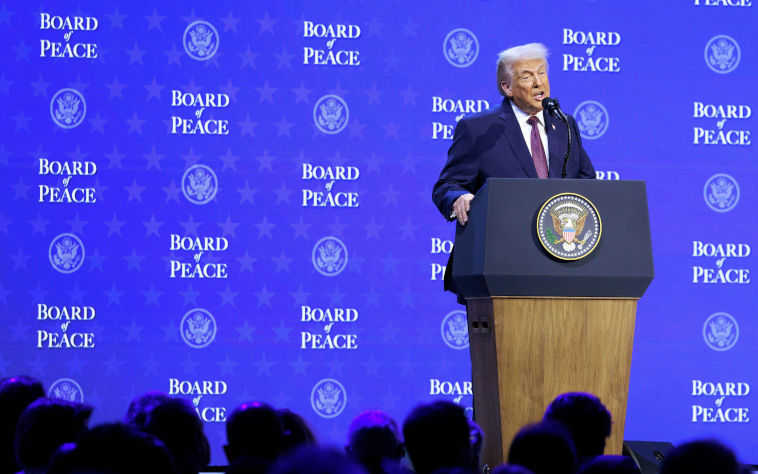
We want to see out the Trump regime, (and possibly even a third Trump regime, if, Deo volente, he is spared for this) without our having excited much focused attention from him and his cronies, let alone demands for any of our states (Queensland, perhaps), or islands, precious metals or rare earth minerals.
Our politicians, our diplomats and our spooks, and even our financial industry are very well aware that the end of Trumpism will not lead to a resumption of life as before, or lawful and constitutional government from the United States, or, in the moribund phrase still repeated by our Defence minister Richard Marles, rule-based trade between nations. Too much has happened. The craven US Supreme Court has sold the old republic and its style of government down the river, and even if, Deo volente, the building and its inhabitants were to be vapourised by a lightning strike it is difficult to imagine any restoration of the Bill of Rights as interpreted 50 years ago, checks and balances on presidential power, or any reduction in the power of big government. Or much in the way of restoration of congressional control, such as it was, over a president’s capacity to make war or pardon his crooked mates.
The Bill of Rights, even the unfortunate right to bear arms, came from a different time, and a different democratic and republican sentiment. Indeed, it came from a time when many of the settlers who had revolted against the rule of King George, or the UK, were focused on British abuse of executive power. That led to the conscious design of a system of separation of powers and constitutional checks and balances, whereby any overreach of power, whether by the president, the congress or even the courts could be restrained by powers vested in the other two arms of government. The current supreme court, under various daft (a)historical theories, has been trying to restore to the president the sort of unrestrained executive power once able to be exercised by the mad King George III.
Even now, a year into the reign of King Donald Trump, Americans, and international statesmen have no real idea of what the limits of presidential authority are. This is because the court has been very slow in handing down judgments explaining how it has arrived at results that have appeared to have turned established rules and interpretations on their head. They have handed down the result (usually 6-3 on unashamed partisan lines) without explaining how or why it decided what it did. What is usually clear, however, is that most of the judges cannot see reasons for restraining the president from making war on the states in pursuit of his immigration agenda, or on adjoining states in pursuit of an undeclared war against drugs, entering foreign states to arrest heads of state accused by an overtly politicised prosecution process of crimes against US law.
Trump can, it seems, impose tariffs on other nations at will, and raise or lower them on arbitrary grounds. There has been some suggestion that the Supremes might restrict this power in some way, but, if it intends to, it has been mighty slow about it. It has become clear that Trump sees the imposition of tariffs as an extension of foreign policy, imposing them to put pressure on other nations, and raising or lowering them to make it clear that the size of tariffs depends not on any rule of law, or recognised principle, but on personal whim. We now have ample instances in which Trump has made it clear that he sees his personal life and human personality as being entirely integrated into the idea of executive power, so that, for example, he can put pressure on Norway simply because he is disappointed that he has not been awarded the Nobel Peace Prize.
He has denied that he is restrained by international law. When international tribunals, such as the International Criminal Court have issued valid warrants for the arrest of non-American nationals (such as Benjamin Netanyahu of Israel for war crimes) Trump has responded by trying to impose criminal sanctions on officials of the court. Trump has made it clear that all, or most of the agencies of executive government, are directly subject to his control and orders. Thus he has directed the Department of Justice and the FBI to investigate and prosecute alleged crimes by direct political opponents, and has interfered in, or issued pardons to political allies accused of breaches of American law.
In some cases, the pardons have been received after substantial donations to his cause, raising serious questions about whether his Administration is selling favours to its friends. Trump, in effect, claims that conflict of interest laws do not apply to him, and openly is involved in business, including in cryptocurrency, Trump memorabilia and Bibles. Some of his more egregious activities are deliberate provocations to annoy and outrage culture warriors of the other side of politics. But a pliant Supreme Court has effectively determined that he cannot be prosecuted under the criminal law for acts done while he is president. And he exercises unprecedented powers over his party, with the apparent capacity to turn party funds and organisations to veto primary candidates who have behaved independently.
His antics over Greenland, and over the imposition of arbitrary tariffs on European nations opposed to its annexation by the US have incited an unusual revolt by leaders of other governments, including threats about the break-up of NATO (America’s security alliance with western Europe) and other trade deals only relatively recently made with Trump. Flabbergasted nations insisted that “a deal’s a deal” – the more vehemently because such deals have always included trade-offs between various claims made by the parties, while Trump, in arrears, has been given to cherry picking only those parts of deals which have worked in America’s favour.
Trump retreated on a host of threats issued against Denmark and other European nations supporting its refusal to sell or hand over Greenland, including fresh arbitrary tariffs for their impudence.
But he did not find nations ducking for cover or hiding in the corner in the hope they would not be noticed, in the Albanese and Wong style. Instead, he found unity and resistance from nations that he has been bullying, individually and collectively, for years, and mostly getting his way. He found nations who had caucused together beforehand, prime ministers who had personal experience of Trump’s capacity to separate one from the herd and to apply heavy pressure, including arbitrary tariffs. If recent history was any guide, Denmark, the Scandinavian countries, and nations such as Britain, France and Germany were set to fold. But they didn’t. And Trump instead settled for a deal, the details of which are yet to be settled, by which he will get some concessions over existing UN bases in Greenland, and perhaps a right of first refusal on any Greenland mining deals. Explicitly, the final shape of any arrangement – if it gets to that – must be agreed with the indigenous population of Greenland – the people for whom Denmark has been a trustee.
Leading the revolt was Mark Carney of Canada – whose own country’s sovereignty is also on Trump’s shopping list. His was a rallying cry worth reading. It was a speech of a power we have never heard from our own Prime Minister, despite some worthy phrases during the antisemitism debate. It is particularly worth considering in the context of Australia Day. Carney was prepared to do something that Albanese, Penny Wong and Richard Marles have not been prepared to do. And not only to directly criticise the United States, but also to consider and discuss the changing nature of the Canada-US relationship. And in something less than the empty and vacuous cliches our representatives are always using.
Carney told Davos participants where Trumpism was taking the world. There was a rupture in the world order, the end of a pleasant fiction about a rules-based international order and the beginning of a harsh reality. That reality was that the big powers submitted to no limits and no constraints.
That did not mean that other countries, including medium powers such as Canada, were powerless. They still had the capacity to build a new order that encompassed their values, such as respect for human rights, sustainable development, solidarity, sovereignty and the territorial integrity of the various states.
“It seems that every day we’re reminded that we live in an era of great-power rivalry, that the rules-based order is fading, that the strong can do what they can, and the weak must suffer what they must, he said. “Faced with this logic, there is a strong tendency for countries to go along to get along, to accommodate, to avoid trouble, to hope that compliance will buy safety.”
[Carney might have been thinking of the conflict-averse Australia, whose voice has been mostly silent over Greenland.]
In recent years, Carney said, great powers had been using economic integration as weapons, tariffs as leverage, financial infrastructure as coercion, supply chains as vulnerabilities to be exploited.
“You cannot live within the lie of mutual benefit through integration, when integration becomes the source of your subordination.
“The multilateral institutions on which the middle powers have relied – the WTO, the UN, the Cop, the architecture, the very architecture of collective problem-solving – are under threat.
“And as a result, many countries are drawing the same conclusions that they must develop greater strategic autonomy, in energy, food, critical minerals, in finance and supply chains. And this impulse is understandable. A country that can’t feed itself, fuel itself or defend itself, has few options. When the rules no longer protect you, you must protect yourself.
“But let’s be clear-eyed about where this leads.
“A world of fortresses will be poorer, more fragile and less sustainable. And there is another truth. If great powers abandon even the pretence of rules and values for the unhindered pursuit of their power and interests, the gains from transactionalism will become harder to replicate.
Middle powers had to act together, “because if we are not at the table we are on the menu.”
“Great powers can afford, for now, to go it alone. They have the market size, the military capacity and the leverage to dictate terms. Middle powers do not.
“But when we only negotiate bilaterally with a hegemon, we negotiate from weakness. We accept what’s offered. We compete with each other to be the most accommodating. This is not sovereignty. It’s the performance of sovereignty while accepting subordination.
“In a world of great power rivalry, the countries in between have a choice – compete with each other for favour or combine to create a third path with impact.
“We shouldn’t allow the rise of hard power to blind us to the fact that the power of legitimacy, integrity and rules will remain strong, if we choose to wield them together…
“Canada is a pluralistic society that works. Our public square is loud, diverse and free. Canadians remain committed to sustainability. We are a stable and reliable partner in a world that is anything but. A partner that builds and values relationships for the long term.
“And we have something else. We have a recognition of what’s happening and a determination to act accordingly. We understand that this rupture calls for more than adaptation. It calls for honesty about the world as it is.
“We know the old order is not coming back. We shouldn’t mourn it. Nostalgia is not a strategy, but we believe that from the fracture, we can build something bigger, better, stronger, more just.
“This is the task of the middle powers, the countries that have the most to lose from a world of fortresses and most to gain from genuine cooperation.”
He is seeking to extend trading links with China. Although the US will always be Canada’s biggest trading partner, he is pushing efforts not only to become less dependent, but to use boycotts and Canadian pride as a counter to American pressure to integrate. He has used and promoted Canada’s sense of itself as a major feature of its resistance to Trump’s idea that Canada should simply become the 51st state of the United States. He is not merely repeating focus-tested slogans as he announced short-of-detail plans to hand over billions to lobbyists. Carney was levelling with the intended beneficiaries about the costs and the advantages of what is on offer.
Carney, and other countries, are thinking of Plan B. And C. They are looking to a world in which the erratic, irresponsible and self-interested actions of a narcissistic old man can be called out, rather than humoured or ignored. In having this discussion with his own voters, and with politicians from around the world, he is doing something from which Australia’s leaders have shrunk. We do not even have an idea of what Albanese thinks about Greenland.
Though the great Albanese silence may have minimised risk, it has also hurt Australia. Australians, like other consumers of mass media and social media see daily reports of Trump, good and bad. We see his role in prolonging the war on Gaza, and in Ukraine. They see his masked ICE agents rounding up illegal immigrants, and his indifference to – virtual incitement of – violence against demonstrators. They see him invading other nations, and his contempt for human rights and the rule of law. They see the cabal around him, including his potential successor JD Vance, themselves unaccountable as they pander to the mob.
What we do not get, for fright about annoying Trump, is any sort of informed commentary from our national leaders about how Australia is affected by the rupture. We do not get decent information about AUKUS and our defence links. Or about trading arrangements. We have a prime minister chronically secretive about matters that ought to be on the public record. One who is tongue-tied about explaining the situation in which Australia finds itself, and what the government is doing about it.
Australians lack the sense that the prime minister is trying to make partners of its citizens in finding a place for us in a new and rather frightening world. Rather than being joined by nationality, some common history and a common will, the rupture is causing Australians to feel more alone, lonely, and out of touch with the broader community. As this is happening our leaders are criminalising more conduct, repressing more free expression and repeating tired, increasingly meaningless, cliches about social cohesion, resilience, unity and civic pride.
The conversation, the information exchange, the sense of partnership are not privileges but a precondition for national survival.
This piece was originally published in the _Canberra Times_.