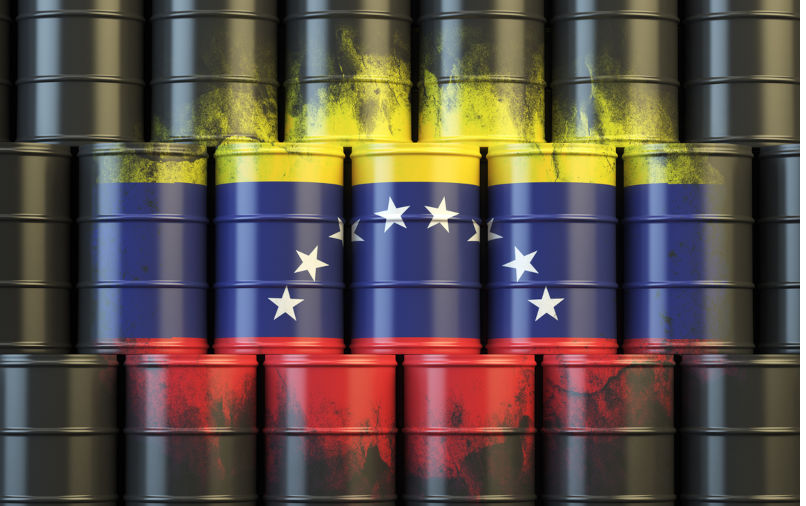
Trump is delusional about Venezuelan oil
January 14, 2026
Trump is banking on Venezuela’s vast oil reserves to justify US intervention. But the state of the industry, global energy shifts and basic economics point to failure.
Trump’s delusions about the value of Venezuelan oil reserves are likely to destroy any chance of the US intervention in Venezuela proving successful.
The arrangements for the future governance of Venezuela over the next few years are still very uncertain. But one thing is certain, Trump is determined to take over Venezuela’s oil industry.
In a Truth Social post on 7 January, Trump announced that “the Interim Authorities in Venezuela will be turning over between 30 and 50 MILLION Barrels of High Quality, Sanctioned Oil, to the United States of America. This Oil will be sold at its Market Price, and that money will be controlled by me, as President of the United States of America, to ensure it is used to benefit the people of Venezuela and the United States!”
There is no doubt that Venezuela needs much more oil revenue if a stable democratic government is to be restored. And Venezuela has the largest oil reserves in the world. But since the Venezuelan Government took over its oil industry in 1999, production has fallen from 3.5 million barrels of oil a day to an average of about 1.1m barrels a day, due to corruption, US sanctions and state mismanagement.
As a result, in the last decade Venezuela has lost three quarters of its GDP, and the collapse in living standards must have played a major role in encouraging almost one quarter of the population to emigrate.
Nevertheless, although there is no doubt that Venezuela has plenty of oil in the ground, the critical questions are how much will it cost to restore the delivery capacity, what are the necessary administrative arrangements to support the restoration of that delivery capacity, how long will it take, and what will be the demand for that oil? So far Trump seems to be oblivious to these issues.
The starting point is that the pipelines in Venezuela are half a century old and badly damaged by acid corrosion. The Maduro regime stole anything easy to steal and treated the national oil Company PDVSA as a cash cow for 20 years, with no money to spare for maintenance.
As Trump himself has recognised, the US oil companies will need to invest billions of dollars in Venezuela’s energy infrastructure before oil production can be restored. Trump has promised to reimburse the oil companies, but how, and if that involves a major cost to the taxpayers, what is the point?
While the oil companies may well be responsible for restoring the oil drilling and delivery capacity, they will need some administrative support from government. However, at the time of writing, a week after the fall of Maduro, the Trump administration had still not spoken to the oil companies, about what arrangements might be considered and their willingness to re-enter the Venezuelan oil market.
A critical issue will be the respective responsibilities of the US and Venezuelan Governments. Will the US administration put ‘boots on the ground’? If not, it is hard to see how much the US could contribute – instead it will need to rely heavily on the Venezuelan Government for administrative support.
However, that in turn raises the question of the administrative capacity of the Venezuelan Government. After a week of considerable confusion, with Trump and Rubio contradicting each other about future governance arrangements for Venezuela, it now seems that the US has endorsed the government under the newly sworn in interim Venezuelan President, the former Vice President, Delcy Rodriguez.
Trump is in no hurry to restore democracy and basically believes he can impose his will on Rodriguez. She is seen as sufficiently pliable as the stand-in leader, and as Trump said, “if she doesn’t do what’s right, she’s going to pay a very big price, probably bigger than Maduro”.
But all the key members of the Maduro regime are still holding the same jobs, including the Interior Minister, Cabello, who has had control of the oil industry and who was very close to Maduro. In addition, the traffickers, corrupt officials and armed groups that worked under Maduro are presumably all still there doing the same jobs.
That makes it questionable how much has changed on the ground administratively, and can the US rely on this new Venezuelan Government to cooperate and deliver?
Finally, there is one other administrative question, and that is how the proceeds from the sale of Venezuelan oil will be distributed. At present sanctions on Venezuela’s oil company, PDVSA, mean that it is excluded from the global financial system, and it is blocked from accessing US dollars.
On the other hand, the reality is that it is most unlikely that any profit will result from selling Venezuelan oil (see more below). So perhaps that question of how profits will be distributed could be put aside, although Trump may be most unwilling to concede that point yet.
According to Trump the Venezuelan oil sector could be “up and running” in less than 18 months. But such comments tell us more about Trump’s delusions than what is likely based on the evidence.
Instead, expert opinion, reported in the Britain’s Telegraph, is that it would take a decade to restore output to the previous three million barrels a day.
The switch to renewable energy means that the price of crude oil is already falling. Furthermore, Venezuela’s oil is bituminous and heavy. it is therefore much more costly to refine.
For example, Chevron, the only American oil company that has continued to operate in Venezuela, has been reported as having production costs which are more than half as much again as its global average. Indeed, a month ago, Chevron announced that by far its biggest future investment will be in nearby Guyana where its production costs for the lighter oil there will be less than half the cost of Venezuelan crude.
Any American oil company will struggle to cover costs in Venezuela at current global oil prices near $US 60 a barrel. Furthermore, even by 2030, the demand for oil and its price will have fallen by enough to throw doubt about whether it is worth investing in Venezuelan oil, and in a decade’s time, any such investment will not be viable.
In China, for example, the demand for fossil-fuelled cars peaked eight years ago. EVs and plug-in hybrids accounted for 53 per cent of the new car market in China in November, and China is a bigger car market than the US and the EU combined. While in Europe the sales of pure petrol driven cars fell to only 36 per cent in the eleven months to November.
Consequently, if Venezuelan oil production were finally restored, this oil would be worth much less. Indeed, so much less that it is questionable whether any serious oil company will be interested in returning to Venezuela, unless they are bribed by Trump contracting to pay most of their costs. But how much would that contract be worth really?
The reality is that Trump is totally delusional about his plans for Venezuela, and especially his reliance on its defunct oil industry. At present, the future oil revenues and their distribution is central to whether any future Venezuelan government can govern at all, but Trump needs to confront the reality that there may well be little or no such oil revenues.
Once again Trump is demonstrating why his delusions and refusal to face the facts make him such an unreliable ally.

