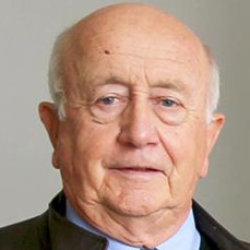
Vale Geoff Miller
January 21, 2026
Geoff’s career as an Australian diplomat and senior public servant spanned over 40 years and later as a writer and commentator for a further 25 years. He was to become one of our most knowledgeable and articulate analysts of Australia’s relations with Asia.
Geoff was born in Queenstown, Tasmania in 1934. He gained a degree from the University of Tasmania and became Tasmania’s Rhodes Scholar taking him to Oxford University.
Last week, Walter Geoffrey Thomas Miller AO sadly passed away in Canberra.
Geoff joined the Department of External Affairs at a time when our relations with Asia were being greatly expanded. In 1960 he was posted to Kuala Lumpur and in the same year married Rachel Webb, daughter of ANU Professor Leicester Webb. A posting to Jakarta followed at a time of the Suharto coup. Then came a posting to the UN mission in New York before a stint back in Canberra and later moving to New Delhi.
In 1998 he was appointed ambassador to South Korea. On his return he had several senior appointments in Canberra before being appointed Ambassador to Japan.
At the completion of his post in Tokyo he became Director-General of the Office of National Assessments (ONA) – Australia’s central intelligence analysis agency, a position he held until 1995. His tenure there spanned major global events including the first Gulf War, the dissolution of the Soviet Union, and the beginning of the Yugoslav Wars.
In 1993 He was awarded an Officer of the Order of Australia (AO) for ‘public service and service to international relations’. Between 1996 and 2000 he served as High Commissioner to New Zealand, at the conclusion of which he retired to Sydney.
On retirement, Geoff became an active participant in the emerging public policy discussions on international affairs in Sydney – and elsewhere around the country. Freed of any government rein (of either hue) he was determined to write and discuss his lifelong personal commitment to working for the most sustainable place for Australia on the world stage in the future. All the more as the concerns about new policy directions spilled ominously out of Washington under President Biden and – dramatically much more – under the two Trump presidencies.
In an early step along this path, Geoff became President of the NSW Branch of the Australian Institute of International Affairs. He reinvigorated the Branch’s speaker program and involved it in a wider range of new activities. He was appointed a Fellow of AIIA Australia in 2014. He also became a regular attendee of the Lowy Institute’s speaker program and similar meetings around Sydney.
It was through Pearls and Irritations that Geoff made his most significant contribution to public discussion. Starting with an article in 2018 titled US/North Korea Negotiations – _Death to Forecasters_ he went on to provide 70 more right up to latter part of 2025 when we had chatted about another one he had on the drawing board with which he was struggling given his fragile health.
The main theme running through Geoff’s writings was the very serious challenge posed for Australia by the increasing tension between China and the US – under both the Trump administration and that of Biden too. He referred often to the advice a senior American friend had once given him that the US cannot abide any “peer competitors”. The notorious “exceptionalism” writ large!
Early on, no doubt reflecting his extensive experience as Director of ONA, he stressed the urgency of the need to resist the increasingly blatant efforts by the US to control our defence and security posture. In one article he wrote:
“But what is this “strategic danger from China"? The Americans certainly see China as a “peer competitor”, which they don’t welcome, but do they see it as a strategic danger to them? Some do, of course, and one rationale for leaving Afghanistan was to “clear the decks” to concentrate on China. What sort of strategic danger does China pose to us? Our objectives for the Asia-Pacific are similar to the United States’, but not identical: we both want a peaceful, stable and prosperous Pacific, but it’s not essential for us, as it seems to be for some Americans, for America to be predominant in it. It will always have a big voice but it doesn’t need to rule the roost, and it does need to face reality and make room for China.”
These concerns later played through into his strong criticism of AUKUS and the nuclear submarine deal – tempered by scepticism about whether the deal would ever be consummated. Given his postings to Seoul and Tokyo, Geoff also kept a keen eye on North Asia and our vital bilateral trade with that area. Australian policy on international environment issues was also an issue he tracked closely.
His posting in Wellington also stirred his interest in the South Pacific as a special area of managing the China-US rivalry, He wrote:
“So the South Pacific is not solely our “backyard”, or “family”, as our politicians now claim, but an area in which different countries have interests, and can be in competition with each other. And we have not always been as interested in it, or done as well there, as we might have. Looking back say 30 years New Zealanders involved with the South Pacific would have said that we had very little idea of the area, or influence there. And while things have improved since then recent governmental decisions to close Radio Australia broadcasts to the region, to substantially reduce aid, including to the Solomons, and to stand against Pacific views on climate change, for example, have been widely criticised as sending a message very different from what we say we want to convey.”
Geoff’s funeral will be held at St John’s Anglican Church, Reid in Canberra at 1pm on Friday 23 January 2026. The service will also be streamed. Details will be on the William Cole Funerals website.