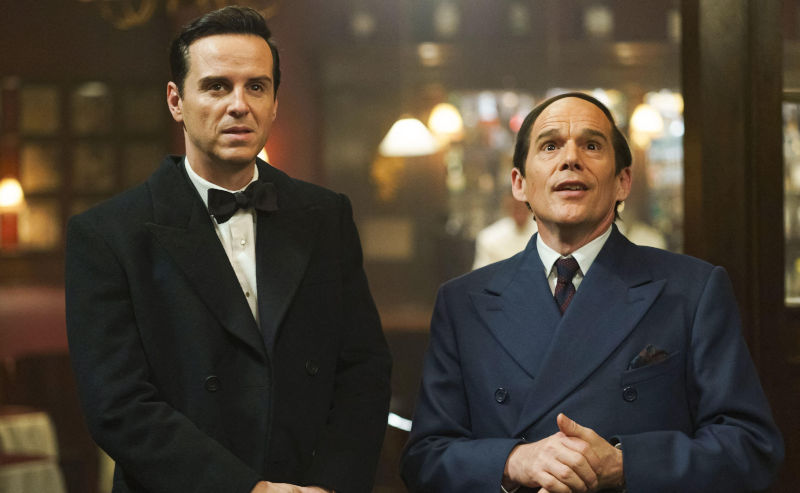
Linklater and Hawke turn a broken partnership into riveting cinema
January 24, 2026
Richard Linklater’s Blue Moon uses Ethan Hawke’s portrayal of Lorenz Hart to explore the grief, jealousy and loneliness that can follow a fractured creative partnership. Patricia Edgar argues it is a sharp, claustrophobic film about talent, loss and the human cost of being left behind.
_Blue Moon_, a film directed by Richard Linklater, is an exceptional character study by an innovative film maker and his long-term actor partner, Ethan Hawke.
Linklater and Hawke have made nine films together including the epic, coming of age drama, _Boyhood_ which portrayed the development of a boy from 6-18 within a changing family structure. The film won multiple awards as a landmark of cinema. Blue Moon, too, is a masterpiece which exposes the toll taken on life by the failure of a creative partnership.
Linklater and Hawke tell a story about the fracture of the collaboration between Lorenz Hart and Richard Rodgers, the song writing team who worked together for more than 20 years. Hawke excels as the embittered lyricist struggling to come to terms with the pain, resentment, failure and crushing loneliness he is feeling, as a rival lyricist shares accolades with Rodgers his long-term friend and partner on the opening night of their musical Oklahoma!
Blue Moon is set in one location, the claustrophobic bar room at Sardi’s in New York where the cast and producers of the opening night of the new stage musical are gathering to await the press reviews. It is March 31, 1943. Events occur with a running commentary by the drunken Lorenz Hart, in emotional turmoil as he observes what he recognises will be the potential triumph of his partner Richard Rogers working now with his new sidekick Oscar Hammerstein.
Hawke’s performance is a tour de force. Uncomfortable to watch, he plays Hart in almost a monologue, and attempts to cover his deep disappointment through a series of encounters – with the barman at Sardis; the pianist, who he nicknames Knuckles, who plays the music of Rogers and Hart throughout; the writer EB White; and the young woman of his fantasies and infatuation, Elizabeth Weiland, a Yale co-ed whose correspondence with Hart served as inspiration for the script.
As Rodgers and Hammerstein arrive, Hart pulls himself together to give a performative congratulatory speech, revealing his intellect and his anxiety. He is obsequious, with razor sharp innuendo. Cutting and hilarious. Cruel and self-destructive.
The scene on the staircase, where Rodgers recognises what he owes his partner and pleads with him to help himself, is heart wrenching. Rodgers knows Hart is beyond help. He reassures him they will work together again, even as he also admits he will work with others.
Those who have worked together for years and forged highs and lows – experienced elation and disappointments, but created artistic work the world has shared – know the depth of emotion at play here.
Many high-profile creative partnerships have dissolved due to creative differences, personal issues, or external pressures, including John Lennon and Paul McCartney; their traumatic bust up led to poisonous exchanges in music - Lennon’s vicious How Do You Sleep? and McCartney’s Too Many People. There were Simon & Garfunkel, Sonny & Cher, comedy pairs such as Martin & Lewis, Bill Murray & Harold Ramis (feuding over Groundhog Day). Gilbert and Sullivan had a famous bust up; they pressed on but were never so successful. Sometimes there can be one partner who is his own worst enemy, as is Hart in Blue Moon.
Richard Rodgers and Lorenz Hart were prodigious; they wrote more than 500 songs including the melodies and lyrics of Blue Moon, Manhattan, Bewitched, Bothered and Bewildered, and My Funny Valentine_._ They wrote dozens of shows including Babes in Arms_,_ The Boys from Syracuse, Pal Joey, and On Your Toes_._ Their music lived outside the theatre as the repertoire for singers and jazz musicians and became the soundtrack that played through the decades between the World Wars. Hart was the Bob Dylan of his time.
During the Great Depression the partners were successful high-fliers, and Hart became the centre of a party culture when he would drink heavily. Persistent alcoholism and unreliability, and ultimately an inability to work on a project set in rural America led Rogers to invite Oscar Hammerstein to be his lyricist.
The result, Oklahoma! was a remarkable hit that still plays. Rodgers and Hammerstein would would work together for 16 years until Hammerstein’s death in 1960 writing eight more musicals including_, Carousel, Me and Juliet, Flower Drum Song, The Sound of Music, The King and I, South Pacific, Pipe Dream,_ and Allegro. They also wrote State Fair, a movie musical, and Cinderella, a made-for-television musical. Hart would die eight months after their success although he worked with Rodgers one more time.
Shakespeare wrote of the insidious human character flaw which rents relationships and sears the soul. Iago warned Othello: “O, beware, my lord, of jealousy! It is the green-eyed monster which doth mock the meat it feeds on”. highlighting jealousy’s self-consuming, torturous nature. It is an emotion that has brought many partnerships to grief.
Still, there are Larry Page and Sergey Brin (the Google brothers), Stan Laurel and Oliver Hardy made it through the decades. And I am most thankful for the duo who create the animated sitcom South Park, Trey Parker and Matt Stone, who met while attending the University of Colorado Boulder and as collaborators shared creative control for The Book of Mormon and the film Team America: World Police. Long may they endure.
An enduring, successful relationship relies on trust, reliability, honest communication, mutual respect and a shared vision. Watch Song, Sung Blue to see a joyful partnership sustain the blows life can inflict. (See part 2 tomorrow)