Carney and Albanese and the collapse of global order?
February 24, 2026
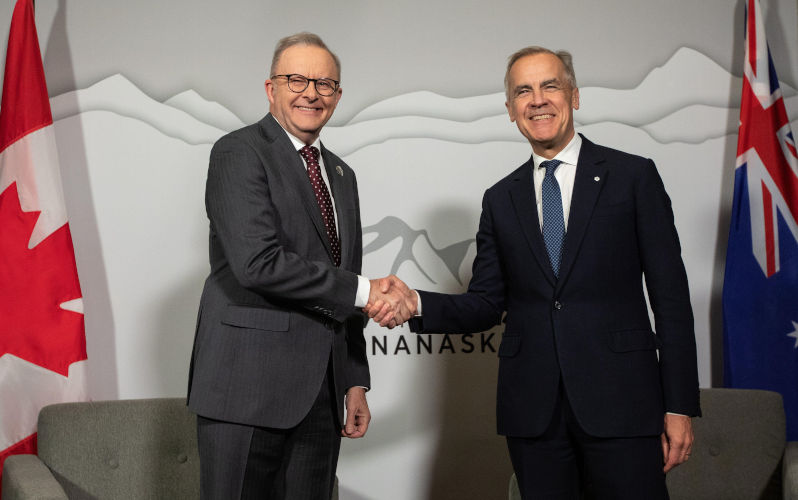
Ahead of Canadian Prime Minister Mark Carney’s visit to Australia next month, it is time to ask will Australia embrace Carney’s call to harness middle power clout.
Are Canada and Australia aligned in response to the touted collapse of global order? A person of interest, in a red cap and tie, is alleged to have lit a fire under the international rules-based order. UN Secretary General Antonio Guterres, at Munich 2025, warned “multilateral institutions are under assault”, obliquely referring to “some [who] put the UN on death watch”. At Davos, having scared the daylights out of his allies with his Greenland demands, Trump touted the US as a “stabilising force”. In his Davos tour d’horizon Canada's Mark Carney came right out and said that the US-led global order is “fading away” to the point where “the very architecture of collective problem-solving [is] under threat.” The Munich Security Report 2026 actually cited Trump by name for “taking an axe to existing rules and institutions.”
Describing what is happening as “rupture” rather than “transition”, Carney endorsed Finland President Stubb’s “value-based realism”, combining core liberal values with a realistic world view. Stubbs discerned a “hinge moment” during which states would adapt to “three major forces”, the Global West, Global East and Global South. Carney focused on middle power strategies of diverse cooperation to compensate for the lost guarantees of US hegemony. Davos was Carney’s coup de pointe. Trump indignantly rebuked the “Governor” of Canada, telling him to shut up, show gratitude, and get off his new Board of Peace.
At Munich, US Secretary of State Marco Rubio entered the debate, saying “The post-war order is not just obsolete, it is now being used as a weapon against us.” He threw down the gauntlet: “…we in America have no interest in being polite and orderly caretakers of the West’s managed decline.”
Chancellor Merz, the host at Munich 2026, repeated Carney’s challenging insight that “imperfect as it was even in its best days” the global order no longer exists. Fearing that states would not face the challenge ahead, Carney warned “Performance sovereignty that furthers subordination is not sovereignty.” Albanese and Penny Wong were missing in action at both Davos and Munich.
Both loyal, resource-rich, but neglected US allies, Australia and Canada have historically required an external guarantee of state sovereignty. Defying Churchill, after the fall of Singapore, Prime Minister Curtin recalled Australia’s forces in the Middle East to counter Japan’s southward movement. The war and its aftermath witnessed the passing from British to American patronage. Whitlam expanded the new parameters, by scrapping the White Australia Policy, recognising China and placing Australia within the Asia Pacific.
Postwar Canada was even more tightly tied to the US. Canada’s Atlanticist world view presumed US leadership, but then Prime Minister Pierre Trudeau declared a “third option”, reducing dependence on the UK and US while promoting a greater diversity of relations with Europe and Asia. Both Canada and Australia hoped to leverage a willing China to strengthen their independence.
At Davos, Carney moved out in front of Albanese. Leaning on the principle of non-interference, Albanese declined to comment on Trump. This may have been prompted by the desire to avoid a challenge to the integrity of the US-Australia alliance. Both countries reacted in the past to dependence on the US. Both want multilateralism to solve increasingly multidimensional issues. Guterres observed that no one country can dominate the global and “multipolarity without effective multilateral institutions courts chaos”. Within the existing order, Canada and Australia are seeking new balance by enhancing their international relations, especially with China.
Compare Trump and Xi Jinping. Who is the voice of reason? At Davos 2025, Xi dismissed the “waving of the big fist” saying “Multilateralism should not be used as a pretext for acts of unilateralism. Principles should be observed and rules, once made, should be followed.” Xi supports the UN, dismisses the hyperbole of Sino-US competition, and recognises climate change. He refuses to accept the wilful “dismantling” of the global order and agrees with Carney’s view that “Hegemons cannot continually monetise their relationships”.
In contrast, Trump says ‘show me the colour of your money’ and boasts that his Peace Board, which was authorised by the UN, “may ultimately supplant the UN”. At Munich 2026, Foreign Minister Wang Yi pointed the finger at the US, claiming that the problems of the international system cannot be laid at the door of the UN. He censured “certain countries amplifying differences”, while engaging in “bloc confrontation”.
The global order is evolving. It is not “fading away”. “Death watch” rhetoric is angst that weighs down practical problem-solving. There will be a lot to talk about when Carney visits Australia in March. How will the two leaders face the touted collapse of the global order? Sulking American exceptionalism that can never get enough gratitude diminishes US leadership. “Value-based realism” will have to cope with spreading Trumpist disenchantment, devaluing the rule of law, human rights, equality, diversity and inclusiveness, and social justice. Guterres’ hard-headed pragmatism offers more progressive “transition”. Trump sheds the costs of responsible hegemony at the same time as he hogs the limelight and wants to “rule the world”.
The antidote to Trump is Trump. His strategic antics may yield unexpected returns in increased middle-power economic diversity and multilateral participation.