Environment: Agricultural emissions are roasting the planet
February 1, 2026
Together, 45 global livestock companies produce more greenhouse gases than all but eight countries. Plus, crimes against nature are big business that rely on criminal networks, corrupt officials and eager customers, and global warming marches on.
Agricultural emissions are roasting the planet
The global livestock industry (mainly producing beef, pork, chicken and milk) is responsible for 12-19 per cent of all annual greenhouse gas (GHG) emissions.
Forty-five major companies, mostly multinationals, currently generate one billion tonnes of CO2 equivalent (CO2eq) each year – more than all but eight countries. They mostly mass-produce and/or process meat and dairy products, typically rearing large numbers of animals in concentrated feeding operations that are vertically integrated into international value chains.
Just five of the companies produce almost as much GHG as the other 40 combined. In fact, the Brazilian company JBS alone produces almost a quarter of the total. Of the six biggest GHG producing companies, three are based in Brazil and three in the US. Nine Chinese-based companies are responsible for just over 10 per cent of the total GHGs. Teys, the only Australian company in the list, produces 4.25 million tonnes of CO2eq per year.
Cattle are the major producers of the billion tonnes of GHGs. Beef is responsible for 46 per cent and milk 34 per cent, with methane production associated with enteric fermentation accounting for about 60 per cent of both. Chicken and pigs produce about 10 per cent of the GHGs each.
Around 80 per cent of global production and consumption of meat occurs in high and upper-middle income countries. Only 2 per cent of each occurs in low income countries. Most if not all of the companies plan to expand production (and emissions) in the coming decades as poor countries develop. JBS is planning for a 70% increase in global meat consumption by 2050.
It is clear that the global beef and dairy industries are major and growing contributors to climate change. Not surprisingly, the companies are highly resistant to any restrictions or practice changes that will hinder their expansion and spend large amounts of money on lobbying against change, disseminating misinformation and promoting false, technological solutions.
Policy recommendations to reduce the sector’s environmental footprint include:
- Improved measurement, mandatory reporting and public disclosure of companies’ activities and GHG emissions.
- Government targets for absolute reductions in the industry’s emissions and requirements for companies to produce emissions reduction plans.
- Significant reductions of global livestock numbers and reduced consumption of meat and dairy in wealthier countries.
- Transfer of government funding from large-scale agriculture to smaller-scale agroecology and a just transition to healthier, plant-based diets.
Healthy oceans, healthy people
Moving offshore, our oceans make critical contributions to human health and wellbeing, particularly when the oceans themselves are healthy:
- Oceans are good for physical and mental health. Coastal residents are more likely to meet recommended levels of physical activity than inland dwellers. Having contact with the ocean is good for mental health. Half of all the tourist dollars (about US$5 trillion per year) is spent on marine and coastal tourism – people do, indeed, like to be beside the sea and walk along the prom, prom, prom. Doctors are starting to issue blue-prescriptions.
- The enormous marine biodiversity is a source of new medicines (for cancers, immune system disorders and skin and infectious diseases, for example) and biotechnology. Bioplastics made from seaweed are a biodegradable alternative to fossil fuel-sourced plastics.
- A healthy ocean supports food security. Over three billion people depend on seafood as their main source of protein but warmer water, increasing acidity, decreasing oxygen content, changing ocean currents, pollution and overfishing are disrupting food chains and threatening marine food supplies.
- A sustainable ocean-based economy can improve health and equity. Marine food industries are worth about US$2.5 trillion per year and support about 500 million people worldwide. If this is to continue and grow, the crucial word is ‘sustainable’.
Three strategies are required to sustain the ocean’s ability to promote environmental sustainability, biodiversity and human equity and flourishing:
- Protect, restore and manage marine biodiversity. This requires international cooperation and the involvement of affected communities.
- Combat climate change and eliminate pollution, particularly plastics.
- Improve and integrate the measurement and monitoring of ocean and human health to better inform decision-making around human-ocean interactions.
Combating crimes against nature
To understand and combat crimes against nature, we must do more than be outraged that tigers are shot by poachers so their skins can be made into trophy rugs, that trussed birds and reptiles are suffocated in suitcases during international flights, that endangered orchids are stolen from tropical rainforests to satisfy a rich collector’s vanity, that ancient teak trees are felled and exported to luxury yacht makers in Europe who turn a blind eye to the military dictators depositing their cut in personal bank accounts, and that sharks are thrown back into the ocean to die after their fins have been sawn off to make soup.
At least 4,000 species of animals and plants are victims of wildlife trafficking and it is a major contributor to biodiversity loss. The movement of live wildlife is also a major factor in the emergence and spread of zoonotic diseases.
Nature crimes don’t only cause enormous damage to our natural environment. They are also associated with a wide range of other serious crimes, many of which undermine the safety and welfare of individuals and communities and the health and functioning of democratic and just societies.
Nature crimes are big business conducted by multinational crime syndicates with many strings to their bows: corruption, money laundering, tax evasion, human trafficking and forced labour, sexual exploitation of women and children, intimidation, violence and murder. None of this could occur without the knowing or negligent involvement of politicians, government officials and financial institutions and the availability of eager customers who can claim ignorance or simply don’t care.
Criminal networks may run the show but there would be no show without legal loopholes, online platforms to buy and sell the trafficked specimens, corruption, failures to detect and prosecute poaching, and ready buyers in the pet, collector, food and traditional medicine markets. Revenues are in the billions and are sometimes used to fund political unrest and insurgencies.
To give one example, illegal gold mining causes massive deforestation, mercury pollution of soil and water and brutal exploitation of (often trafficked) miners and generates profits of over $70 billion a year. The criminal gangs are frequently also engaged in drug trafficking, prostitution, money laundering and corruption of government officials.
There are similar stories for illegal logging for the global timber trade, unreported and unregulated (IUU) fishing, and land grabs to convert forests and grasslands to agriculture. All these activities frequently occur at the expense of Indigenous Peoples’ rights, lifestyle and physical safety.
Combating nature crimes depends on a range of strategies:
- Developing and implementing stronger national and international legal frameworks. For instance, closing legal loopholes, stronger penalties, effective asset seizure, protection of whistleblowers, safeguarding Indigenous Peoples’ land and rights, and protecting workers.
- Better international intelligence-based cooperation on law enforcement. This should include not only organisations directly involved with wildlife crime (e.g., CITES and the International Consortium to Combat Wildlife Crime) but also organisations focused on related crimes including drugs, money laundering (as ever, follow the money) and trade.
- Better coordination of governmental and nongovernmental agencies, both grassroots and international. I’ve been a supporter of the Environmental Investigation Agency for over 30 years and recommend a look at their website for an insight into their activities.
- Use of modern technologies to detect and prevent nature crime: e.g., AI, geospatial monitoring tools using satellite and on-ground monitoring, and identification of species and their places of origin using chemical and DNA analysis.
Regrettably …
Australia is not a safe haven for wildlife
We know that in Australia trafficking and trading of native species (particularly birds and reptiles), unlawful removal of habitat, water theft, illegal killing of animals and illegal harvesting of fisheries and timber, etc. are happening. We also know that these activities are harmful to ecosystems and biodiversity, can drastically reduce the numbers of threatened species and spread invasive species and disease.
For instance, in 2018 a farmhand in Victoria was convicted of killing over 400 wedge-tailed eagles and in 2004 fish farm staff were convicted of shooting and killing thousands of egrets, herons, pelicans, jabirus and ducks over 14 months. Generally, however, the details of Australian nature crimes are thin.
Between 1995 and 2024, 120 prosecutions for wildlife and environmental crime (WEC) occurred in higher courts across Australia, with the rate increasing from about one to six per year. Most of the crimes involved illegal removal or damage (37 per cent), illegal harvesting (33 per cent) and trafficking and trade (18 per cent). Plants (41 per cent), fish (31 per cent) and reptiles (12 per cent) were the commonest targets. Limited resources and dispersed responsibility for monitoring and prosecuting WEC severely limit the effectiveness of the more than 5,000 relevant legal provisions across Australian jurisdictions.
These figures are likely to be gross underestimates of the problem. Higher courts deal only with serious crimes. The far more common less serious ones are dealt with in lower courts that do not usually publish judgements or sentences.
Community education and training of judges about the damage done by nature crimes, increased resources and utilisation of modern technology, and harmonising laws across the country would help to tackle the problem
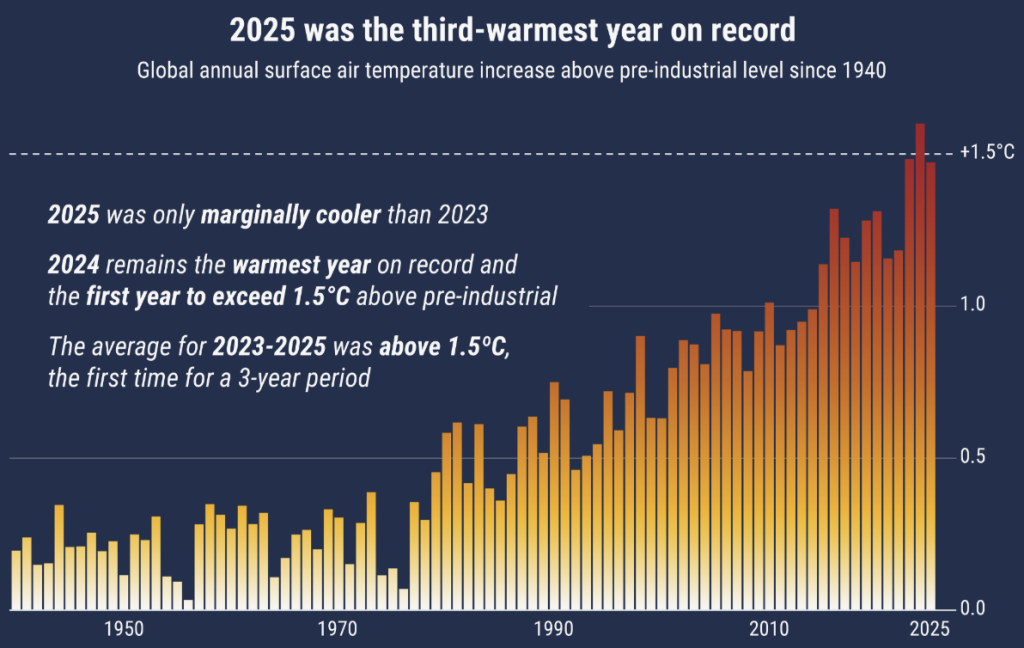
Global warming 1940-2025
The baseline in the graph below is the average temperature for 1850-1900.