Environment: The energy transition is underway – nuclear is not part of it
February 15, 2026
Nuclear is going nowhere, fossils are facing a bleak future and renewables are surging to the future. A Rich Polluter Profit Tax and an Excess Profit Tax would raise over US$1 trillion each year.
Nuclear power radiates stagnation
I doubt that Australia’s nuclear power zealots are ever going to accept that it simply isn’t going to happen. For political reasons alone, the idea is never going to hold water, heavy or not. But it’s well for the rest of us to keep an eye on what’s happening with nuclear power elsewhere so we don’t get misled by any of the hype.
The main message is that nuclear power isn’t going anywhere – it’s stagnant and has been for 30 years.
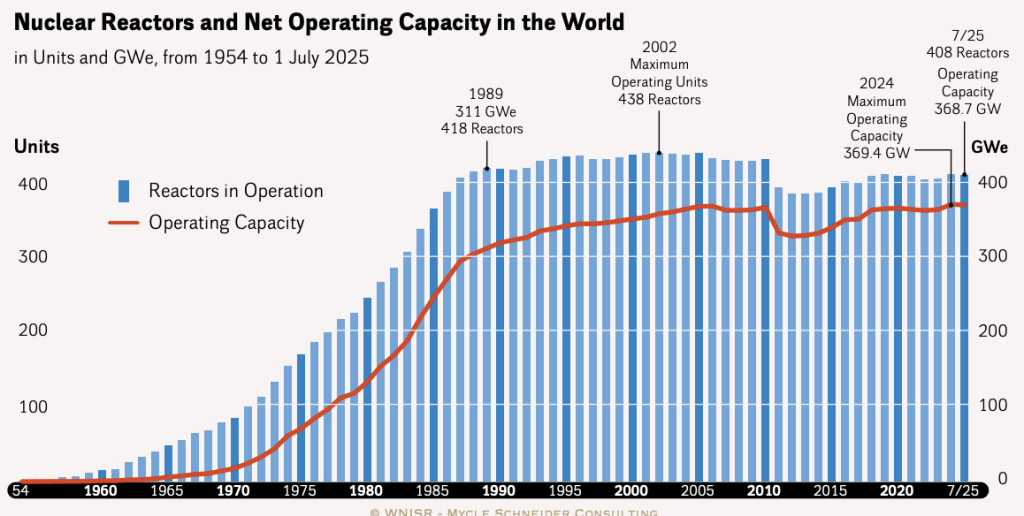
In mid-2025, 31 countries had 408 operational reactors, 30 below the 2002-peak. Also in 2025, 11 countries were building 63 reactors, with little change in numbers over the last few years. China is building the most (32, of which 31 are inside China) and Russia is second (27 in total, 20 of them in other countries). Sixty of the construction projects are associated with states that possess nuclear weapons.
Governments, investors and nuclear power enthusiasts have been raving about and sinking money into Small Modular Reactor (SMR) development for decades but only two are operational and at most five are currently under construction worldwide. In 2025, CSIRO reported that SMRs were the most costly option for the generation of electricity in Australia, with a levelised cost around four times higher than the predicted cost of generating electricity in 2030.
Between 2005 and 2024, 104 reactors were started and 101 were closed down. Worryingly, of the 218 closed nuclear power reactors, only 23 have been fully decommissioned and only nine have been released from regulatory control.
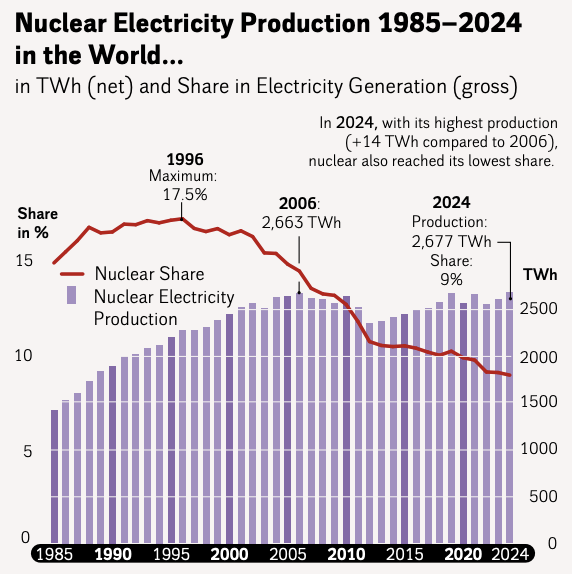
Nuclear’s heyday was the mid-90s when it generated 17.5 per cent of global electricity. These days it hovers around 9 per cent. In 2024, global investment in non-hydro renewable technology was over 20 times that of nuclear. Generating capacities of wind and solar grew by 11 per cent and 32 per cent respectively and together they generated 70 per cent more electricity than nuclear.
Nuclear reactors are very expensive and very slow to build (about a third of current constructions are delayed) and the power they produce is much more expensive than alternative sources and challenging to integrate into energy systems. Disposal of the nuclear waste is an unsolved problem – not a single country has a safe and independently verified method of storing it. There is currently about 60 million tons of waste, 40,000 tons of which may be extremely toxic for hundreds of thousands of years. Current storage arrangements are makeshift and temporary.
For a variety of reasons, a few countries seem to want some nuclear power in their energy mix but it’s clear that nuclear is not going to provide more than around 10 per cent of global electricity. Not only does Australia not want nuclear power, we don’t have any need for it. The smart money can see that wind, solar and batteries are the future.
Renewables are the future for electricity generation
At the end of 2024, global renewable energy power capacity was 4,448 GW. Solar dominated both the current capacity (42 per cent) and the growth over the previous year (32 per cent). Hydropower has a little more of the current capacity than wind (29 and 25 per cent respectively) but wind’s annual growth rate is much faster (11 v 1 per cent). “Others” (bioenergy, geothermal and wave power) are fringe-dwellers.

Solar, nearly all photovoltaic (PV), and wind, nearly all onshore, accounted for 97 per cent of all renewable energy capacity expansion in 2024. Over half of the total capacity and almost three-quarters of the expansion is in Asia. Needless to say, China is responsible for 64 per cent of global renewable expansion and dominated the growth of each of solar, wind and hydro in 2024.
Two features of the next graph clearly show the past and the future:
- In 2004, renewable energy accounted for less than 30 per cent of annual power capacity expansion, by 2012 it was 50 per cent and in 2024 it exceeded 90 per cent.
- More significantly in many ways, in 2004 total annual capacity expansion was approximately 110GW but by 2024 it had grown to approximately 620GW.
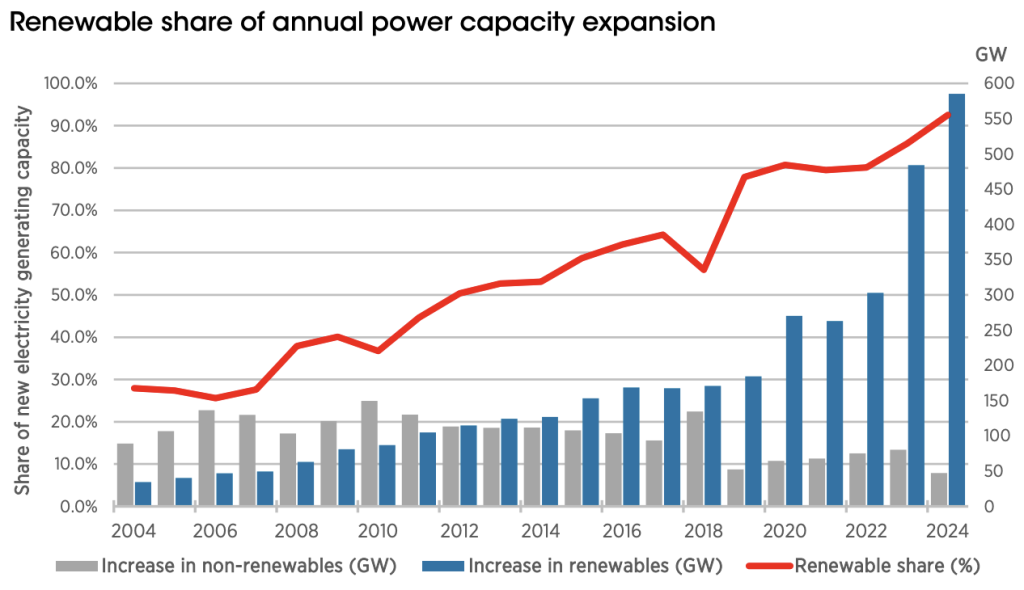
In summary, the last two decades have seen a massive roll out of new electricity generating capacity around the world. This has been achieved by a twenty-fold annual increase in renewable capacity while the growth of non-renewable capacity has halved.
That’s the good news but there are two bits of bad. The record 15 per cent increase in renewable energy capacity in 2024 is still too slow to meet the global target of over 11.2TW of installed renewables by 2030. Reaching that target will require an annual growth rate of at least 16.6 per cent. That’s not far above 15 per cent but that is very China-dependent. Other regions’ growth rates languish in the high single digits.
Nevertheless, the future is clear and it isn’t nuclear or fossils. The issue is getting to the clean, green future before we all get burnt to a cinder.
Fossil fuel’s lifecycle threatens life, nature and human rights
In 1995 nine environmental activists (the Ogoni Nine) were executed in Nigeria. The Nine had been leading peaceful resistance to the extraction of oil and gas by international companies in the Niger Delta. At the time, Shell was the biggest oil company operating in the Delta. The trial of the Ogoni Nine (allegedly for the murder of four Ogoni chiefs) is widely held to have been unfair. In June 2025 the Nigerian Government pardoned the Nine.
“Climate change is an unprecedented global human rights emergency. Without urgent action to stabilise and reduce GHG emissions, global heating will dramatically accelerate, making extreme weather events and unnatural disasters more intense and more likely, with grave human rights implications for billions of people and the critical ecosystems on which we all rely.”
So begins _Extraction Extinction__. Why the lifecycle of fossil fuels threatens life, nature and human rights_ from Amnesty International. The report “illustrates the ways in which fossil fuel projects feed into systemic patterns of exclusion, including through the disenfranchisement of environmental human rights defenders and communities fighting polluting infrastructure, and in some cases, outright silencing, intimidation or violence”, especially in Indigenous Peoples and traditional communities. On the upside, the report highlights the ways in which such groups are resisting.
At least 463 million people, including 124 million children, live in “fenceline communities”, communities within 1 km of the over 18,000 operating fossil fuel extraction, processing and transport sites. At least 2 billion live within 5 km. About 16 per cent of the sites are on Indigenous territory and a third overlap with a critical ecosystem. An additional 3,500 developments are planned or under construction. Proximity to fossil fuel infrastructure is associated with poor health, including elevated risks of cancer, cardiovascular and respiratory diseases and mental illness.
Amnesty studied infrastructure sites in Brazil, Canada and Senegal, interviewing members of fenceline communities, regional and local government officials, academics, community service organisations and journalists. They found that:
- Most of the projects visited had eroded the integrity of the land, air and water and were pollution hotspots. The areas had been turned into community and ecosystem sacrifice zones.
- Governments had failed to protect people’s right to a clean, healthy, sustainable environment, including Indigenous Peoples’ cultural rights, rights to self-determination, access to information and right to effective remedy.
- Fossil fuel companies had failed to consult directly, meaningfully and transparently with local communities.
Amnesty recommends that states:
- Eliminate fossil fuel production, use and subsidies and ensure access to affordable sustainable energy;
- implement the Fossil Fuel Non-Proliferation Treaty;
- monitor the environmental and human health impacts of fossil fuel projects;
- prevent human rights abuses by corporate actors and hold them to account where necessary; and
- protect environmental and human rights defenders.
Taxing rich polluters’ profits would raises US$1 trillion a year
In 2023, the richest 10 per cent of the world’s population were responsible for almost half of all consumption-based emissions of CO2; the poorest 50 per cent contributed 8 per cent.
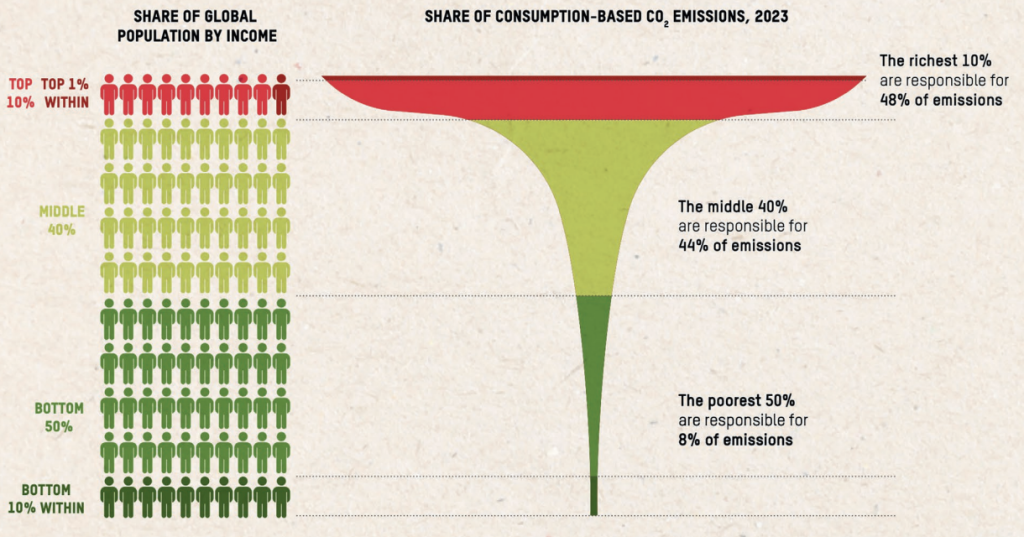
The emissions of 340 fossil fuel corporations in 2023 accounted for more than half of all global emissions. In 2024, 585 fossil fuel corporations made US$583 billion in profits and paid their shareholders dividends of US$403 billion. The top 1 per cent of wealthy people (mostly men) dominate the shareholdings of these corporations.
A Rich Polluter Profit Tax on fossil fuel companies could raise up to US$400 billion in the first year. This revenue could be used to help those communities and nations that have contributed least to climate change, are suffering the most consequences and have the least capacity to manage the problems. Priorities include providing access to affordable renewable energy, ensuring adequate housing, food and working conditions, correcting gender biases, helping communities prepare for climate shocks and providing funds and expertise to deal with the losses and damages already suffered.
Adding an Excess Profit Tax on all sectors of the economy (especially industries that are highly concentrated such as food, shipping, pharmaceuticals and IT) would increase the revenue to over US$1 trillion a year, provided robust international tax avoidance rules were introduced.
In a recent P&I article, Michael Keating discussed the Australian Superpower Institute’s The Case for Pricing Pollution. The report proposes two new taxes that would raise $35 billion per year: a ‘Polluter Pays Levy’ to make polluters pay for climate damage and a ‘Fair Share Levy’ to ensure that Australians get their fair share from the extraction of Australia’s gas resources. Compensation payments to small businesses and households are also proposed. As well as limiting greenhouse gas emissions, the plan would help to strengthen Australia’s economy.
How do birds land?
High-speed photography can display one second of flight as 40 seconds of viewing and turn a blur …

into remarkable clarity. Definitely worth watching the short video.