No Plan B: Trump’s Gaza plan sidelines justice and law
February 27, 2026
Donald Trump’s so-called Peace Board for Gaza promises reconstruction but delivers domination. With Palestinians excluded and international law sidelined, the plan exposes the urgent need for a credible alternative grounded in justice, accountability and self-determination.
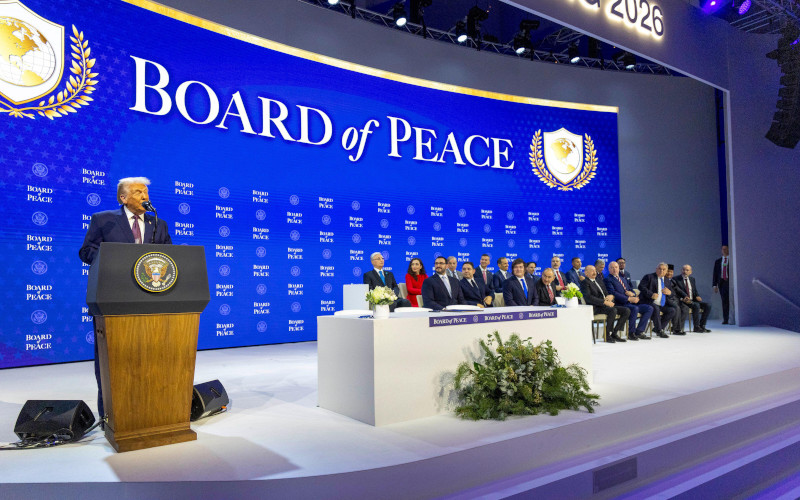
Claimed to rebuild Gaza and promote peace, the Trump Peace Board displays the same deception and plan for domination which characterises US foreign and domestic policy under that President.
Because the Peace Board is touted as the only game in town, political leaders have hobbled themselves with dilemmas: join the Board and show loyalty to Trump, or refuse to join, and remain powerless because there is no Plan B. In their compliance with bullies, and in the hollowness of claims about respect for international law, they have contributed to that powerlessness.
A cursory appraisal of the Trump initiative offers some guidance on the principles needed for any Plan B. Western leaders – including in Canberra – could replace passivity and thoughtlessness with ideas for a genuine peace with justice in Palestine and beyond. But that requires first recognising Trump’s so-called peace-making claims for what they are: plans for commercial and political domination.
US ridicule of the UN coupled to deception about Security Council resolutions set the stage for the Trump promotion. On November 17 2025, Security Council Resolution 2803 established a Board of Peace to set benchmarks for Israeli withdrawal from Gaza and for Hamas disarmament. A second draft included a clause supporting Palestinian self-determination and statehood, but was replaced by Trump boasting that as the peacemaker, his Board should take control and implement a ceasefire over Gaza.
The imperialist features of the Trump plans start with ensuring no agency for Palestinians. Trump, Israel and their supporters resurrect imperialism by colluding in stealing another’s lands, eliminating resistance with military force, slaughtering Indigenous people and consolidating cruelty via political and economic domination.
The Trump Board has gained global attention while 600 more Palestinians have been killed during a ceasefire. Meanwhile, presumably to help kill Palestinian men, women and children, 50,000 volunteer soldiers from other countries, over 12,000 from the US and over 500 from Australia (reported by the Israeli Defence Force in response to an FOI of March 2025) have enrolled to fight for Israel. In response, the western world is silent.
Military and economic domination is central to the Trump Board. He is the chairman whose invitations to join have been accepted by countries comfortable with human rights abuses – Russia, Israel, the UAE, Saudi Arabia – but there’s no place for Moslem supporting Turkey and Pakistan. To join is to appease Trump. Despite genocide as background to this peace initiative, there is no accountability to Palestinians or the UN. Both should be ignored.
Fees to join the Peace Board, $1 million dollars for three years membership, $1 billion to become a permanent member, display Trump’s money-making motives. At the much-trumpeted first Board meeting, the US was announced as having contributed $10 billion, but it’s not obvious where that sum came from or into which account it might be deposited.
The Board ignores Palestinians’ immediate cries for shelter, for water, food, medicine and an end to Israeli slaughter. Instead, at the World Economic Forum in Davos, Jared Kushner the President’s son-in-law gave a powerpoint master plan for Gaza. Along the Gaza seafront there will be a ‘coastal tourism zone’ of 180 skyscrapers, and in flattened Rafah, 100,000 housing units, 200 schools, 75 medical facilities, while destroyed Gaza City will see a ‘modern industrial and business centre.’
Life enhancing alternatives to imperialism challenge the fatalism that the only way to support the Palestinian people requires every nation to join Trump.
The lack of any Plan B looks like a repeat of western nations’ cowardly refusal to intervene against Israeli genocide, even by refusing to escort those small boat humanitarian aid flotillas sailing to Gaza through international waters.
The Gazan journalist Refaat Ibrahim says that the question of Palestine has become a decisive test for what remains of global justice. The survival of Palestine is intertwined with the influence of international law, hence the need for a Plan B first clause, ‘If Palestine does not survive, neither can international law.’
As an alternative to remaining silent, and to revive respect for international law, it does not require much courage to remind supporters that the Genocide Convention imposes a responsibility on states to prevent genocide and to punish those who commit it. To that reminder can be added the ICJ’s ruling that Israel’s occupation of Palestine is illegal and must be ended immediately.
A second Plan B clause would recall principles central to any peace settlement, namely the value of inclusiveness, consultation with and representation of people made powerless by a conflict. That may sound trite but criticism of Trump’s commercialism must highlight those principles. Not to do so is to concede that bullies should be respected, that any semblance of democracy has passed its use by date.
Areas of conflict always expose struggles over identity and recognition – the plea to be heard and taken seriously. Hearing, and taking seriously, the hopes of homeless, hungry and powerless Palestinians would generate many ideas. As a starting point, Western governments could consult the educated, jobless, hopeless and angry young people who have the most at stake. Their immediate proposals and longer-term visions would lend credibility to any Western claim to be pursuing alternatives to portraying Gaza merely as a future real-estate or tourist project.
Principles to bolster the importance of consultation are enshrined in the Geneva Convention’s reminder of peoples’ rights to self- determination, as in entitlement to choose their own governments without outside interference.
Western nations seem anxious about defending democracy but could rehearse defence of their own interests by seeing Palestine as a test case. The people of Gaza and the West Bank want to elect leaders they can trust, yet polls show that Palestinians do not feel their leaders are legitimate. Eighty-seven per cent consider the Palestinian Authority corrupt, and 72 per cent judge Hamas to be corrupt – hence the need for a Plan B to express enthusiasm for fair elections as the way to create a Palestinian state.
The Trump Peace Board operates against a background of worldwide and fast developing authoritarianism which this US President has fostered. Any plan for peace with justice in Palestine should relate to those dangerous trends, at least by opposing cruelty and attempting to be truthful.
Although inspiration can be sought from diverse sources, any drafting of alternatives to Trump/ Netanyahu discarding of a people requires accountability to Palestinians as a priority.
From Gaza, writers and thinkers plead that the west cease acquiescence to Israel and the US. They are also saying, for the sake of a common humanity, cease being impotent, produce a plan, imagine at least a few life enhancing ideas.