Globalisation of occupation: when genocide becomes an international project
February 23, 2026
Thousands of foreign nationals are serving in Israel’s military with the legal tolerance of their home states, while peaceful protest against the war is criminalised. This double standard exposes a deep failure of international law and accountability.
The Israeli occupation recently announced shocking figures that not only reflect the scale of the military strain it is experiencing on the ground, but also reveal the changing structural nature of this conflict.
Official data disclosed the presence of nearly 50,000 soldiers of foreign nationalities actively serving in its army. The United States topped the list with 12,135 soldiers, followed by France with 6,127, then the United Kingdom, Germany, Ukraine, Italy, and the Netherlands, in addition to other European and Asian countries.
The matter does not end there. Israeli media reports confirmed that the government is seeking to recruit 30,000 additional soldiers from new immigrants and grant them immediate citizenship in order to integrate them into the military and economic apparatus. This move aims to address a shortfall estimated at around 20,000 combatants, according to official army sources. Israeli Finance Minister Bezalel Smotrich affirmed this direction while discussing the government’s plan for the next phase, describing the importation of “human resources” from abroad as a fundamental pillar to ensure the continuation of the Zionist project in the face of what he termed existential challenges.
The central question raised by this transcontinental mobilisation is: how are these individuals persuaded to leave their lives in the world’s affluent capitals to fight in the alleys of Gaza and the West Bank? The answer lies in a complex mobilisation machine in which Israel collaborates with countries of origin through multiple channels.
First, there are programs of ideological recruitment sponsored by global Zionist organisations in coordination with the Israeli Ministry of Defence. Among them is the Mahal program, which allows non Israelis to volunteer in the army, and the Gadna program, which targets adolescents aged 15 to 17 in order to prepare them psychologically and militarily. For these young recruits, fighting in Israel is portrayed not as a war crime or an occupation, but as a civilisational rescue mission or the defence of the only democracy in the Middle East.
Second, Western states play a central role through legislative complicity. The laws of many of these countries permit their citizens to hold dual nationality and serve in a foreign army, specifically Israel, without losing their citizenship. In many cases, those returning from combat zones are treated as heroes rather than foreign fighters or mercenaries, labels that are immediately applied if a citizen chooses to fight in any other conflict that does not align with Western interests.
This legal facilitation, reinforced by political rhetoric that justifies Israeli actions under the banner of the right to self defence, has created a moral shield that encourages thousands to engage in acts of killing without fear of prosecution in their home countries.
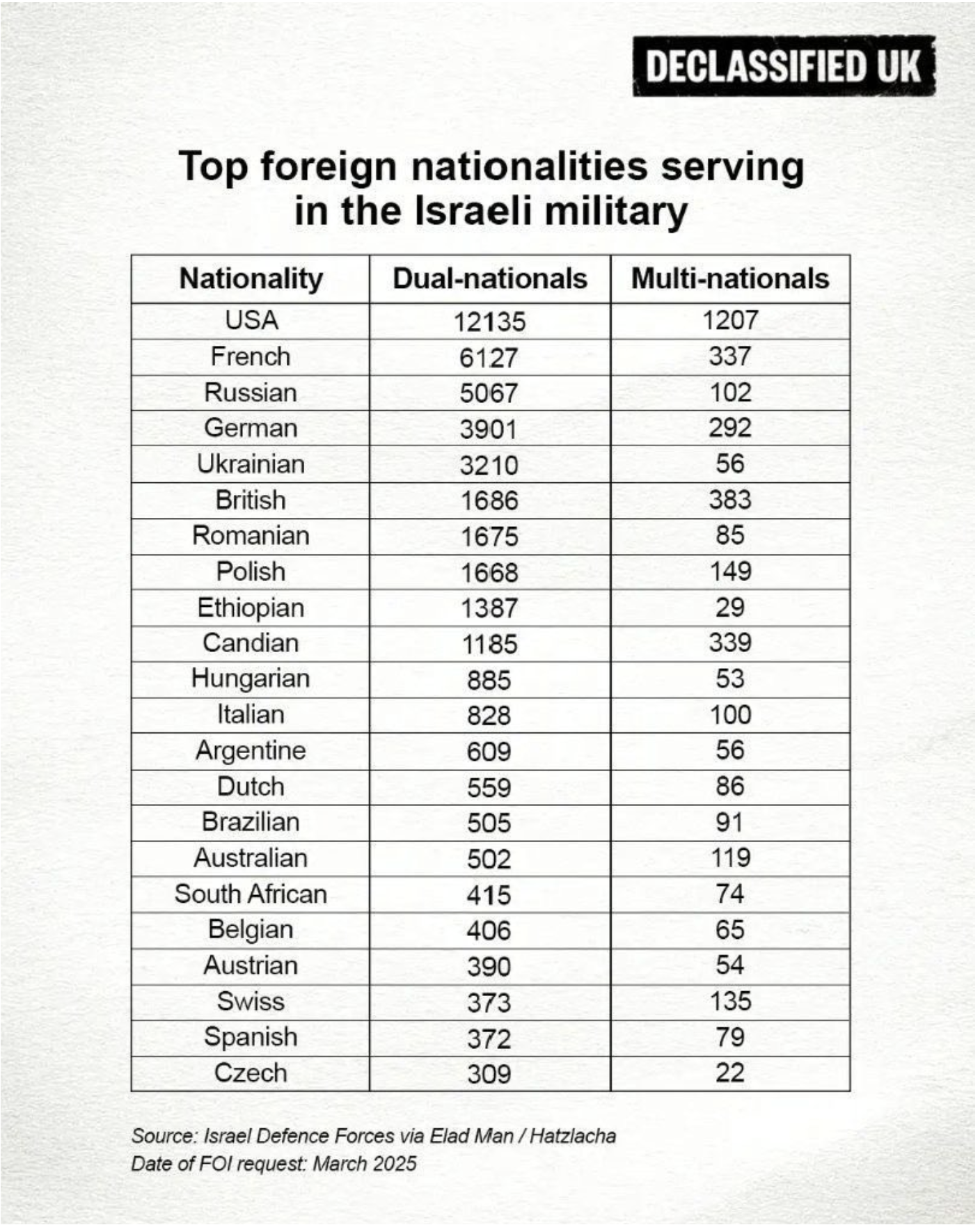
What we are witnessing is a fully formed case of what can be described as the globalisation of occupation. Transforming the war into an arena in which tens of thousands of foreign volunteers and mercenaries participate is a calculated attempt to diffuse responsibility for a local crime into a scattered global burden. The blood of Palestinian victims is diluted across multiple nationalities, making legal accountability a complex process that would require confrontation with major world capitals.
The tragedy of this moment is embodied in the fractured standards practiced by Western governments. While airports and offices are opened to facilitate the passage of fighters to Israel, doors are shut and laws sharpened to silence any voice of conscience that rejects this genocide. The movement Palestine Action in the United Kingdom stands as a stark example of this systematic repression.
When the movement carries out peaceful or protest activities targeting arms factories that supply the occupation with tools of killing, such as Elbit Systems facilities, authorities do not treat them as demonstrators exercising free expression. Instead, they launch sweeping campaigns against them and level vague accusations such as globalising the intifada, domestic terrorism, or threats to national security. Activists are arrested, their homes raided, and counterterrorism laws deployed to silence them in a desperate attempt to criminalise acts of conscience.
Here the contradiction is unmistakable. The same state that allows its citizens to carry a weapon and travel to Gaza to kill children, providing legal protection upon return, is the state that handcuffs another citizen and throws them in prison for staging a peaceful sit in to block the export of missiles that kill those children. The peaceful protester who raises their voice against injustice is punished, while the soldier who enacts that injustice receives full political and legal cover.
This distortion of justice reflects a structural failure in the international system, where freedom of expression is beaten back with batons while thousands of armed individuals participating in operations that target civilians without distinction are met with silence.
From a legal perspective, these foreign soldiers cannot hide behind dual nationality or the protection afforded by their states. Under the Rome Statute that established the International Criminal Court, criminal responsibility rests with individuals who commit, participate in, or incite war crimes and crimes against humanity. The invocation of the right to self defence is a political argument for states, but it does not exempt the individual soldier from prosecution if proven to have been involved in bombing populated areas, participating in siege and starvation policies, or firing upon civilians.
The involvement of citizens from countries that are signatories to the Geneva Conventions and the Rome Statute in military operations that have resulted in documented acts of genocide opens the door to prosecution not only before international courts but also within their own domestic judicial systems on charges of participation in war crimes. The failure of these states to hold their citizens accountable, contrasted with their eagerness to prosecute peaceful activists, places the credibility of the rule of law in those countries under severe scrutiny and risks rendering them complicit through inaction.
This military mobilization cannot be separated from the narrative war led by western governments. The adoption and repetition of official Israeli rhetoric in the corridors of the White House, Downing Street, and European parliaments created fertile ground for the recruitment of these 50,000 soldiers. When the conflict is framed as a clash of civilisations or a war against barbarism, young people in those countries may perceive joining the Israeli army as a civilisational duty.
This political endorsement did more than justify actions on the ground. It functioned as an unofficial recruitment agency. The tolerance of inflammatory rhetoric against Palestinians, coupled with the criminalisation of any counter narrative that describes the reality as occupation, genocide, or apartheid, has mobilised individuals through sentiments of hostility and superiority. This climate has facilitated grave violations carried out with cold detachment, under the belief that they are morally shielded by their governments.
The globalisation of occupation is not merely a technical military measure to compensate for manpower shortages. It is an ideological and political project that reflects the failure of international institutions to protect fundamental rights and the unchecked expansion of colonial power. Today, the question of Palestine has become a decisive test of what remains of global justice. Either international law applies to all, or we formally declare the end of the human rights era and the beginning of the law of the jungle.
Addressing this situation requires more than slogans. It demands firm legal pursuit of every individual whose hands are stained with blood, regardless of the passport they hold, while simultaneously protecting the fundamental right to peaceful protest as a moral instrument to confront military overreach. Silence in the face of exporting killers and suppressing voices of conscience is a formula for comprehensive moral and legal collapse, reducing justice to a hollow slogan masking ongoing violations.
Defending the rights of Palestinians today is not merely about a geographic dispute in a small stretch of land. It is a defence of the sanctity of international law and of human dignity everywhere, before this globalisation of occupation becomes a model replicated in other conflicts, where killing turns into a borderless enterprise and justice into a memory preserved only in history books.
History will not absolve the states that replaced the scales of justice with the rifle of the mercenary, criminalised those who sought peace, and armed those who spread death.