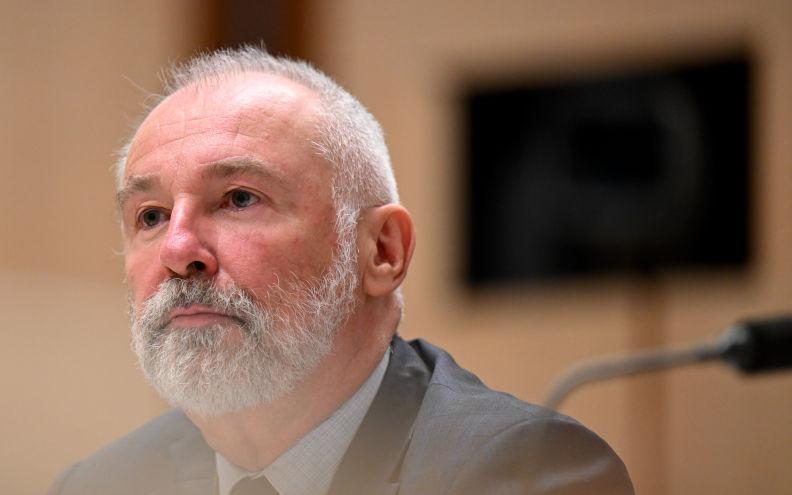
Gordon de Brouwer: A disappointing legacy
February 3, 2026
Gordon de Brouwer leaves as APS Commissioner having strengthened capability processes and leadership roles, but without the legislative and institutional reforms needed to restore integrity, independence and long-term resilience.
Gordon de Brouwer is leaving the APS in February after nearly three years as APS Commissioner following just under a year as Secretary for Public Service Reform.
It was a propitious time to pursue reform: a new government with an election platform to rebuild APS capability and strengthen integrity and transparency; a promise to reconsider the recommendations of the 2019 (Thodey) Independent Review of the APS that the previous government had rejected; and the impending Royal Commission into the Robodebt Scheme expected to add impetus to much-needed reforms. Glyn Davis, a member of the Thodey Review and an expert in public administration as scholar and practitioner, had also just been appointed Secretary of the Department of Prime Minister and Cabinet. And of course, de Brouwer himself had been a member of the Thodey Review.
As he and Davis have noted in the past, their views on the reforms needed are largely in the public arena in the Thodey recommendations. On this basis, it is hard to believe that de Brouwer would not have advised support for more fundamental reforms, for example on secretary appointments and terminations and tenure, on the role and appointment of the APS Commissioner, or for legislative reforms to board appointments along the lines recommended by Lynelle Briggs.
That such reforms have not been made no doubt reflect the unwillingness of Albanese and some of his ministers to have their political powers constrained.
In the absence of substantial legislative reform, de Brouwer (and Davis) would seem to have improved the processes within the APS for advising on secretary appointments and terminations and strengthened succession management arrangements, building on processes established by earlier Commissioners starting with Helen Williams. On at least one occasion, they convinced ministers to advertise a position.
With Davis’s support, de Brouwer has also increased the position of the APS Commissioner amongst the APS leadership, particularly through the Secretaries Board.
He has contributed to the effort to reduce reliance on consultants, contractors and labour hire and to rebuild in-house capability, though we are yet to see data on the level of success since the 2023 Finance/APSC Audit of Employment.
He has also cemented the renewed system of capability reviews which, over time, should lead to rebuilding depth of expertise across the APS, particularly if action plans are tied to PGPA Act requirements for corporate plans and improved annual performance reporting, and if agencies draw more upon the renewed interest in evaluation led by Treasury. De Brouwer has also contributed actively to lifting digital and data skills and careful consideration of how AI can best be adopted.
De Brouwer continued the support he championed through the Thodey Review of NZ-style ‘insight briefs’ where departments prepared public reports on longer-term challenges facing their portfolios, forcing departments to explore in some detail longer-term issues rather than be constantly overwhelmed by short-term demands. Such insight briefs now have statutory support, though are yet to have the widespread impact de Brouwer has been seeking.
He has also helped to raise awareness across the APS of the importance of integrity as well as capability, though some of his messaging has been awry and the needed supportive legislation has not been introduced.
Too much of the material on APS reform prepared by the public service under de Brouwer’s leadership has been disappointingly shallow, reflecting the very loss of APS capability that so clearly still needs to be addressed.
The 2023 material on the emerging ‘first tranche’ of legislative reform was issued by de Brouwer’s then team in PM&C. I disagreed at the time with the proposed addition of ‘stewardship’ to the APS Values (I still fear it is diluting the important responsibility of senior management to ensure organisational capability for the future), but accept that that is an honest professional disagreement. More concerning was the absence of any serious re-examination of the APS Values as a whole, to reflect the core role of the APS as an institution in our democracy, including the central importance of the merit principle, and to ensure a proper understanding of integrity in the APS.
The Thodey recommendations in this respect also had weaknesses, but they deserved more serious examination than de Brouwer and his team provided. Most worryingly, the material omitted any consideration of the Thodey recommendations on secretary appointments etc.
Even more concerning was the APS Commission’s 2024 Issues Paper on Stage 2 Integrity Reforms, following passage of the disappointingly limited amendments to the Public Service Act in the ‘first tranche’ of reform. Here was the opportunity for de Brouwer to draw on his statutory independence to at least ensure that the more substantial reform recommendations from Thodey remained on the table. But they were all simply ignored, presumably because the government was by then walking away from the commitments made not only in the 2022 election but also in a speech by Senator Gallagher in late 2023. Instead, the Issues Paper just canvassed a new set of second-order reforms.
It is, of course, a difficult balancing act for any APS Commissioner: to what extent are they ‘inside the tent’ working with the Public Service Minister and the Government, and with the APS leadership, and to what extent should they be ‘outside the tent’ exercising their statutory responsibilities and independence? Publications like ‘issues papers’ and the State of the Service Report are where Commissioners need to demonstrate their extra degree of independence as well as the expertise in public administration which they and the Commission should hold.
Other areas where more progress might have been made include establishing a coherent APS-wide pay and classification system and addressing classification creep and excessively hierarchical structures and cultures, particularly the growth in deputy secretary and other SES positions. This again probably reflects a loss of expertise in the APS central agencies over many years which the APSC has yet to repair.
In his farewell letter, de Brouwer strongly defended the actions he took on the Robodebt code of conduct investigation. The situation was unique and the processes he established were suitably careful but, with respect, I think he got several aspects at the end terribly wrong.
Given the damage done to hundreds of thousands of disadvantaged Australians, surely the confidentiality provisions of the PS Act did not outweigh the public interest provisions in that same Act and hence justify not revealing the names of SES officers who breached the code.
The findings about the secretaries involved are also unconvincing, particularly given the failure to mention the context. Surely the fact that Leon lost her job after finally revealing the scheme’s unlawfulness while Campbell was twice given new prestigious appointments after years of actively avoiding consideration of lawfulness (one appointment being after the scheme was finally stopped) was relevant in assessing the relative seriousness of their breaches of the code? This fact was also central to the Royal Commission’s concerns about secretary appointment and termination processes.
The question also remains whether, despite the APSC investigation finding otherwise, Campbell and Pratt did in fact breach the code back in 2015 when both were in the Cabinet room as Cabinet first considered the scheme, and both were involved with the Cabinet submission which stated that no legislation was required. The courage required of Leon in 2019 to tell ministers the scheme was unlawful was way higher than that required of Campbell and Pratt to advise that legislation was needed before the scheme started.
De Brouwer’s calls for widening exemptions to the FOI Act have also been wide of the mark. His comment in early 2024 that without such a change there was no point in telling public servants to put their advice in writing was inconsistent with the recommendation of the Robodebt Royal Commission that the government had agreed to. While the APS Commission has since issued guidelines on record-keeping in line with the agreed recommendation, these are sadly not in the form of a firm legal direction from the Commissioner, presumably in part because of his concerns about the FOI Act.
His subsequent comments last year before the Senate Committee examining the government’s proposed amendments to the Act were even more inappropriate, suggesting that the FOI framework has had unintended negative consequences on actual transparency, integrity and record keeping, and mentioning Robodebt as a case. The central failure to provide frank and fearless advice in writing back in 2015 had nothing to do with FOI – the failure was in the Cabinet Submission and related advice that was exempt under the current FOI Act. And there was no sign of providing the needed advice orally without a written record. Moreover, the Royal Commission recommended limiting FOI Act exemptions, not extending them.
The framework of rewards and penalties associated with secretary appointments and terminations, not the FOI Act, was and remains the main institutional contributor to failure to provide frank and fearless advice, whether written or not, and to avoid written advice more generally.
Sadly, de Brouwer’s comments only reinforce the culture of secrecy rather than transparency and accountability that has grown within the APS leadership as well as amongst ministers and their staff.
My assessment of de Brouwer’s record is coloured, of course, by my own advocacy of much more substantial and lasting public service reform than the government has pursued. De Brouwer is probably disappointed too that he cannot be associated with more substantial reform along the lines he and Davis and Thodey advocated in their 2019 report.
He can, nonetheless, claim achievements towards rebuilding APS capability and strengthening the role of the APS Commissioner.
He could have done more, however, and his successor still has much more to do to rebuild the capability of the APS Commission as a centre of excellence in HRM and in promoting proper understanding of the integrity requirements across the APS.

