Herzog’s visit exposes Australia’s legal weakness on human rights
February 7, 2026
As Israel’s president visits Australia, debates over protest, terrorism and antisemitism expose a significant problem: Australia lacks a coherent human rights framework.
When Israel’s President Isaac Herzog visits Australia next week, would protests carry more weight if built on legal bricks atop moral foundations? In contrast with the UK, NZ, Canada, the US and almost everywhere else, Australia doesn’t have a Human Rights Act.
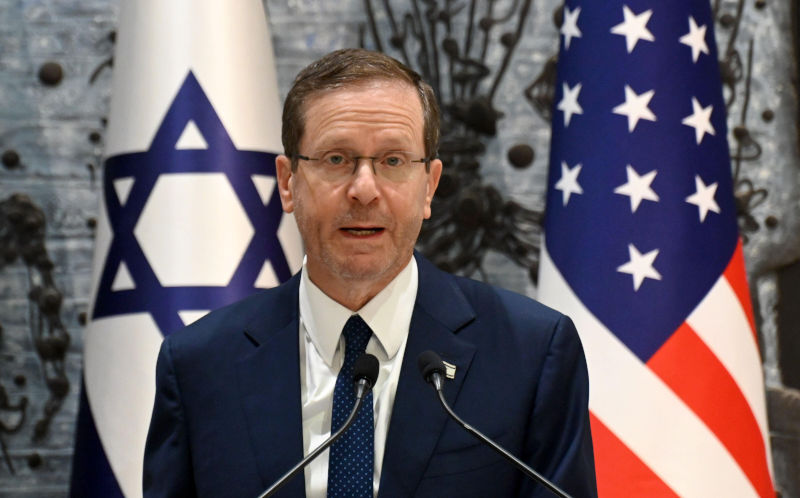
It’s been reported that while in Australia, Herzog wants to talk about “the importance of taking all legal measures to combat antisemitism, extremism and terror in Australia.”
Before the Bondi killings, Newcastle University academic Dr Amy Maguire, Professor in Human Rights and International Law, wrote that Australia has a dualist legal system.
“The Australian government can consent to treaty obligations that are binding on state parties, but those obligations are not absorbed into domestic law. This limits Australia’s capacity to meet its human rights obligations, because many are unenforceable under domestic law.
“Instead, Australia has built a patchwork human rights system. The Constitution affords only minimal rights protections, including the right to vote and the right to a trial by jury for certain offences.”
A review by the Parliamentary Joint Committee on Human Rights started in 2023. Opponents of change argue it would hand powers from parliamentarians to unelected judges with limited flexibility.
After the 1996 Port Arthur massacre in Tasmania, Prime Minister John Howard proposed changes to gun safety legislation with bipartisan state, territory and Commonwealth support. It was also endorsed by Coalition partner and Nationals leader Tim Fischer, and Labor’s Kim Beazley, leader of the Opposition.
That praiseworthy unity has been largely absent in the solutions offered since the Bondi massacre.
We’ve also had Israeli Prime Minister Benjamin Netanyahu claiming the Albanese government was promoting and encouraging antisemitism through our foreign policy.
As Foreign Minister Penny Wong said: “Australia’s longstanding commitment [is] to a two-state solution, which has always been the only path to enduring peace and security for the Israeli and the Palestinian peoples … and the legitimate and long-held aspirations of the people of Palestine to a state of their own.”
Will the president renounce Netanyahu’s slurs on his host during his trip Down Under? Will a gutsy journo ask the question? Will she or he get the call?
There’ll be protests and demos and speeches and lots of cops during Herzog’s visit, which is expected to garner international attention, particularly next door, where Muslims dominate – more than any other state on the globe.
Indonesia, where this story is being written, has Human Rights law embedded in the Constitution. Like other states, having the legislation doesn’t guarantee access. It helps to be megarich.
The nation is tagged a ‘flawed democracy’ by the Economist Intelligence Unit. Judaism is officially banned, and visits by Israelis are almost impossible. The Middle East Republic is not recognised as a sovereign state.
Late last century, Indonesia’s antisemitism seemed to be weakening. In 1994, the Egypt-educated Islamic intellectual Abdurrahman Wahid, aka Gus Dur, went to Israel for a signing treaty with Jordan, and to promote peace in the Middle East.
Five years later and despite being almost blind, he briefly became the nation’s fourth president. He died in 2009 aged 69.
For 15 years, he led Nahdlatul Ulama (Revival of the Scholars), reportedly the world’s largest Islamic NGO with maybe more than 100 million members. This year it celebrates its first century.
Deakin University academic Dr Greg Barton wrote that although the cleric’s trip was condemned by Indonesian Islamists, “…he demonstrated his commitment to religious pluralism by giving speeches in non-Muslim places of worship.
“He carved out a role as an advocate of change in national affairs that was without precedent in NU history.
“His point was that Islam was at its best when it was open-minded and pluralistic.”
Gus Dur’s values would not get a hearing in Indonesia today, where all sympathies are with Palestine, as parades, street posters and graffiti assert.
The Western label ‘Islamic terrorist’ is absent, though the term ’extremist’ does get the occasional airing.
Until the trial of the alleged Bondi mass murderer Naveed Akram, we won’t know motives – and maybe not even then.
The Jewish lobby has allegedly been using lawfare and other intimidating tactics to silence those who shy from blind support for the Israeli government and its actions in Gaza.
There’s no evidence that reportedly peaceful pro-Palestine marchers across the Sydney Harbour Bridge last August convinced the shooters to kill Jews in Bondi on 14 December. It was called the March for Humanity, and an estimated 90,000 participated.
After the massacre, keyboards were pounded to analyse the event. Many got it wrong. The Bondi killings were not Australia’s worst terrorist attack, for the catch-all noun has many definitions.
Whether a killer is driven by xenophobia, mental disease, or personal revenge matters not to the victims.
Commonwealth law says ’terrorism’ is " an act or threat intended to advance a political, ideological or religious cause; and coerce or intimidate an Australian or foreign government or the public …”
That includes a desire for infamy, one of many factors behind the 1996 shootings at Port Arthur in Tasmania; toll 35, mostly youngsters.
The Coniston Massacre in 1928 in the NT, allegedly the last officially sanctioned slaughter, took the lives of between 31 and 200 human beings.
The Frontier Wars from 1788 to 1934 recorded an estimated 30,000 deaths, including 2,500 whites. The roots were racism, aka Neo-Colonialism, and grabbing Aboriginal lands without negotiation and compensation.
To the original owners, the killers would have been terrorists.
Human Rights advocate Bill Rowlings, CEO of Civil Liberties Australia, wrote: “Menzies’s Australian Liberalism is, within the limits of social justice, the primacy of the family, parliament’s power over the executive, the rule of law, and these issues:
“Freedom from government interference in an individual’s right to speak, to choose to be ambitious, industrious, to acquire skill and seek and earn reward, provided individuals accept responsibility for what they do or say; and
“Freedom to associate with like-minded people who contribute to their community in line with their worldview.
“These are the cornerstones of the 1948 Universal Declaration of Human Rights, a document supported by successive Liberal governments.”
Passing a Human Rights Act could be the principle we need to appear righteous. After the 21 January memorial service, Rabbi Jacqueline Ninio said:
“Now go forth to life. In that moment of loss, there’s an acknowledgement that life is not going to be the same, but that we can’t stay at the grave.
“We need to walk back into the world.” The published reports of her speech did not mention Islam.