Modi in Israel, Tokyo’s shift on arms, and Duterte at The Hague – Asian Media Report
February 28, 2026
India and Israel deepen ties, Japan edges towards lethal arms exports, Duterte faces crimes-against-humanity charges, Indonesia weighs its Gaza role, Bangladesh confronts rule-of-law reform, and China’s unofficial K-pop ban shows signs of strain.
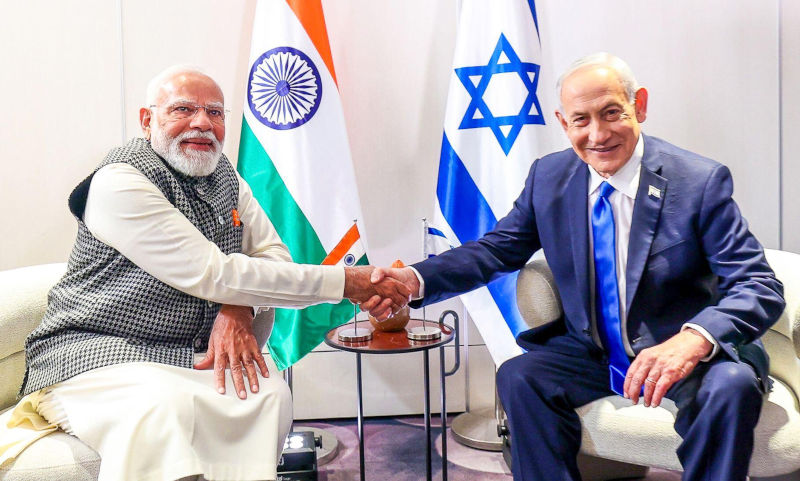
India and Israel have decided to strengthen their relationship, by elevating it to the status of special strategic partnership.
The two countries will soon sign a free trade agreement and establish a critical and emerging technology partnership, covering such areas as AI, quantum computing, and critical minerals.
Indian Prime Minister Narendra Modi made a two-day state visit to Israel this week, his second visit there.
He was feted by Benjamin and Sara Netanyahu on arrival at Ben-Gurion airport. He went on to address the Knesset, receive a top state honour (the Speaker of the Knesset Medal) and cap off the trip with the strategic partnership announcement.
At one point, The Statesman newspaper reported, Sara Netanyahu called India a wonderful country and her husband said: “He is a wonderful leader.” Ms Netanyahu wore a saffron-coloured pantsuit, to match the pocket square in Modi’s jacket.
Chants of “Modi, Modi” greeted him when he addressed Israel’s parliament. Referring to the Hamas terrorist attack on 7 October 2023, he said: “India stands with Israel firmly, with full conviction in this moment and beyond.”
Modi said India firmly supported the Gaza peace initiative. “We believe it holds the promise of a just and durable peace for all the people of the region, including by addressing the Palestinian issue,” he said.
When he received the Speaker of the Knesset Medal, Modi joined a small group of leaders who have been awarded top honours by both Israel and Palestine,having received the Grand Collar of the State of Palestine in 2018.
The Statesman said Netanyahu ranked Modi’s visit as extraordinarily productive and extraordinarily moving. “I think there wasn’t a dry eye left in Israel after your moving statement… in the Knesset,” he told Modi.
International affairs expert C Raja Mohan wrote in The Indian Express that India was now able to pursue parallel tracks with confidence – supporting Palestinian statehood while engaging Israel as a vital partner. “India’s growing interests… are too important for Delhi to engage the region with old ideological slogans,” he said.
A commentary in Al Jazeera, written by Indian journalist Yashraj Sharma, said a shared ideological vision was at the heart of the ties between the two countries.
Modi’s Bharatiya Janata Party (BJP) had its roots, Sharma said, in a philosophy known as Hindutva that sought to turn India into a Hindu nation and a natural homeland for Hindus anywhere in the world – similar to Israel’s view of itself as a Jewish homeland.
Tokyo to scrap lethal weapons export ban
Japan and China risk a deep freeze in their relationship.
An article in Nikkei Asia, the online business and politics magazine, said relations between the two countries were once described as politically cold but economically hot. But they were now moving towards a new normal of politically and economically cold.
China’s campaign against Japan reached a new high this week when Beijing banned exports of dual-use (commercial and military) items to 20 Japanese companies and tightened scrutiny on another 20.
The story said the move was part of the stand-off with Japanese Prime Minister Sanae Takaichi over her remarks about her country’s possible intervention in any war over Taiwan. But it was also part of a paradigm shift in Japan-China ties.
China in December conducted large-scale military exercises that included the aircraft carrier Liaoning in waters near Okinawa – drills in keeping with Beijing’s medium-to-long-term defence strategy. “Japan has no choice but to respond to such a shift in its security environment,” the story said.
Global Times, an official newspaper in China, said the export controls were aimed at curbing Japan's remilitarisation and nuclearisation. They were fully justified, reasonable and lawful, it said.
On Wednesday – the day after Beijing announced the export controls – Japan’s ruling Liberal Democratic Party unveiled plans to scrap a rule that limited Japan’s military exports to non-lethal categories – rescue, transport, reconnaissance, surveillance and minesweeping.
Instead,The Japan Times reported, defence equipment would be divided into two categories – lethal arms (such as warships and fighter jets) and non-lethal equipment (such as radars). The decision on whether to export lethal arms would rest with the National Security Council, chaired by the prime minister.
The paper said the proposal was a major shift in policy and could be put into effect in coming months.
A commentary in The Japan Times said the new US National Defence Strategy, released last month, offered Takaichi a unique opportunity to cement Japan’s role as an indispensable partner in building a new Indo-Pacific architecture to contain Communist China.
The article, by Tokyo-based American academic Stephen R. Nagy, said the institutional genes of the Chinese Communist Party were totalitarian and expansionist.
“Takaichi understands that you cannot ‘engage’ with these genes; you can only constrain them,” he wrote. “The NDS strategic focus on ‘deterrence by denial’ is the antibody to this viral spread. By locking shields, the US and Japan can create an environment where the CCP’s expansionist impulses hit a wall of hard power.”
Note: Last year’s contract to sell Mogami-class frigates to Australia was facilitated by earlier, much more restrictive, rules on lethal equipment sales.
Philippine leader ‘drew up death lists’
Former Philippine President Rodrigo Duterte personally drew up death lists and boasted about murders committed during his so-called war on drugs, a prosecutor told an International Criminal Court crimes-against-humanity hearing this week.
Prosecutor Edward Jeremy said the poor were often targeted because they were the ones least likely to file complaints.
The Manila Times reported Jeremy had said Duterte publicly named people he claimed were involved in drugs and many would end up as victims. The Duterte list was basically a death list.
The ICC, sitting in The Hague, this week conducted a four-day confirmation of crimes hearing and the judges will have 60 days to decide whether to proceed with a trial. Duterte was not present, claiming he was not well-enough mentally to follow proceedings. But the court had already determined he was fit to stand trial.
Duterte has been detained at the ICC since March last year on three charges of murder that amount to crimes against humanity, _Nikkei Asia_said. He was president from 2016 until 2022 but the charges stopped at 2019, as he had then as a signatory to the Rome Statute, the treaty on which the ICC was based.
Prosecutor Mame Niang told the court Duterte was in control of the war on drugs. “Duterte’s so-called war on drugs resulted in the killings of thousands of civilians and many of these victims were children,” Niang said. “When there was a public outcry over individual cases and Duterte publicly said the violence must stop, then the case numbers dropped.
“He knew he was in control.”
Nicholas Kaufman, Duterte’s lawyer, dismissed the allegations. “He won seven elections in 20 years and he implemented many anti-poverty measures,” Kaufman said. “But his opponents say he fought a war against the poor… He is a victim of a media controlled by the elites.”
In a separate story,_The Manilla Times_set out the charges against Duterte – multiple counts of murder and attempted murder as crimes against humanity, structured into three counts:
Count One: Murder of 19 victims, including three children, in or around Davao City, by members of the Davao Death Squad between 2013 and 2016, while Duterte was mayor;
Count Two: Murder of 14 people across the Philippines by state actors and others in a so-called National Network during Duterte’s time as president; and
Count Three: Murder and attempted murder of 45 victims, again by the National Network, between July 2016 and September 2018.
Trump praises Prabowo as a tough cookie
Indonesia, the world’s largest Muslim-majority country, is to supply 8,000 of the 20,000 troops needed for the Gaza International Stabilisation Force under Donald Trump’s peace plan. The force will be led by an American commander, Major General Jasper Jeffers; an Indonesian officer will be his deputy.
Jeffers said Albania, Kazakhstan and Kosovo would also send troops.
Indonesian President Prabowo Subianto attended the first meeting of Trump’s Board of Peace, held in Washington late last week, _The Jakarta Post_reported. Few western democracies, countries that traditionally allied with the US, were present, the paper said.
Trump said the US would contribute US$10 billion (A$14 billion) to the board, but did not say whether Congress had approved the contribution. Qatar, Saudi Arabia and the United Arab Emirates had each promised at least $1 billion.
The story said Trump hailed Prabowo, calling him a tough cookie.
A commentary in the Post said public reaction in Indonesia was sharply divided between pride in the nation’s active role and scepticism, based on concerns that Indonesia was stepping into an American trap, or being used to legitimise a foreign agenda.
The article, written by Khairul Fahmi, co-founder of the Institute for Security and Strategic Studies, said the planned arrival of Indonesia troops faced fierce opposition from hardline groups in Tel Aviv, even from some right-wing factions in Benjamin Netanyahu’s coalition.
Some believed Indonesia’s involvement was a strategic mistake for Israel as Jakarta was seen as too closely aligned with Palestine.
Another commentary, by Indonesian diplomat Purna Cita Nugraha, praised Prabowo's decisive leadership. “Indonesia believes it can actively shape decision-making within this new platform,” he wrote.
_Tempo_magazine said Hamas was open to the presence of international peacekeepers in Gaza but would reject interference in its internal affairs.
It quoted Hamas spokesperson Hazem Qassem as saying: “We want peacekeeping forces that monitor the ceasefire, ensure its implementation and act as a buffer between the occupation forces and our people in the Gaza Strip, without interfering in Gaza’s internal affairs.”
Bangladesh economy in a fragile state
The new government in Bangladesh, elected earlier this month – 18 months after the autocratic former leader, Sheik Hasina, fled the country – faces a multitude of challenges. A critical underlying issue is establishing the rule of law, while the most pressing is keeping the economy afloat.
A commentary in The Diplomat, the Asian online news magazine, says the election was largely peaceful and orderly, with the Bangladesh National Party winning a big majority – 209 seats (212 in its coalition) out of 300 in the National Parliament. Its main rival, an alliance led by Jamaat-e-Islami, won 77 seats.
The analysis, written by Bangladeshi journalist Saqlain Rizve, says the Commonwealth Observer Group rated the election as one of the largest and most significant electoral exercises worldwide in 2026.
The story quotes Mirza Hassan, of the BRAC Institute of Governance and Development, a social science research centre, as saying he had worried that the outgoing interim government might not have been able to ensure law and order. “Many thought there could be terrible violence,” he said.
The election marks a milestone, the story says – BNP’s return to power after almost 20 years. With a two-thirds majority, it would be able to govern without the need for large coalitions. Rizve describes BNP, led by Tarique Rahman (the son of former leader Khaleda Zia), as a party of pragmatic conservatism.
Bangladesh also voted on an extensive reform package, including a new upper house, introducing proportional representation, a legal framework for electoral fairness, civil liberties protections and checks in executive power. The vote in favour was 68 per cent.
Hassan said the biggest challenge for the new government would be establishing the rule of law. “Bangladesh has never truly had the rule of law,” he said. “The judiciary and the police have never been able to function independently.”
University of Dhaka economics professor Selim Raihan said the economy was in a fragile state. “Bangladesh has faced one shock after another,” he said. “Economic growth, job creation and private investment have all been affected. Inflation remains high and investment… has stagnated for almost a decade.”
The new government has formally applied to the UN to defer the country’s graduation from least developed country (LDC) for three years, _Nikkei Asia_said. The graduation had been scheduled for November this year.
The government cited macroeconomic stress, trade uncertainty and institutional weaknesses as reasons for the delay. Being classed as an LDC would mean Bangladesh would continue to receive preferential trade terms.
Hong Kong loophole for China’s K-pop fans
Pop and politics shouldn’t mix, we might think. But in China, pop and politics are thoroughly entangled when it comes to K-pop.
Beijing has had a Clayton’s ban – the ban you impose when you’re not imposing a ban – on ‘hallyu’, or ‘Korean wave’ popular culture since 2016.
China has never admitted the ban exists but when Seoul deployed the US anti-missile system known as THAAD (Terminal High Altitude Aerial Defence) K-pop concerts were cancelled, South Korean dramas disappeared from Chinese streaming platforms and Korean stars were edited out of Chinese variety shows.
Although the ban officially doesn’t exist, cultural imports were discussed at last month’s meeting between South Korean President Lee Jae Myung and China’s Xi Jinping, according to a feature article in South China Morning Post.
Lee told reporters Beijing might handle the issue gradually. He quoted Xi as saying: “Ice three feet thick does not melt all at once and fruit ripens and falls when the time is right.”
Slight cracks are appearing in the barriers, the story said. In January, a Chinese remake of a South Korean TV series called My Mister was released on a streaming platform – the first South Korean drama remake to be distributed in China since the ban was imposed.
K-pop concerts are banned but in recent times artists have been allowed to hold fan meetings and autograph-signing sessions in China.
Getting face time with K-pop idols worked like a lottery system, the story said. The “tickets” were physical albums. “Fans will buy albums in bulk to try to secure a spot at meet-and-greet events,” it said. “Fans typically get 60 to 90 seconds to talk to a band member.”
Hong Kong is coming to the rescue of K-pop fans. Thanks to one country, two systems, K-pop concerts are not banned there.
K-pop phenomenon BTS will play three concerts in Hong Kong early next year, as part of a planned world tour. And Blackpink last month held a three-day concert series in the city. Immigration figures showed that on the first day alone 188,100 Mainland visitors flooded into the city – eclipsing the New Year’s Eve record of 148,400.
But fans will have to wait for Xi Jinping’s slowly melting ice to end the geopolitical chill. The story quoted Seoul academic Lee Dong-gyu: “China cannot loosen what doesn’t exist.”

