Inside Indonesia’s Board of Peace diplomacy on Palestine
February 7, 2026
Indonesia’s decision to join the Board of Peace places it inside a US-dominated body whose approach to Gaza risks prioritising reconstruction over sovereignty, rights and political legitimacy.
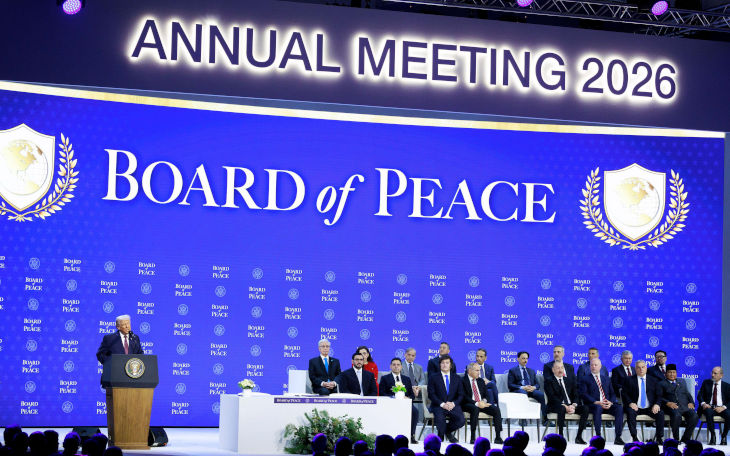
History does not always turn on the thunder of war. Sometimes it shifts quietly, with a signature in an alpine hall. When Indonesia joined President Donald Trump’s Board of Peace in Davos in January 2026, it was far more than a ceremony; it marked a bold experiment in power, reconstruction and control over Gaza’s shattered future.
Indonesia’s decision sits at the intersection of conscience and calculation. As the world’s fourth-largest nation and its largest Muslim-majority democracy, Indonesia has long treated Palestine not as an abstraction but as a moral constant of foreign policy. From Bandung in 1955 to repeated votes at the United Nations, Jakarta has framed Palestinian self-determination as inseparable from its own post-colonial identity.
That history explains why Indonesia’s presence on the Board of Peace matters and why it is fraught with risk.
The humanitarian facts are no longer contested. Gaza’s death toll has surpassed 70,000, more than 95 per cent of the population has been displaced, and entire neighbourhoods have been flattened. The World Bank estimates reconstruction costs at over US$50 billion, a figure that will rise as damage assessments continue. Against this backdrop, the Board of Peace presents itself as a vehicle for economic rebirth: ports, housing corridors, tourism zones, a ‘New Gaza’ built on infrastructure and investment.
Yet economics divorced from politics rarely delivers peace. Analysts have repeatedly warned that post-conflict reconstruction without sovereignty entrenches dependency rather than stability. Gaza risks becoming a development project rather than a polity; a balance sheet without a voice. That concern deepens when the Board’s public materials scarcely mention Palestinians at all, while Israel holds a seat and Palestinian representatives do not.
This asymmetry matters. Comparative experience shows it clearly. In East Timor, international reconstruction only succeeded once political self-determination was recognised. In Aceh, Indonesia’s own peace process worked because demobilisation followed autonomy, not the other way around. The lesson is consistent across cases studied by the World Bank and International Crisis Group: legitimacy precedes investment.
Indonesia’s engagement, therefore, is not naïve. Officials argue that presence allows influence, that absence cedes the field to others less concerned with international law. That logic has merit. Reports highlight that few Western powers beyond the United States have embraced the Board, and several have expressed unease that it could sideline the United Nations.
In that vacuum, Indonesia’s participation introduces a counterweight – a voice shaped by non-alignment, multilateralism and constitutional commitment to a ‘just and civilised humanity’.
Still, the Board’s structure raises uncomfortable questions. The US President chairs it, membership is invitation-only, and decision-making authority rests overwhelmingly in Washington. The public withdrawal of Canada’s invitation underscored the institution’s personalistic nature. That model sits uneasily with the inclusive diplomacy Indonesia has historically championed. Indonesia may exit US President Donald Trump’s ‘Board of Peace’ if Palestine’s independence goals are not advanced.
Economically, the stakes are equally stark. Gaza’s future economy cannot be reduced to construction contracts and donor conferences. Before the war, unemployment exceeded 45 per cent, youth unemployment nearly 70 per cent, and GDP per capita had been shrinking for a decade. Without freedom of movement, access to markets and control over borders, reconstruction risks reproducing the same structural strangulation under a shinier façade.
This is where Indonesia’s role could become transformative, or symbolic. By insisting that reconstruction be tied to a credible pathway toward Palestinian statehood, Jakarta can reframe economics as a tool of emancipation rather than management. By invoking UN Security Council resolutions that anchor Gaza’s future within international law, Indonesia can resist the quiet normalisation of permanent limbo.
The comparison with other middle powers is instructive. Turkey and Egypt have leveraged geography. Qatar has leveraged finance. Indonesia’s leverage is moral authority, earned through consistency. That authority would be diminished if participation in the Board is seen to legitimise a process that excludes the very people it claims to rebuild.
None of this argues for withdrawal. It argues for clarity. Indonesia’s presence should be conditional, vocal and principled. Development must serve dignity. Investment must follow rights. Peace must be more than architecture.
For Australia and the wider Indo-Pacific, this moment deserves attention. Indonesia’s choices increasingly shape regional norms on how emerging powers engage global crises. If Gaza becomes a case study in economic reconstruction without political justice, the precedent will travel to other conflicts, other regions, other forgotten peoples.
But if Indonesia succeeds in bending this process, even incrementally, toward inclusion and legality, the implications are profound. It would demonstrate that middle powers can still humanise global governance. That economics and empathy need not be opposites. And that the future of Palestine – like Indonesia’s own past – is not ultimately about aid flows, but about freedom.
In diplomacy, presence is power only when it is principled. The world is watching whether this one will be.