Lai sentenced, Beijing doubles down on HK security – Asian Media Report
February 14, 2026
China’s ‘zero tolerance’ white paper to Takaichi’s all-powerful supermajority, opposite views on India-US trade deal, why BYD is beating Tesla, Cambodia war a key to Thai PM’s victory, and the K-pop path for Bad Bunny – news, opinion and analysis from across our region
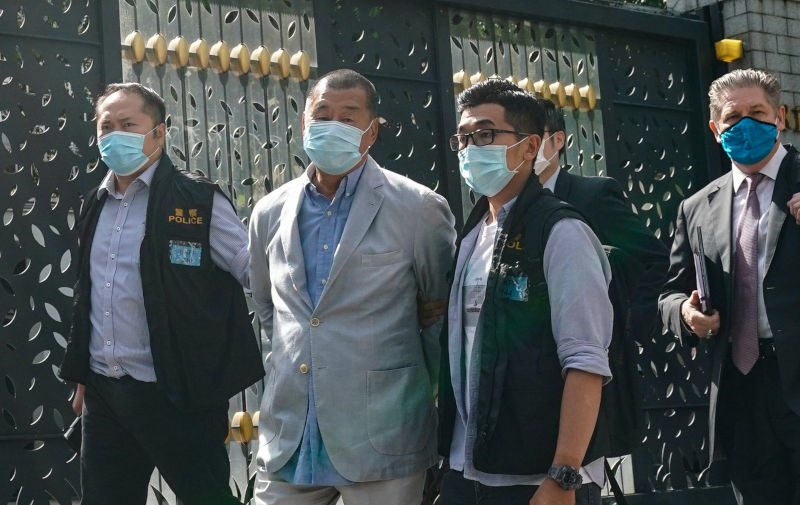
On Monday, Hong Kong’s High Court sentenced political activist and former media owner Jimmy Lai Chee-ying to 20 years in prison for national security offences. On Tuesday, Beijing issued a white paper on HK national security.
South China Morning Post said that from the timing the message was clear: Beijing would have zero tolerance of any offences in its unrelenting fight to defend national security.
The Post reported that Lai, 78, the founder of the now-defunct Apple Daily newspaper, was set to spend the rest of his life behind bars after being found guilty of two conspiracy counts of collusion with foreign forces and a third conspiracy to print and distribute seditious articles.
The paper said Lai had used his newspaper and a network of international contacts to push for sanctions against the local and central governments. He would be 96 by the time of his earliest possible release. Six former Apple Daily senior executives received sentences of up to 10 years and two activists were jailed for more than seven years.
Global Times, an official newspaper, quoted HK Chief Executive John Lee Ka-chiu as saying the 12,000-word white paper, Hong Kong: Safeguarding China’s National Security under the Framework of One Country, Two Systems, delivered a stern warning to “traitors who endanger national security”.
The paper was of great significance and had come at exactly the right time, Lee said.
China Daily said in an editorial the white paper underscored the need for a legal shield to guard against threats posed by external and internal forces.
SCMP also editorialised, saying safeguarding national security did not come to an end with Lai’s imprisonment. It quoted from the white paper: “Safeguarding national security is a long-term and enduring task.”
The three papers also ran opinion pieces criticising Lai and defending the sentence but he gained support elsewhere in Asia.
The Indian Express said in an editorial Lai’s extraordinarily harsh sentence was the final nail in the coffin of the promise of One Country, Two Systems.
It said the court had described Lai’s offences as grave and premeditated. “Yet, by all accounts, his real crime has been the relentless championing of democracy,” the paper said.
And a commentary published by ucanews.com, the Catholic Asian news site, said Lai’s crimes were nothing more than the crimes of journalism – of daring to think differently from the Chinese Communist Party. It said Pope Leo XIV should publicly pray for Lai, a Catholic, and call for his release.
Empowered Takaichi to engage in robust diplomacy
Sanae Takaichi’s historic landslide victory in Japan’s national elections has put her in a very powerful position: she has won a supermajority of more than two-thirds of lower house seats, enabling her to override the upper house if it blocks any of her bills.
Her Liberal Democratic Party won 316 seats, giving it a higher proportion of lower house numbers than any other party in the postwar era, The Japan Times said. Its coalition partner, the Japan Innovation Party, won 36. A two-thirds majority is 310 seats.
The result allows the coalition to override challenges that might emerge from its lack of an upper house majority.
A separate Japan Times story asked the question: is Takaichi on course to build an enduring administration, in the mould of her mentor, the late Shinzo Abe, or the reformist Junichiro Koizumi?
Investors were turning bullish on the idea that “Japan is back,” Nikkei Asia, the politics and business newsmagazine, said. They were betting that the empowered leader would boost growth through fiscal expansion.
Stocks jumped after the election, it said. On Monday the Nikkei Stock Average soared by almost 4 per cent. The rally continued on Tuesday.
But the Asahi Shimbun newspaper expressed reservations. It said in an editorial that during the short election campaign Takaichi avoided giving specific details of policies she wanted to implement.
“…[T]he landslide victory does not mean the voters have given carte blanche,” it said.
The Japan Times said in a commentary that China’s retaliation against Takaichi for her remarks suggesting Japan might intervene in a conflict over Taiwan had fallen flat. Voters had endorsed her unyielding stance towards Beijing. She had the political capital to confront Beijing on her own terms.
“A stable political foundation also provides significant strength for advancing robust diplomacy,” Takaichi said.
Beijing hit back. China Daily, an official newspaper, published a commentary saying Takaichi had spoken of collaborating with the US to evacuate nationals from Taiwan if a serious situation arose.
It said Takaichi was the first Japanese leader to advocate such an intervention.
“These remarks are by no means casual diplomatic rhetoric but a deliberate strategy that signals the revival of militaristic tactics by right-wing forces,” the OpEd said.
India’s US trade deal an interim framework
In Australia, journalists and politicians often judge a policy by whether they think it passes the pub test. In India, it seems, they have the smell test. And a senior columnist with The Indian Express does not like the odour of the new India-US trade agreement.
The pact, formally a framework for an interim trade agreement, cuts US tariffs on Indian goods to 18 per cent. It comes as negotiations continue for a broader bilateral trade agreement and follows the signing late last month of an Indian-EU free trade agreement that creates a free trade zone of almost two billion people.
Indian Prime Minister Narendra Modi said the US framework agreement would deepen bilateral ties and boost exports, jobs and manufacturing, The Statesman newspaper reported. It quoted Modi as saying it would generate large-scale employment for women and young people.
Modi said the agreement was “great news for India and USA”. He thanked Donald Trump for his “personal commitment to robust ties” between the two countries.
But Pratap Bhanu Mehta, a political scientist and contributing editor with The Indian Express, said the new tariff regime remained worse than it had been before Trump came to power.
“Even if we acknowledge that the agreement has some pragmatic economic potential, it does not pass the smell test,” he wrote. “America is not playing for reciprocal equality. It is playing for imperial domination… The agreement reflects this asymmetry. In a manner reminiscent of 19th century imperial trade, the tariff structure favours the United States: India cuts tariffs to zero, while the US imposes rates as high as 18 per cent.
“The perfume of official announcements cannot disguise the stench of our own diminishment.”
Fellow Express contributing editor, political scientist C Rajah Mohan, takes the opposite tack. He said the agreements with the US and Europe reflected India's effort to reposition itself in a rapidly changing global economic order.
“But Delhi’s negotiating culture has long been shaped by the peculiar idea that India’s opening position must also be its final one,” Mohan wrote.
“Trade negotiations, by definition, involve give and take but the public discourse has focused on what has India ‘given away’, ignoring what it has ‘gained’. This zero-sum mindset is out of step with trade as a positive-sum game.
“By closing the deal with the US – and defending it without diffidence – Delhi signals that India has emerged as confident negotiator and purposeful interlocutor.”
Musk loses EV sales crown to China’s BYD
Elon Musk’s Tesla has lost its world #1 title. China’s BYD has raced to the front and is easily the world’s biggest maker of fully electric vehicles.
In the last quarter of 2025, BYD produced 100,000 more battery EVs than Tesla – 595,000 to 495,000.
And Tesla’s latest financial results show its revenue fell by 3 per cent last year – its first drop in yearly revenue.
The loss highlights the extent to which the EV market is tilting towards China, says an analytical article in Hong Kong’s South China Morning Post. The article, by Mark Greeven, dean of Asia at the International Institute for Management Development, says BYD has pulled ahead because it is organised to operate at a vast scale.
“BYD can lower the price of its cars without squeezing its margins because of its lean cost base,” Greeven says. “This pricing advantage has come into sharper focus as the EV market matures beyond niche early adopters to more mainstream buyers. For the mass market consumer, lower prices are king.”
But the growth of China’s car market has come at great cost, says a story in Nikkei Asia. A bruising price war wiped out US$68 billion (A$95 billion) in carmaker revenue over the past three years, it says, citing a new research report.
The average price of cars sold in China dropped by 11 per cent between 2023 and 2025, the story says. The cut-throat competition sparked a regulatory crackdown, with Beijing warning carmakers against fierce price reductions and unpaid bills to suppliers. The discount war eased.
Carmakers have adopted more subtle approaches. Tesla announced zero-interest financing for Chinese buyers of its best-selling vehicle, called Model YL. Some Chinese brands offered buyers compensation for the phasing out of government subsidies. BYD has upgraded existing models while keeping prices steady.
Analysts do not expect big price cuts this year, the story says.
Nikkei Asia notes that Tesla in 2023 fired the first shots in China’s discount war. Rivals followed, aggressively.
Dominant victory a rare feat for conservative forces
Thai Prime Minister Anutin Charnvirakul was swept back into office at last weekend’s elections, aided by nationalistic sentiment aroused by the on-again, off-again border war with Cambodia and assiduous networking with wealthy businesspeople and local godfathers in provincial areas.
These alliances with the baan yai (“big houses”) enabled Anutin’s Bhumjaithai (‘Thai Pride’) Party to outperform expectations in the 400 lower house constituencies in which MPs are elected under a first-past-the-post system, according to a detailed report in The Diplomat, the Asian online news magazine. (The remaining 100 seats are allocated under party-list proportional representation system).
“By dissolving parliament in mid-December, when the [Cambodia] conflict was at its height, Anutin was able to wrap himself in the flag and harness the nationalistic passions stirred up by the conflict,” the story said. It quoted Anutin as telling a campaign rally: “I promise you I will protect our soil with my life.”
Thai PBS World, an official news site, listed the numbers of seats won by different parties as:
Bhumjaithai – 194; People’s Party – 116 (the party won all of Bangkok’s 33 seats);
Pheu Thai – 76 seats; Kla Tham – 57 seats; and Democrat Party – 22 seats.
The Diplomat said Bhumjaithai was the first conservative party to prevail at the polls since 1996. And Anutin would be the first prime minister to be returned to office in two decades – a reflection of the chronic instability of Thai politics since the anti-Thaksin coup of 2006.
The election marked a further decline in the fortunes of Pheu Thai, the political machine of former prime minister Thaksin Shinawatra, The Diplomat said. It slid into third place and even failed to win a seat in Chiang Mai, Thaksin’s hometown.
The result was a disappointment for the progressive People’s Party, as polls had suggested the party was in front and its leader, 38-year-old Natthaphong Ruengpanyawut, was the preferred prime minister. In the last election, its predecessor, the Move Forward Party, came first with 151 seats but was prevented from forming government by senators appointed by the military. It was later dissolved by the Constitutional Court over its plans to amend Thailand’s strict royal defamation law.
But the trouble over the proposal to amend the lese majeste law continues to dog the People’s Party. The National Anti-Corruption Commission this week voted unanimously to ask the court to ban from politics 44 former Move Forward MPs who supported the plan, The Nation news site said. The number includes 10 who won seats for the People’s Party at this month’s election, with Natthaphong among them.
The Nation reported the commission as saying the move reflected a failure to uphold the country’s democratic system with the King as Head of State. If the court ruled against the group, the 10 would lose their seats.
Why Korean fans feel the Bad Bunny energy
When Puerto Rican megastar Bad Bunny last weekend delivered the Super Bowl LX half-time show as a celebration of Latin music and culture, people in at least one Asian country recognised the power of his music: South Korea, home of K-pop.
Korean audiences understood his show’s energy and his confidence that pop does not need translation to be understood.
A story in The Korea Times said the show was a statement about language as power, the idea that a global stage can be claimed without switching tongues, flattening accents or sanding down culture.
The story was written by Lucero Santiago, founder of Kmagazine, a Mexican media outlet specialising in Korean and Asian culture. “Like BTS or BLACKPINK performing in Korean on global stages, Bad Bunny didn’t code-switch for mass appeal,” Santiago said. “Instead… he brought the audience into his world.”
Al Jazeera said in a report on the show that many viewed it as an act of defiance against the anti-immigrant raids by ICE agents. It said Donald Trump complained that it was the worst performance ever and a slap in the face to “our country”. Trump said: “Nobody understands a word this guy is saying, and the dancing is disgusting.”
But Lucero Santiago noted in his Korea Times article that last year Bad Bunny was Spotify’s global top artist for the fourth time, with more than 19.8 billion streams. And last week he won album of the year at the Grammy Awards.
“Rather than adapt to the global stage, Bad Bunny made the global stage adapt to him, just as K-pop artists have done with Korean,” he wrote. “In both cases, language was not diluted for consumption.
“It was the source of emotional connection, cultural resistance and pride.”