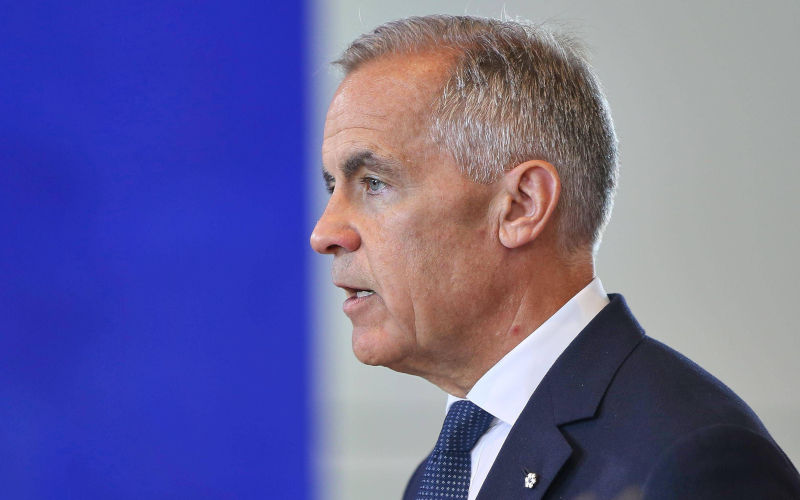
Mark Carney – Values: an economist's guide to everything that matters
February 1, 2026
Mark Carney argues that treating price as a proxy for value has driven crises in finance, health and climate. His book offers a roadmap for rebuilding trust, fairness and resilience.
Mark Carney has received international acclaim for his speech calling out the rupture of the rules-based international order. But we shouldn’t have been surprised. In this outstanding book, _Values: An economist's guide to everything that matters_, Carney demonstrates how the marketisation of our values has provoked major crises, and he then provides a road map to a fairer, more responsible and resilient world.
Mark Carney is uniquely experienced. First, he was the Governor of two central banks – the Bank of Canada (2008 to 2013) and then the Bank of England (2013 to 2020). Carney was the first foreigner to hold this position, demonstrating the high regard in which Carney was held. After the Bank of England Governorship, Carney was the UN Special Envoy for Climate Change and Finance, along with some other Board appointments. It was during that period with the UN that Carney in 2021 wrote this book.
Since then, in March 2025, Carney became Prime Minister of Canada and after winning the subsequent election he has continued in that position.
As far as I know Carney is the first and only senior public servant to ever become Prime Minister of his country. But in addition, Carney has written an extraordinarily erudite book about values. Something that none of his contemporaries in government could ever have achieved. And it is a great shame that Carney’s book has not achieved wider circulation and received more attention in Australia.
What are our values
In many respects our values are what define us, both as individuals and as a society. For Carney our values are central to determining the future of our society, our economy and the planet.
The first part of Carney’s book is therefore a discussion of what are values our and why they matter.
Critical to Carney’s analysis is the distinction between value as measured by the price of something and values. Or as Oscar Wilde famously put it, “he knows the price of everything and the value of nothing”.
As Carney says: “Values and value are related but distinct”. Values represent the standards of behaviour that we expect, such as integrity, fairness, kindness, excellence, sustainability, passion and reason. “Value is the regard that something is held to deserve – its importance, worth or usefulness”. But the economic value of a good or service is generally relative – how much will be given up in exchange for it, and that depends upon circumstances.
In Part 1 of his book Carney provides a most erudite history of the concept of economic value and how that has evolved over time, eventually giving rise to today’s marketised society.
This discussion starts with Aristotle, followed by analysis of values in the Middle Ages and the Reformation before turning to discuss the intellectual giants of the Industrial Revolution – Adam Smith, David Ricardo and Karl Marx – who focused on the value of the factors of production, and especially labour. Subsequently in the 1870s a new school of thought – the neo-classicists – explained the value of a product through differences in the utility to the consumer. Finally, this discussion concludes with Alfred Marshall, who at the beginning of the last century brought it all together explaining value in terms of the interaction of both supply and demand.
Carney’s conclusion from this discussion is that economic theories of value originally tied value to factors of production and how production takes place, followed by value being in the eye of the beholder and determined by their preferences. But “today it is widely assumed that there is no underlying, intrinsic or fundamental value that isn’t already reflected in the price”.
Carney then turns to the role of money. “Money is used to measure value”. Without money the markets’ decentralised exchange of goods and services could not operate.
But what determines the value of money? For a long time, the price of gold determined the value of money, but this broke down when the supply of gold failed to keep pace with the growth of the economy. Today, the key role of a central bank is to control the demand and supply of money and therefore its price.
To do this successfully, Carney argues that the central bank must have the belief and confidence of the people, and that is best achieved by an independent central bank charged to pursue both monetary stability and financial stability. But people will only support “the tough decisions that are necessary to maintain the value of money provided the authorities deliver monetary and financial stability. They must do so transparently and fairly.” In short, “The value of money and the legitimacy of the Bank come from the people’s trust and their belief in the fairness and integrity of the system.”
Right now, however, the problem is that “Today this economic approach to value has spread widely. Market value is taken to represent intrinsic value.”
In the final chapter of this first part of his book, Carney explores the negative impact of moving from a market economy to a market society. where “Increasingly the value of something, of some act or of someone is equated with their monetary value.”
According to Carney this emphasis on market value ignores the following flaws:
- Many markets are imperfect driving a wedge between private and social value.
- Humans are not always rational and forward-looking in their decisions.
- Social capital and natural capital are generally not priced, and well-being includes other factors that are not bought and sold, while the distribution of well-being also matters.
- What is not bought and sold on the market risks being ignored or at least under-valued.
Consequently, as Carney sees it: “The view that market outcomes always equal value creation gives rise to three sorts of risks”, which are:
- market failure where externalities such as the common good are ignored;
- a tendency to under-value the future relative to the present, and over-rely on past information; and
- a flattening of our values with insufficient consideration of that which isn’t priced, such as distribution, nature, community and diversity.
This marketisation of our society, “is now undermining our basic social contract of relative equality of outcomes, equality of opportunity and fairness across generations.”
Three crises of value(s)
These changes in our values have led to “a series of crises of finance, health, climate and identity that are not merely the product of shortcomings in the ability of markets to value, they are also the result of how the encroachment of markets has changed our values.” Carney’s basic thesis is that how we measure value is a common cause of the three crises of credit, climate and Covid explored in part two of his book.
First, the failures of the financial system as exposed during the Global Financial Crisis were caused by the authorities and market participants falling for the lies that “markets are always right and that markets are moral”. This led to light touch regulation that encouraged the growth of credit by increasingly risky institutions as “bad behaviour went unchecked, proliferated and eventually became the norm.”
Carney then discusses how to create a simpler, safer and fairer financial system. The key will be to rebuild the social fabric of trust on which finance depends.
Covid is the health crisis, which is discussed next, but it also brought on an economic crisis. Carney argues that the severity of the Covid crisis was magnified by the way we discount the future and thus under-value resilience by not taking the necessary preparations to mitigate such risks.
On the other hand, Carney says that the Covid “crisis could help reverse the causality between value and values”, as “societies have prioritised health first and foremost, and then looked to address the economics. Public reaction to the threat of the virus revealed the values of solidarity and community”.
This is part of an interesting discussion of the responsibilities of the state and how these have evolved through time. Carney writes that “Decisions around Covid policy represent arguably the most difficult, and undeniably the most significant weighing of sacred and secular values ever performed”, where sacred refers to the value of human lives.
The third crisis discussed is climate change where “Measuring the consequences of climate change goes to the heart of the challenges of value and valuation.” Not least there are “fundamental questions of value(s), particularly since much of what climate change destroys, such as biodiversity and communities, is not explicitly (financially) valued. And our assessments of the relative value of policies to address climate change depend critically on how much we value the future.”
At present, however, “Climate change is the ultimate betrayal of intergenerational equity.” Indeed, we face a “tragedy on the horizon in which the catastrophic impacts of climate change will be felt beyond the traditional perspectives of most businesses, investors, politicians and central bankers.”
Carney has an interesting discussion of how we can bring the war against climate change into the heart of policy-making by turning urgency into opportunity. “The transition to a green economy can be the greatest commercial opportunity of our time.”
“Meaningful carbon prices are a cornerstone of any effective policy framework. … But the scale of the challenge means that carbon prices alone are not enough. The policies for achieving our climate goals should be designed to encourage the economic adjustments and technological innovations at the least possible cost, while sharing the burden of adjustment within countries and across nations.”
In addition, changes in climate policies, new technologies and growing physical risks will prompt a reassessment of virtually every financial asset. The financial system must be retooled to make the markets a key part of the solution. Climate change must be “as much a determinant of value as credit worthiness, interest rates or technology, where the impact of an activity on climate change is a new vector, a new determinant, of value.” This will also involve changes to financial reporting and risk management.
Reclaiming our values
In part three of his book, Carney draws on the experience of the three crises to create action plans for leaders, companies, investors and countries, before finishing with a new platform-based approach to managing the global commons in the wake of the demise of the rules-based international order.
The first chapter in this part discusses the future role of leaders and emphasises the importance of “values-based leadership…because such leadership across society is at the heart of how we can refind our values.”
After a discussion of different leadership models, Carney examines the traits and behaviours necessary for leaders to catalyse change, help their colleagues realise their potential, and encourage their organisations to fulfil their mission. This chapter concludes with a discussion of the essential attributes of values-based leadership and what is required in the present disruptive age.
“Companies are the engine of value creation in a modern economy,” and how purposeful companies create value is the focus of this chapter on companies. A key theme is that “purpose is fundamentally a question of value and values”, where a company with true corporate purpose is responsible and responsive to more than its shareholders, by building honest, fair and lasting relationships with its employees, suppliers and customers, and by being a good corporate citizen making full contributions to society.
Furthermore, Carney argues that “By uniting broader interests behind a common purpose, purposeful companies can be more impactful, dynamic and profitable”, not least by generating competitive advantage, reducing risks and inspiring employees.
The message from the next chapter on Investing for Value(s) is that the key to the rebalancing of value and values required for sustainable investing “will be developing and embedding comprehensive and transparent approaches to measuring stakeholder value creation by companies.”
One approach is to develop and embed measures of a wide range of sustainability outcomes, commonly referred to as environmental, social and governance (ESG). Investment that incorporates ESG measures can mitigate risks and enhance long-term economic value.
Beyond simply incorporating ESG considerations, “Impact [investment] strategies make investments with the intention of generating positive, measurable social and environmental impact, alongside a financial return.”
The core challenge is to value activities that are not priced in markets. A comprehensive understanding of relevant research and evidence is required, but in many cases it is better to tailor analysis based on monetarisation to specific investments or how best to achieve a specific impact, such as reducing child poverty or addressing climate change.
Finally, the last two chapters bring together the many policy strands already discussed to develop a policy framework to build value for all.
A critical problem is that despite the benefits of technological innovation for many people “globalisation and technological advance are associated with low wages, insecure employment and striking inequalities.” And too often this is resulting in right wing populism and a loss of trust in government.
But as Carney says, “It isn’t globalisation and technology that have led to increased inequality but our response to them.”
Carney agrees that “the dynamism of markets is essential to our prosperity and wellbeing.” So “Country strategies must make existing markets work better and build new markets. But markets alone will not solve our most intractable problems.” In addition, “the marketisation of our society has created some of our problems.”
Carney’s solution is to ensure that markets, too, have a purpose. “We need political processes to define our goals and objectives – to set our values.” Then “through shared understanding and values, we can channel the dynamism of markets to create value for all.”
To do this Carney says we need to reinforce the core values of solidarity, fairness, responsibility, resilience, sustainability, dynamism and humility which are emphasised throughout his book, and in the remaining pages he provides extensive examples of how to put these principles into action.