Dragged from prayer – how Muslim belonging became conditional in Australia
February 15, 2026
The police pulling Muslim men from prayer during protests against Isaac Herzog’s visit exposes how fragile Muslim belonging has become in Australia. Shaymaa Elkadi argues this was not a failure of judgment, but a political choice.
In December, I wrote that the Bondi massacre had become open season on Muslims – that our belonging is conditional.
Two months later, New South Wales Police dragged Muslim men from prayer.
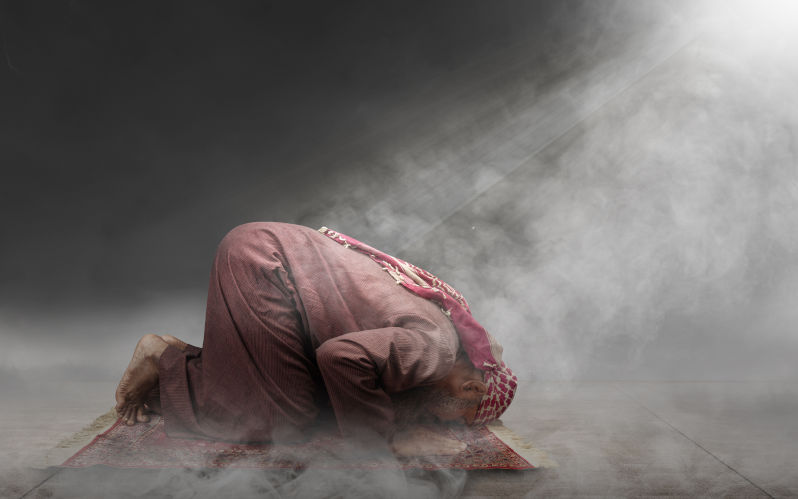
On Monday evening, February 9, 2026, Sheikh Wesam Cherkawi led around a dozen men in evening prayer outside Sydney Town Hall. They had gathered during a protest against Israeli President Isaac Herzog’s visit – two straight lines of worshippers, kneeling in prostration, fulfilling an obligation during Ramadan, the holiest month of the Islamic calendar.
Police descended. Grabbed them. Pulled them from prayer and dragged them across concrete. A witness reported being “dragged from sujood, made to stand and told: it’s time to move on, buddy.” Buddy.
At that same moment, Premier Chris Minns was attending ‘An Evening of Light and Solidarity’ – a gala welcoming Herzog to Sydney. The same Herzog whom a UN Commission found had incited genocidal rhetoric when he claimed “an entire nation out there [in Gaza]… is responsible” for October 7.
The timing tells you everything.
After Bondi, government action moved with unprecedented speed. Emergency legislation was passed within weeks: the Public Assembly Restriction Declaration, the Major Events Act, and new hate speech laws. Hundreds of millions were allocated for security, protection, and anti-hate programs.
Swift. Decisive. Unequivocal – as it should be.
The state demonstrated what it is capable of when it chooses to act urgently.
But when mosques receive ‘Christchurch 2.0’ threats? The response is a familiar lullaby: condemnation, assurances, careful words about “safe havens,” and slow, partial admissions about Islamophobia, delivered after the damage has already landed.
Herzog’s visit was met with court orders restricting protests, thousands of police, private security, exclusion zones, and tight control over documentation. Protesters opposing the visit were met with pepper spray, mounted police, arrests, and beatings. A Greens MP was hospitalised. The media were pushed away from documenting the violence.
And when Muslims knelt to pray, quietly, lawfully, non-threateningly, they were assaulted by the state.
This was not inevitable.
It was a choice.
Last month, Scott Morrison travelled to Jerusalem for an international conference on antisemitism and delivered what amounted to an administrative ultimatum: Muslims must be governed.
Not supported. Not engaged. Governed.
He demanded “nationally consistent” standards: accreditation for imams, a national register for public-facing religious roles, translated sermons, monitored links, enforceable discipline, surveillance repackaged as “reform.”
He said nothing about the Muslim rescuers at Bondi, ordinary men who ran toward danger to save lives, because extraction doesn’t require recognition. It requires subordination.
The Australian National Imams Council called Morrison’s remarks “reckless, irresponsible, and deeply ill-informed.” They were being generous.
Because Morrison, who secretly appointed himself to multiple ministries, left Australians in crisis to holiday overseas, presided over Robodebt and its devastation, and built a political identity around cruelty at the border, now wants to lecture Muslims on accountability and governance.
His logic is the oldest one on the books: Muslims must ‘do more’ – but Muslims cannot be trusted to do more without supervision.
That is not reform.
That is colonial management by another name.
After the prayer assault, over 100 Muslim organisations condemned it as “completely unacceptable.” Australia’s Islamophobia envoy, Aftab Malik, stated there was “absolutely nothing on the face of the earth” that could warrant police breaking up peaceful prayer.
The response was not an apology. It was a defence.
Minns defended police actions. Assistant Commissioner Peter McKenna said police conduct was “justified” and he was “very proud.”
Proud of dragging worshippers from prayer.
Then came the Prime Minister’s instruction to “lower the temperature.”
Not “we will hold police accountable.” Not “dragging people from prayer is unacceptable.” Not “we failed Australians exercising lawful religious practice.”
But a demand that Muslims, whose “temperature” was prostration, whose “temperature” was prayer – calm down.
The brutalised community was told to manage the reaction to its brutalisation.
This is the gaslighting that runs through the DNA of this nation: Muslims are harmed, and then told their response is the real problem.
For decades, Muslims in Australia have known that belonging is conditional. We’ve heard it in rhetoric, seen it in policy, and felt it in the ambient hostility of public space.
But knowing it intellectually and experiencing it physically are different orders of reality.
Monday night was a threshold.
We have been told we are suspicious. Now we have been dragged from prayer to prove it. We have been told our faith is threatening. Now we have been assaulted while practising it. We have been told our presence is conditional. Now we have felt the state’s hands enforce that conditionality.
This is no longer a metaphor.
This is flesh. Bone. Concrete against skin.
Young Muslims watching that footage will carry it longer than any speech about multiculturalism. Muslim parents will speak differently to their children about safety and citizenship. Community leaders will recalibrate what cooperation yields, and what it costs.
Because we can no longer pretend that if we condemn loudly enough, rescue bravely enough, cooperate fully enough, we will be protected. We did all of that. Two months later, worshippers were dragged from prayer.
Good-faith engagement collapses when the state shows you, physically, that your rights are revocable.
Together with public narratives accusing worshippers of “baiting” police, this has become a point of no return.
Not because Muslims choose withdrawal, but because the state has clarified, through force, that our participation is tolerated only at its convenience.
We will still pray. But we will do so knowing the state can treat it as provocation. We will still advocate. But we will do so knowing our concerns will be met with calls for greater surveillance. We will still rescue, condemn, cooperate, but with the knowledge that it earns us nothing except the right to be brutalised more politely next time.
The game has changed because the violence is no longer hypothetical. It is not what might happen if we step out of line. It is what happened while we were in line – in prayer, exercising rights supposedly protected by law.
Morrison can demand Muslims be “governed.” Minns can defend police violence. Leaders can insist we “do more.” But they cannot undo what Monday night revealed:
Muslim safety in Australia is not treated as a right. It is treated as a revocable privilege.
Young Muslims will not forget being dragged from prayer. That memory will shape their understanding of citizenship for decades. No rhetoric about cohesion will erase what they learned in the forecourt of Sydney Town Hall.
If we are not safe while praying, we are not safe at all.
The past two months have proven a devastating truth: we cannot perform our way into protection.
We cannot pray our way into belonging. Worshippers were assaulted mid-prayer. We cannot cooperate our way into safety. Quiet prevention work is ignored while “reform” is demanded. We cannot condemn loudly enough. Every denunciation is forgotten when the next incident arrives.
Because the problem is not Muslim behaviour.
It is the hierarchy that decides whose humanity is inherent – and whose must be proven, again and again, and still denied.
The open season that began at Bondi has moved into deeper territory: into rights, identity, and the most basic conditions of existence.
And those who claim to defend religious freedom remain silent while Muslims are met with state violence and told to accept more control as the price of admission.
