What Australia’s past might teach Israel about its future
February 8, 2026
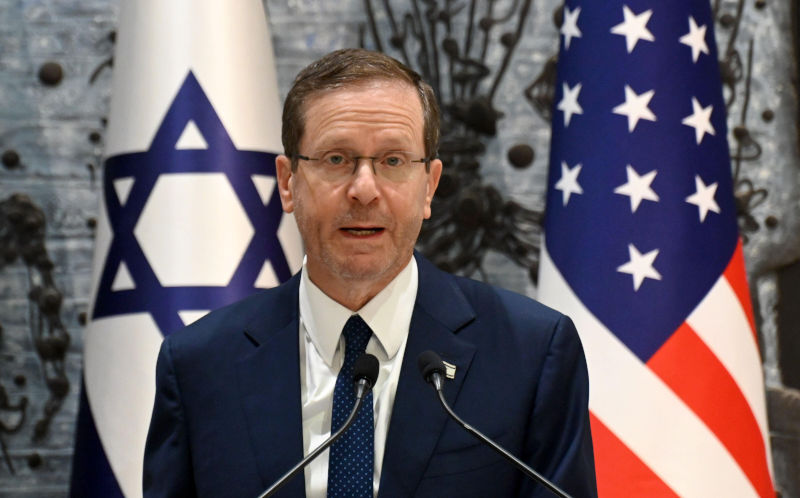
President Herzog’s visit might be useful if he could be persuaded to ponder the lessons Australia might offer.
When the six Australian states joined together in 1901 to become a new nation, there was no doubt that they conceived of Australia as a white country. First Nations peoples were denied citizenship, and the centrepiece of immigration policy was the White Australia Policy.
Today, other than a few activists on the far right, that vision of Australia is rejected. In over a century our national identity has moved from a loyal outpost of Anglo Britain to a multicultural society, still struggling to find justice for its Indigenous peoples.
Nations evolve, and if they fail to adjust, they decline. Perhaps the Australian experience suggests that Zionism, conceived as creating a Jewish homeland, also needs to evolve.
Currently the lands of Israel/Palestine are occupied by roughly equal numbers of Jews and Palestinians, over whom Israel is determined to maintain total control. While our government pays lip service to the idea of a two-state solution it is increasingly apparent that Israel will not allow this and is using the expansion of Jewish settlements on the West Bank to make it less and less viable.
Claims that calls for freeing Palestine “from the river to the sea” is antisemitic ignore the fact that many Israelis, including senior cabinet ministers, echo this call in their claim to ‘Judea and Samaria’, namely the entire area now controlled by Israel.
Whether or not one views the present situation as one of apartheid, it is obvious that the status quo can only mean greater repression, increasing resort to violence and the increasing decline of any pretence that Israel is a democratic state. Indeed, the constant refrain that is a Jewish state ironically echoes its great enemy, the Islamic State of Iran.
It is ironic that Australia, a country which prides itself on its multiculturalism, has been so willing to overlook the contradictions of an ethno-nationalist state which denies equal citizenship to half of the population it effectively controls.
The settler colonial analogy often made by critics of Israel, breaks down, in that Jews had some historical connection to the land, which British settlers here did not. It is correct in that the Zionist project ignored the rightful claims of Palestinians.
There have been Zionists who have recognised this contradiction and acknowledged that Jewish settlement has meant the dispossession of Palestinians. This is not a call to eliminate Israeli Jews. When Australians seek an Indigenous welcome to country or speak of the “unceded lands” of First Nations people, we do not mean that those of us who are born or have migrated here are illegitimate.
Perhaps President Herzog might ponder whether a similar recognition of Palestinian claims is a necessary first step to real peace. Having virtually eliminated the possibility of a Palestinian state it is now incumbent upon Israel to imagine a future in which both peoples are granted dignity and equal citizenship.
Yes, Israeli Jews have legitimate fears of recognising the equal claims of Palestinians to their land. These fears cannot be countered by increasing repression, because repression begets resistance in an over escalating cycle of violence, as the last two years have demonstrated.
Just as we abandoned our national self-image of White Australia, any genuine solution requires Israeli Jews to abandon their idea of permanent supremacy. This may mean the end of Israel as it is now constituted; it does not mean the end of Jewish existence in the land.
The reality is that there are many millions of people on both sides of the conflict who have no other homeland, and who must either live together or face the prospect of dying together.