Reverend Jesse Jackson's legacy on the Middle East
February 20, 2026
Tributes to Reverend Jesse Jackson rightly honour his civil rights leadership. Far fewer acknowledge his long, consistent support for Palestinian self-determination – and the political costs he paid for it.
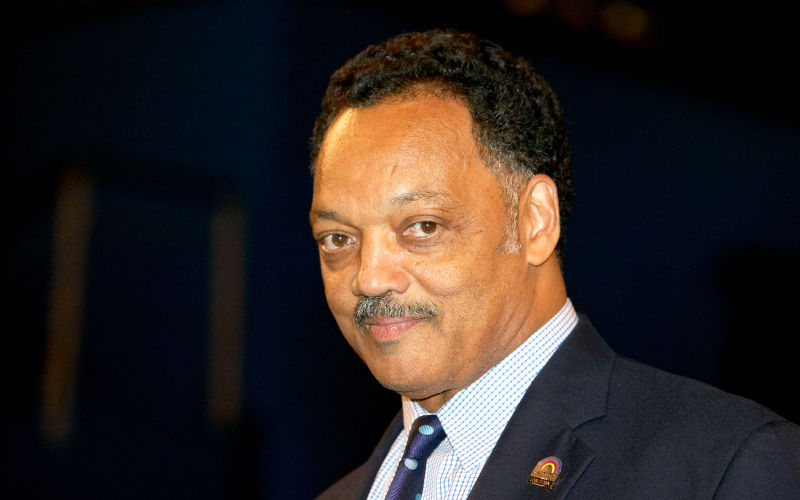
Civil rights icon Reverend Jesse Jackson, 84, died on 17 February, 2026. Corporate media reporting on his legacy will acknowledge his groundbreaking two runs for president and his civil rights work, but they are likely to leave out Jackson’s vital impact on Arab and Muslim American political organising and his support for a Palestinian state. Searching the Washington Report on Middle East Affairs website, we found 182 articles mentioning Jackson.
James Zogby, president of the Arab American Institute, discussed the Democratic Party’s evolution on Palestine on 14 September, 2016, at the Palestine Center. Dale Sprusansky’s article in the November/December 2016 Washington Report noted that when then-presidential candidate Jackson named Zogby his deputy campaign adviser, things began to change for the better in the early 1980s.
Jackson’s decision made Arab Americans feel as though they finally had a place at the political table. “The community got energised in ways I hadn’t seen,” Zogby recalled. “There had never been an American political campaign that had included American Arabs by name.”
In an article published in the January/February 2025 Washington Report, titled ‘This Year, Arab American Political Power Came to the Fore’, Rami G Khouri reminds us, “Jackson was the first serious presidential candidate to include Arab Americans as Democratic Party convention delegates, part of his Rainbow Coalition of ‘the white, the Hispanic, the Black, the Arab, the Jew, the woman, the Native American, the small farmer, the businessperson, the environmentalist, the peace activist, the young, the old, the lesbian, the gay and the disabled [who] make up the American quilt.”
A much earlier article published in the August 1988 issue of the Washington Report, titled ‘Palestinian Self Determination: Missing Plank in the Platform’, by Richard Curtiss recalls Jackson’s influence on a generation:
The second night of the Democratic Party’s national convention in Atlanta was the Rev. Jesse Jackson’s, and before it was over there wasn’t a dry eye in the house. The convention hall seats 16,000 people, but even before Jackson arrived to make his speech, it was filled to overflowing. Everyone wanted to be present for the emotional highlight of the three-day session, and when fire marshals closed the doors, many national Democratic Party and civil rights notables found themselves locked out of an event that some had traveled thousands of miles to see.
Jackson lived up to his reputation as America’s most stirring orator. As the television cameras moved from one ecstatic, rapt, or tear-stained face to another, each reflecting a different thread in the colourful American ethnic quilt, Jackson’s moment in the national spotlight was one that no American who saw it will ever forget.
For Americans middle-aged or older, just the sight of a Black man, born in a southern shanty to a housemaid, being introduced to a national television audience by his five well-dressed, well-spoken, well-educated children symbolised how far their country had come in one lifetime. For younger Americans, Jackson articulated ideals held in common. Yes to education; no to drugs. Yes to the environment, no to despoliation. Yes to economic justice, no to economic exploitation. Yes to peace, no to war.
For his own special constituency, the underprivileged and the underpaid, Jackson’s was a message of hope. No matter who you are or where you are, you can be better. You can make it. It’s no tragedy to fall short of achieving personal goals. The only tragedy is to have no goals.
For all, it was a moment of catharsis: Americans, no matter how diverse, can find common ground. No matter whether their ancestors came to the new world in an immigrant ship or a slave ship, they’re all in the same boat.
A descendent of Americans who came in a slave ship was articulating as clearly and as passionately as it had ever been expressed the vision of America’s founding fathers: Americans can be better; America will be better.
Jackson also spoke out against war in Iraq, and those warnings resonate today as the threat of a US war on Iran looms. A Washington Report article by Sara Powell, published in November 2002, described a civil rights protest at Freedom Plaza on 13 September, 2002. Americans wanted “to stop terror, not to spread it,” Jackson told the crowd, and the US should “lead the world, not rule it.” He said significant portions of the American public want “negotiation over confrontation,” and “minds over missiles.”
In an article published the following year in the May 2003 Washington Report, Pat Twair wrote:
In a last-ditch effort to challenge the Bush administration’s push to war, a crowd of 10,000 to 50,000 demonstrators braved the heaviest storm since 1952 in downtown Los Angeles on March 15. Wearing a yellow raincoat, the Rev. Jesse Jackson vowed that President George W Bush will face war crime charges if he starts a war on Iraq. “Give us a sense of sanity in high places,” Jackson shouted. “We need a coherent foreign policy that is committed to one set of rules. We must not look at the family of nations with contempt.” Jackson noted that the people in Bush’s administration didn’t fight for democracy in Selma, South Africa or Angola. Why then, he asked, are they so eager to install democracy in Iraq? “When the bombs fall, the US will lose its moral authority,” he warned.
Not everyone appreciated Jackson’s views on US foreign policy. As noted in a Washington Report article, published in November 1983, a group called Jews Against Jackson, started by Rabbi Meir Kahane, the founder of the Jewish Defense League, ran full-page ads claiming Jackson was “a danger to American Jews,” illustrated with a photo showing Jackson embracing PLO Chairman Yasser Arafat.
The American Israel Public Affairs Committee (AIPAC) was also not a Jackson fan and tried to discredit his presidential campaigns. In a Washington Report article titled ‘The Secret Section in Israel’s US Lobby That Stifles American Debate’, published in July 1992, author Gregory Slabodkin, who was an opposition researcher for AIPAC in 1990 and 1991, wrote, “The largest file that AIPAC keeps on any single person is that of District of Columbia ‘Shadow Senator’ Jesse Jackson.”
In an article by Washington Report cofounder Richard H Curtiss titled, ‘Who Suffers When Criticism of Israel Is Equated With Anti-Semitism?’ published in the May 1990 issue, Curtiss describes a familiar tactic waged today:
Jackson was the target of a smear campaign that all American Blacks, and most whites, recognise as unfair. His “Hymietown” remark was made in private and at the height of a campaign in which he was being harassed at every appearance by noisy, organised Jewish hecklers.
In fact, he is being smeared because he traveled to the Middle East to meet Yasser Arafat. There Jackson embraced not only the Palestinian leader, but the two-state solution to provide Israel with security and the Palestinians with self-determination. Some American Jews, more than half of whom now also support the two-state solution, apparently cannot forgive him for being the first to be right. In routinely referring to him as “anti-Semitic,” they are repeating slurs every bit as serious as his own one-time slur six years ago against New York’s Jews.
For decades many Americans have urged negotiations instead of bombs in the Middle East. They’ve been called anti-Semitic and that is the end of discussion. Rev. Jesse Jackson helped open the doors of American politics and society to everyone and championed equal rights at home and abroad – including in Israel and Palestine. “It’s hard to imagine a world without Jesse Jackson,” Washington Report’s ‘Other Voices’ editor Janet McMahon remarked yesterday.
Republished from Washington Report on Middle East Affairs