
Should Australia copy Canada and New Zealand on immigration policy?
February 25, 2026
Canada and New Zealand cut migration sharply and saw modest rent falls – but only alongside weaker labour markets and stronger housing supply. The lesson for Australia is not imitation, but stability.
There has been much discussion in the media (and amongst some politicians) that we should copy Canada and NZ on immigration policy after those two nations brought down net migration very significantly and experienced some falls in house rents. The Editor of the Australian Financial Review has explicitly recommended that Australia follow Canada’s lead. It’s therefore worth examining what has happened in those two nations.
Canada After running a very high immigration policy for a number of years (both before and immediately after covid), Canada made major cuts to overseas student numbers (much more than the reductions Australia has made) as well as to temporary worker numbers that led to net migration falling close to zero (see Chart 1).
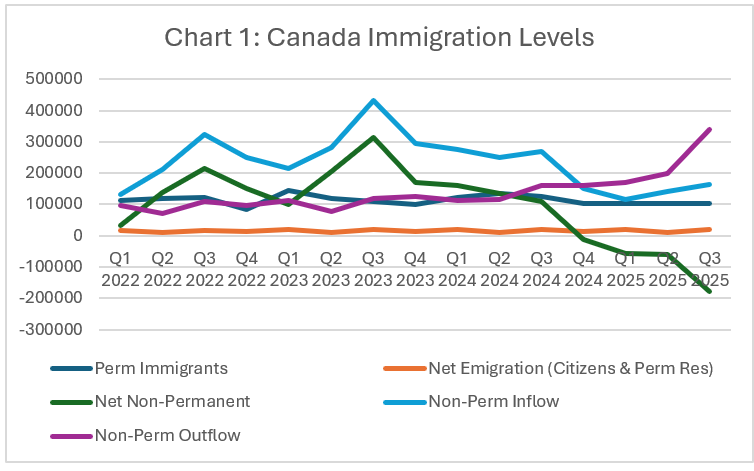
Permanent migration was also reduced but remains at around 380,000 in the current year. Australia’s permanent intake is around 210,000.
But it wasn’t just the cuts to students and temporary workers that drove down net migration to Canada. It was assisted by a massive increase in the outflow of students and temporary workers (as well as Canadian citizens and permanent residents) due to a very weak labour market. The rapid increase in the outflow has been much larger than the increased outflow of students and temporary workers from Australia. A key difference is the very different labour market conditions in the two nations.
Six months after the end of Covid, the Canadian unemployment rate had fallen to 4.8 per cent – the lowest in over 10 years. But soon afterwards, the unemployment rate increased to 7.1 per cent by September 2025. Australia’s unemployment rate has hovered just above 4 per cent through this period.
The Canadian employment rate (that is the portion of people 15+ who are employed) fell from 62.2 per cent in July 2022 to 60.6 per cent in September 2025. Compared to the situation a decade ago, Canada’s participation rate has been persistently low and is currently around 65 per cent (Australia’s participation rate has been around 66.5 per cent for a number of years).
Much of the weakness in the Canadian labour market is likely to have been driven by the trade war with the USA and the fact Canada’s median age is around 42 compared to Australia’s at around 38.
Driven by both policy change and a weak labour market, net emigration of non-permanent residents from Canada in the September quarter of 2025 was a record negative 176,479 with the outflow of non-permanent residents reaching 339,505 in the September quarter of 2025.
Not surprisingly, Canadian universities are facing serious budget problems and are significantly reducing teaching staff. As they used tuition revenue from overseas students to offset the costs of teaching domestic students, the offerings for domestic students have also been cut back. Private colleges are closing down in large numbers. Businesses operating near universities are also struggling.
This has had an impact on housing/apartment rents. After rising very strongly from August 2021 to September 2024, average rents fell over the next 12 months by 3.2 per cent, year on year to September 2025. This is likely to have been a function of net migration falling close to zero, a much weaker labour market over the same period, and record house completions in 2023 and 2024 leading to a slight slow down in 2025.
According to Canada Mortgage and Housing Corporation, “combined housing starts across Canada’s seven key census metropolitan areas (CMAs) in the first half of 2025 were just a few units below 2024 levels and near all-time highs”. It goes on to say “nationally, the housing starts total for all areas in Canada in 2025 was 259,028, the fifth highest annual total on record and up 5.6 per cent compared to 2024 (245,367)…These increases were driven by a second consecutive year of record rental housing starts which made up just over half of all housing starts in Canada’s urban centres”.
Canada has clearly been much more successful in boosting housing stocks than Australia.
As births only marginally exceed deaths in Canada (as a result of an older population), it is unlikely Canada will maintain a policy of zero net migration for very long. Canada’s management of immigration policy has exhibited even greater fluctuations than Australia in the recent past. This unpredictability will have negatively impacted business confidence and investment.
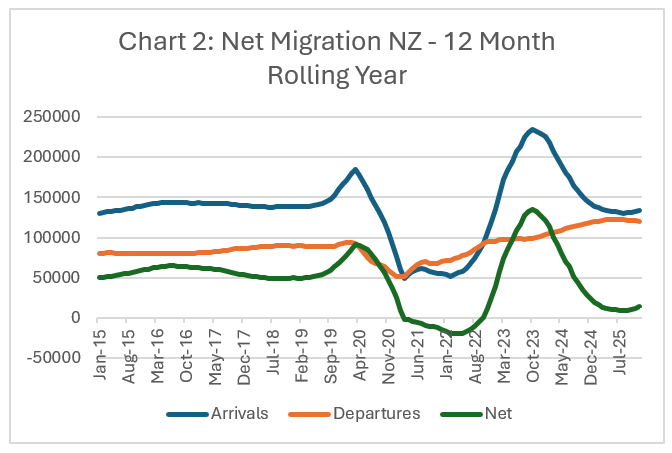
New Zealand Net migration to New Zealand was relatively high at around 50,000 to 60,000 per annum in the period 2015-17 due to a strong labour market compared to Australia. Even though the unemployment rate continued to fall, net migration in 2018-19 fell to just below 50,000 as Australia’s labour market recovered.
Net migration to NZ surged to just over 90,000 at the start of covid as large numbers of NZ citizens returned home. As in many nations, net migration to NZ fell into negative territory for most of covid before rising strongly just after covid to over 130,000 in 2023 due to the combination of highly facilitative policies as well as a strong labour market with the unemployment rate falling to less than 4 per cent.
NZ responded to the high level of net migration by tightening immigration policy which led to net migration beginning to fall. The fall in net migration accelerated because the NZ labour market deteriorated rapidly in 2024 and 2025 with unemployment rising to over 5 per cent in the second half of 2025.
Net migration fell to around 10,000 through most of 2025 with record numbers of NZ citizens leaving (see Chart 2). While this did result in housing rents in NZ falling marginally in 2025 (negative 0.5 per cent), the NZ Government is now loosening immigration policy, particularly in terms of overseas students.
The Canadian and NZ experience (as well as the Australian experience) highlights the importance of predictability in the management of net migration to a long-term target range in much the same way as the Reserve Bank manages inflation. The constant wild fluctuations in net migration levels make it very difficult for both government agencies and businesses to plan for the long-term, particularly from an infrastructure. housing and service delivery perspective. These also undermine the confidence of the general public in the management of immigration policy.
Prior to the last election, the Labor government promised it would introduce a long-term immigration plan. To date, it has failed to live up to that promise for no good reason.