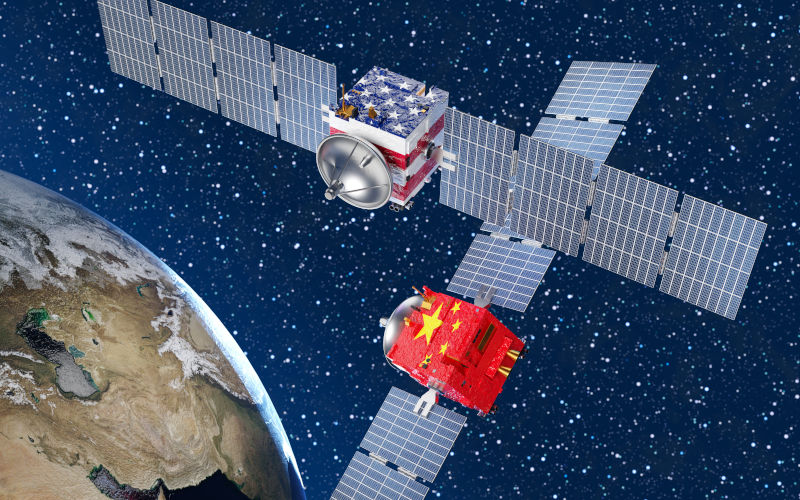
Steadfast state support is key to China winning tech race with US
February 2, 2026
China’s sustained investment in science, engineering and technology is pulling it ahead globally, while the United States cuts research funding and hollow-outs its scientific workforce.
In the science and tech race, China is steadily advancing while America is retreating. That’s the conclusion of multiple Western studies. US President Donald Trump’s own policies have greatly contributed to this trajectory.
Several salient features in this race for supremacy have been identified: China’s highly focused state support of science and tech, America’s federal defunding of them, and a nation of engineers and science graduates versus a nation of lawyers.
“China is an engineering state … facing off against the United States’ lawyerly society, blocking everything it can, good and bad,” wrote Dan Wang in _Breakneck: China’s Quest to Engineer the Future_.
The US may have a qualitative advantage in science, technology, engineering and mathematics (STEM), but China is well ahead quantitatively. In 2016, China already had 4.7 million STEM graduates, compared with 2.6 million in India and 568,000 in the US. In 2022, China graduated over 50,000 PhDs in STEM, while the US had 34,000.
China’s industrial policy has been consistent, long-standing and expanding. It is able to support and scale up a winning tech field and the firms in it to compensate for other bad choices.
Lizzi Lee, an Asia Society Policy Institute fellow, told Bloomberg that the Chinese system is “showing a very different – yet perhaps also viable, or even more feasible – model of development”.
Citing the examples of electric vehicles, solar energy and batteries, she said China’s strength is to “scale technologies quickly and deploy them throughout its economy”.
“I think similar dynamics will continue to manifest in its AI ecosystem, next-generation infrastructure, robotics and quantum sectors,” she said.
In July 2025, Unitree Robotics debuted its R1 humanoid model priced affordably at 39,999 yuan (US$5,741). It can walk, kick, jump and dance, as well as box and make some kung fu moves. In a brief, James Kynge, a senior research fellow in the Asia-Pacific program of Britain’s Chatham House, calls the R1 robot “a fitting symbol of China’s tech ascendance”.
Why? “In industry after industry, product after product, Chinese manufacturers are making cutting-edge technology at prices that Western competitors cannot match,” he wrote.
When it comes to quantum technologies, the congressional US-China Economic and Security Review Commission has warned that China has “deployed industrial-scale funding and centralised coordination to seize dominance in quantum systems”.
“China leads the world in quantum communications and is making rapid progress in quantum computing and sensing,” it said in a November report.
The report notes that while US research and development is distributed across agencies, businesses, and universities, “Beijing is concentrating talent, funding, and infrastructure in a handful of promising avenues” and that “in other areas of industrial policy, China has successfully used its ‘brute force’ approach with some success”.
Overall, according to the Australian Strategic Policy Institute, China is leading research in nearly 90 per cent of 74 technologies deemed crucial to national interests.
The Washington-based Information Technology and Innovation Foundation analysed 10 advanced tech sectors and found that China is either ahead of or near the world leaders in six of them.
Meanwhile, according to a new survey in the science journal Nature, the Trump administration is cutting science research funding and workforce across the board.
The survey features these headline figures: “More than 7,800 research grants terminated or frozen. Some 25,000 scientists and personnel gone from agencies that oversee research. Proposed budget cuts of 35 per cent amounting to US$32 billion.”
“These are just a few of the ways in which Donald Trump has downsized and disrupted US science,” according to the report. “As his administration seeks to reshape US research and development, it has substantially scaled back and restricted what science the country pursues and the workforce that runs the federal scientific enterprise.”
It’s clear what all this leads to. An analysis of China’s latest five-year plan by the Atlantic Council summarises the dilemma now facing the US.
It is “engaging domestically in more intense, partisan, and harmful confrontations and divisions on many subjects critical to its future financial stability and technological and scientific competitiveness”, according to the analysis, which notes that “Americans struggle with rancorous domestic divisions, project dysfunction over such basic issues as keeping the government open and planes flying, and indulge in partisan hostility to science and research.”
Trump’s emasculation of domestic basic science and tech is rooted in civil strife endemic across US society. “Such deep divisions at home are inflicting harm on the very institutions and principles that made the United States the world leader in the areas noted above for many decades,” wrote the Atlantic Council.
Republished from _South China Morning Post_ on 27 January 2026.