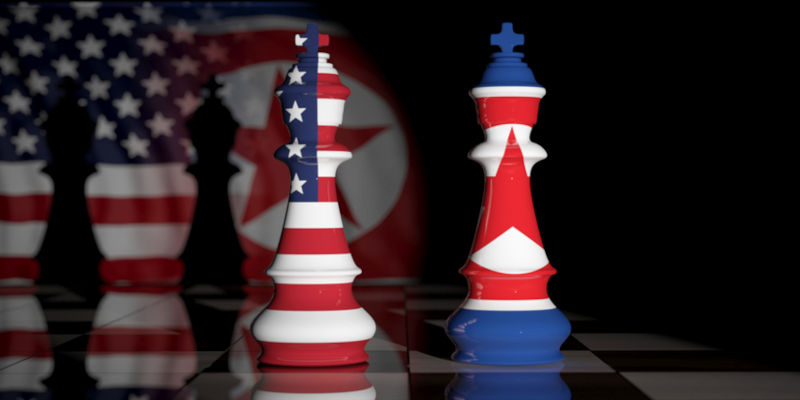
Why sanctions have entrenched conflict with North Korea, not resolved it
February 9, 2026
Sanctions on North Korea have neither halted its nuclear program nor produced stability, while imposing heavy costs on civilians and regional security.
The sanctions imposed on North Korea by the US, Australia, New Zealand and others have already resulted in the deaths of thousands of North Korean civilians. Are they still worth continuing to force North Korea to comply with the demand to roll back its nuclear and ballistic weapons program? Has the West deployed the appropriate ends, ways and means to achieve this goal?
US Ambassador (ret) Chas Freeman told me this week:
“I consider policies of maximum pressure that created a nuclear threat to my country where there had been none to be definitive proof of the imbecility of those policies. Quite aside from that, human decency would not countenance the denial of medical assistance to Koreans in the north regardless of how vile the regime they must live under may be. I fear that similar policies directed at Iran will also drive it to build the nuclear weapons it has heretofore declined to build and to mount them on ICBMs aimed at its American tormentors.”
I recently listened to former UK diplomat Ian Proud interview Commodore (ret) Steve Jermy on_ The Peacemonger_. Jermy, who commanded the UK’s Fleet Air Arm, and is undoubtedly a master strategist, pointed out the abysmal performance of the West in recent years.
“We’ve seen failed interventions in Afghanistan, Iraq, Libya, Syria and now the Russia- Ukraine war,” Jermy says.
Foremost, he says, what failed was the ability to think strategically and that prompted him to write _Strategy for Action: Using Force Wisely in the 21st Century_
“The evidence of effective strategic thinking is that operations are successful,” Commodore Jermy said. “And I use the test of Effectiveness, Efficiency and Enduring. Was the operation efficient? Was it effective? And were the results enduring? If you look back at Afghanistan, Iraq … I could go on … there’s no evidence whatsoever of any success. Indeed, the reverse.”
Let us extend that framework of strategic success – Effectiveness, Efficiency and Enduring – to the sanctions campaign to stop North Korea’s nuclear and ballistic missile programme.
Effective
Did the operation achieve its stated strategic objective? Did sanctions stop or reverse the nuclear and ballistic missile weapons program?
The factual record: No. According to Western intelligence estimates, North Korea now has approximately 50 nuclear warheads, with fissile material for up to 90. They’ve developed solid-fuel ICBMs, including the Hwasong-20, capable of striking the US mainland. Their weapons program is designed to achieve deterrence. The sanctions accelerated this.
Efficient
Did the operation achieve its aims with optimum cost/resources relative to the outcome?
The sanctions required a massive international enforcement apparatus – 11 countries deploying naval vessels and surveillance aircraft, an Enforcement Coordination Cell (aboard USS Blue Ridge) coordinating operations across multiple seas, decades of diplomatic effort at the UN, and untold billions in monitoring and compliance costs. The sanctions achieved the opposite of their stated goal at enormous cost to both innocent civilians and to the nations enforcing them.
Enduring
Did the operation produce lasting, stable results that don’t require continuous intervention?
Clearly, the enduring effect is a state of intense hostility. Both sides conduct endless war games, trust is at zero and the mechanism for diplomacy has been largely destroyed. We are further from a lasting solution than when sanctions began.
I sent Commodore Jermy a copy of this article and in his reply he commented on the sanctions:
“There’s very little evidence that they work. Worse still, they are evidence of a continuing Western meddling in other people’s countries, for reasons largely to do with hubris and moral righteousness.”
So, it is clear that, in respect to curtailing the North’s nuclear weapons program, UNSC 2397 and other measures have failed miserably. As geopolitical realists like John Mearsheimer point out: when faced with existential threats states will sacrifice anything to achieve deterrence. Now they have the nukes, the North has stated it wants to grow the economy and improve the livelihood of its population. That is the last thing the US wants (see the Cuba, Venezuela, Iran playbooks on destroying economies and harming civilians).
Despite the colourful rhetoric and aggressive posture of their leaders, the reality is that North Korea has had its back to the wall for generations, hemmed in by a more powerful South which has had US nuclear weapons stationed on its territory. These were apparently removed in the 1990s but the waters off North Korea bristle with US nuclear submarines and ships. At any one time several US nuclear submarines are prowling in the deep waters of the Yellow Sea, Sea of Japan and the South China Sea. Each can carry missiles the equivalent of over 1,000 Hiroshima bombs – truly apocalyptic. Would you trust Donald Trump to behave responsibly?
The Non-Proliferation of Nuclear Weapons Treaty (1970) is potentially excellent and to be encouraged. The first essential of such a program, however, is for nuclear powers (US, Russia, UK, France, China, Israel) to respect the territorial integrity, the sovereign rights of non-nuclear powers. We do not live in such a world.
Thankfully for millions of North Korean civilians the US grip on North Korea is slowly weakening. The war in Ukraine, terrible as it is, has provided a powerful engine for Russia and North Korea to cooperate. There has been a major increase in two-way freight, for example, North Korean artillery shells in one direction, and fuel and food from Russia in the other.
This has come about through a masterclass in Strategy by Dummies delivered by the Trump and Biden administrations.
As I pointed out in “The infantilisation of Western Grand Strategy”
“Geopolitical thinker Zbigniew Brzeziński, national security advisor to Jimmy Carter, said an even bigger threat to US dominance than a rapprochement between Moscow and Beijing was if Russia, China and, heaven help, Iran formed an alliance.”
Not only have they achieved just this but, for good measure, have moved the Russians and Chinese out of supporting UNSC 2397 directed at North Korea.
Most people I speak to are completely unaware of the fact that the US, trading under the nom de guerre ‘The United Nations Command’, killed millions of civilians in a revenge aerial bombing campaign as punishment for getting trounced by the North Koreans and Chinese in 1950.
So here we are 75 years later, still attacking North Korea in yet another of the West’s dark, mad forever wars. Isn’t it time we consulted our moral compass and set a course correction? Isn’t it time we killed the sanctions, not the civilians?