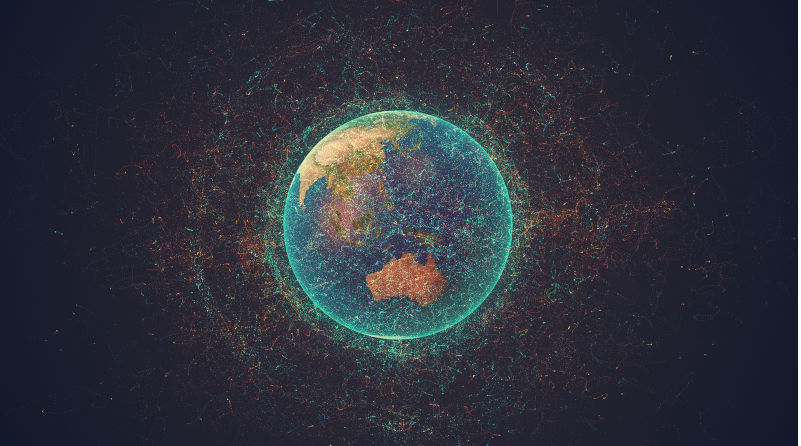
When ecosystems fail, civilisation follows
February 6, 2026
A new UK security assessment warns that ecosystem collapse is no longer an environmental issue alone – it is a direct threat to global security, prosperity and human survival. Without urgent action, the consequences will intensify well beyond climate change.
Worldwide, nature is collapsing and – according to the UK Government – will take human civilisation with it when it goes.
A new report from the UK states baldly what many countries’ governments and politicians are desperately trying to hide from their people: that environmental decline and collapse will hit all humans as hard as the animals and plants it is wiping out, as hard as global heating, nuclear war or any other catastrophic threat.
Worldwide ecosystem degradation and collapse threaten both national and global security and prosperity, says the British Government’s latest Security Assessment.
“The world is already experiencing impacts including crop failures, intensified natural disasters and infectious disease outbreaks. Threats will increase with degradation and intensify with collapse,” the report states. It warns that, without global action, the trend will continue beyond 2050.
“Cascading risks of ecosystem degradation are likely to include geopolitical instability, economic insecurity, conflict, migration and increased inter-state competition for resources,” the report says, hinting at the wars to come.
The UK’s findings strongly echo those of the UN’s Global Environment Outlook 7, issued in September 2025.
This stated that, “humanity now faces perhaps the biggest choice it will ever make: continue down the road to a future devastated by climate change, dwindling nature, degraded land, and polluted air, land and water, or change direction to secure a healthy planet, healthy people and prosperity for all.”
“If we choose to stay on the current path – powering our economies with fossil fuels, extracting virgin resources, destroying nature, polluting the environment – the damages will stack up,” warned UN Environment Program (UNEP) chief Inger Andersen. Climate change will slash 4 per cent a year off world GDP, food supplies will fail , millions will die from pollution, and the earth will become “a toxic garbage dump”.
The British Government adds that critical ecosystems that support major global food production and impact global climate, water and weather cycles will affect national security for most, if not all, countries.
“Severe degradation or collapse of these would highly likely result in water insecurity, severely reduced crop yields, a global reduction in arable land, fisheries collapse, changes to global weather patterns, release of trapped carbon exacerbating climate change, novel zoonotic diseases and loss of pharmaceutical resources.
“All countries are exposed to the risks of ecosystem collapse within and beyond their borders. Some will be exposed sooner than others and are likely to act to secure their interests, particularly water and food security.”
The UK highlights the following national security risks from ecosystem collapse:
- Migration will rise sharply as more people are pushed into poverty, food and water insecurity.
- Organised Crime will exploit scarcity and suffering leading to an increase in blackmarket trade in scarce food, drugs and strategic metals, human trafficking and slavery.
- Terrorist groups will discover fresh opportunities in political instability and may seek to control scarce resources.
- Internal threats will grow as individual countries face greater food and water threats.
- Pandemic risks will rise with the collapse of nature, due to mass migration, travel and new diseases passing between humans and animals.
- Economic insecurity is much more likely. Nature is a finite asset – whereas human demands now exceed the Earth’s ability to supply.
- Geopolitical tensions will rise as countries compete over scarce resources including land, water, safe transit routes and strategic minerals.
- Political polarisation and instability will grow in regions subject to food and water insecurity and/or natural disasters.
- Disinformation will increase.
- More wars will break out within and between states, as groups and nations compete fiercely over dwindling food, land and water. Existing conflicts will get worse.
The headlines in the UK report were also underscored in Australia’s first national Climate Risk Assessment, and in two recent reports by the Australian Security Leaders Climate Group. Though these deal specifically with climate rather than the wider environment, the warnings about rising threats to national security and national sovereignty are identical.
At the back of this mounting menace to the human future is the issue that no politician dares to speak: the collapse of the environment, and of human civilisation, is driven at root by overpopulation and overconsumption.
Global population is now approaching 8.3 billion people, who together consume 105 billion tonnes of materials a year – almost twice what the Earth can sustainably supply. That’s 13 tonnes of materials to support every human – four times more than in the past.
Although its growth rate is slowing somewhat, population is not expected to reach its peak, 10.3 billion people, until the 2080s. Then it will be five times the carrying capacity of the Planet. Meanwhile materials consumption is forecast to reach 160 billion tonnes a year by the 2060s.
The global environmental crisis that is now engulfing all nature as well as civilisation stems directly from the human ‘industrial metabolism’, a number of scientific groups have pointed out. As we rip apart the biosphere in a furious search for ever-more materials, minerals, food, water and energy, the environment that cradles all life is disintegrating.
“These changes are mostly driven by social and economic systems run on unsustainable resource extraction and consumption,” warned Rockstrom and colleagues in 2024.
This brutal truth lies at the core of the British Government’s warning of impending global instability, collapse and mass migration. Even the most thick-skinned and ill-informed in society are beginning to sense there is something seriously amiss with the world. Though they often strike out at the wrong targets, their apprehensions are not wrong.
If we destroy the cradle of life on Earth, we will knowingly destroy ourselves.