The smouldering wreckage on Capital Hill – part 1
February 3, 2026
The Coalition’s implosion after the Bondi sitting was not a sudden accident. It exposed long-running tensions between the Liberals and Nationals, intensified by polling anxiety, One Nation’s rise and the limits of Australia’s Westminster conventions.
Commenting on the chaos of the special post-Bondi sitting of Parliament, Malcolm Turnbull referred to the Coalition as a “smouldering wreckage”.
The government had set some traps for the Coalition, but they needn’t have bothered, because the party’s strategists brought it all on themselves. Prompted by Pauline Hanson and Barnaby Joyce, they decided to use the Bondi murders as a way to attack Labor, and to portray Albanese as “weak”. They insisted on a quick recall of Parliament to enact laws against racial vilification.
Had they thought through the way it would play out, they would have realised that condemning the hatred of antisemitism while directing a hate campaign against the elected government carries dissonant messages. They would have realised that legislating against racial vilification is politically difficult, particularly when some of the Coalition’s support from the right can be traced to white supremacists and nazis. They would have recalled the problems raised by faith-based groups, and by free speech libertarians when the question of racial vilification had come before Parliament in earlier times: having promised so much they were bound to disappoint those Jewish voices calling for tough action. And they would have known that the National Party was bound to resist firearms control.
Unsurprisingly it all blew up over just a couple of days. That was a catastrophe waiting to happen, because the forces that tore the Coalition apart have been building up over a long period, concerning not only right-wing parties, but more basically the ‘Westminster’ conventions that have become increasingly detached from Australia’s political reality.
Each of the two parties that comprised the Coalition have their own views of these developments.
As the National Party sees it
Over most of the last 125 years the Country Party, later to become the National Party, has been in some form of coalition arrangement with the Liberal Party and its predecessors. In terms of Parliamentary numbers it has generally been the junior partner, but it has wielded disproportional influence because the Liberal Party has rarely been in a position to govern in its own right. Writing in The Conversation Linda Botterill of ANU describes this history, bringing us up to date with the current conflicts. She uses the metaphor of a marriage that has gone bad: journalists are extending the metaphor to refer to a couple trying to get back together. The marriage metaphor falls down somewhat, because in a wedding vows are exchanged in public, but the Liberal-National agreement has always been secret.
For now, strategists in the National Party feel inclined to show their power. While the Liberal Party has been clobbered in the last two federal elections the National Party has held up comparatively well. In 2019 the Liberals won 45 House of Representatives seats, the National Party 10, and the LNP in Queensland 21. In last year’s election the Liberals’ representation was reduced to 18 seats, while the Nationals held 9 seats, and the LNP 16.
In raw numbers, the Liberal Party has lost its base, while the National Party’s base, particularly in rural Queensland and rural New South Wales, has held up – perhaps even consolidated.
The other emboldening factor has been the growing popularity of One Nation, confirmed in polls taken after the federal election and showing up more strongly in polls taken since the Bondi murders, but before the Coalition collapse. The figures from these recent polls, taken from William Bowe’s Poll Bludger, are in the table below.
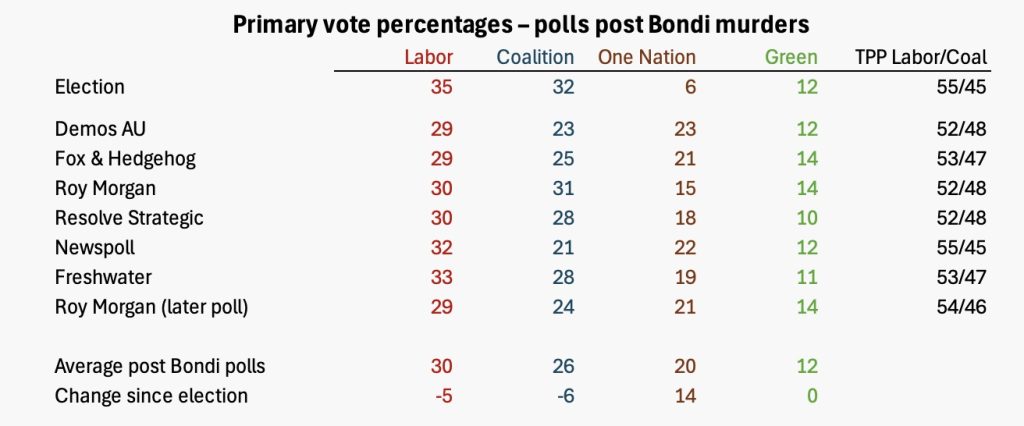
Although both the Coalition and Labor lost support, while One Nation surged, Labor’s relative strength in TPP terms (particularly in Newspoll which seems to carry most authority among the commentariat), suggested that One Nation picked up support mainly from the Coalition, and in view of the demographic similarity of National/LNP electorates and those electorates where One Nation has strong support, it’s a reasonable inference that it’s the Nationals who were losing support to One Nation.
Wednesday’s Poll Bludger covered four polls taken during or just after the bust-up. They suggest there has been a small movement back to Labor, a further loss in support for the “Coalition” (pollsters may need to refine their categories), and further support for One Nation.
Jason Falinski, former president of the New South Wales Liberal Party, said on Radio National that the National Party has been “freaked out” by those poll numbers, and is trying to occupy One Nation territory, hoping that they can drag the Liberals to come along with them.
The media and political parties are probably over-estimating the extent to which polls indicate support for One Nation. The Australian Election Study tracks people’s support for political parties, and while our feelings about the established parties are roughly neutral on a like-dislike scale, our feelings towards One Nation are distinctly in the “dislike” zone. A response to a pollster indicating support for a fringe party is a politically costless way to register discontent, that may not be replicated in a real ballot.
But the political establishment takes polls seriously. So the Nationals have sought to differentiate themselves from what they portray as the woke Liberal Party. Firearms control provides a case in point. At first sight it makes little sense for the any party to oppose tighter firearms control, because as reported in the last roundup, everyone, including National Party voters, wants stronger control of firearms: in fact country people probably feel more threatened by firearms than city people because there are so many weapons out in the bush. But that’s not the point, which is about political differentiation. (Not that the Liberals had any intention of supporting the government’s firearms bill.)
So too on hate speech. The idea that the National Party would take a principled stand on any aspect of civil liberties is risible. But a wide interpretation of the government’s already watered-down legislation suggests it could throttle free speech – a point made strongly by the Greens, and by constitutional expert Anne Twomey. Again it has been a point of differentiation. And it gives some comfort to those who want to spout white supremacist ideas, antisemitism, and scare campaigns about threats from hordes of armed African youth, even though the government, under pressure from the Liberals, dropped racial vilification from its legislation.
So the Coalition, at least the coalition with a capital “C”, has come apart. The conflict during the two-day special sitting of Parliament, involving rules about shadow cabinet loyalty, are described in forensic detail in a Saturday Paper article by Karen Barlow: Inside the Coalition split. To the outside observer the conflict seems to be about arbitrary administrative rules, making as much sense as a long-term friendship torn apart by a spelling dispute in a social Scrabble game. But as Niki Savva points out on Saturday Extra, the conflict between the parties was going to happen some time, over some issue, because the basic differences between the parties have become irreconcilable. Crispin Hull’s article explores ways that the parties could get back together, but he seems to conclude that it’s the beginning of the end for the Nationals.
Maybe, but they remain strong in rural Queensland, the Northern Territory, and northern rural New South Wales. A pity that most Australians live somewhere else.
Tomorrow: as the Liberals see it and trouble for the Westminster system