Davos and the myth of a global conversation
February 5, 2026
The World Economic Forum claims to represent global cooperation, but its structure, silences and hierarchies tell a different story about who sets the agenda – and who is expected to listen.
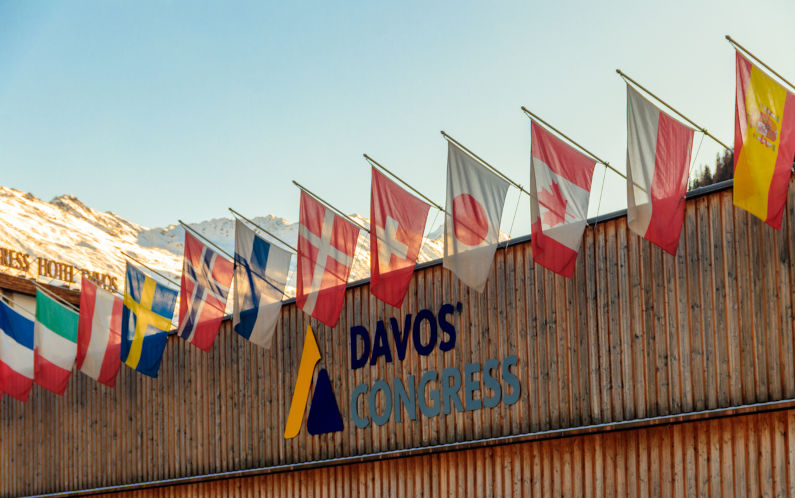
The World Economic Forum (WEF) at Davos likes to call itself a global meeting place for leaders to “improve the state of the world”. In truth, it is still an exclusive club in which a largely white western elite talks to itself about the future of the world as they want to see it, to which the rest of humanity is invited to listen politely from the sidelines whilst often being lectured. When they are viewed as posing a threat to the western worldview – as is the case for China and India – they are patronisingly given a platform to explain themselves or assure the western world of their worthiness.
And make no mistake, entry to this club costs money. Serious money. Corporate memberships run up to $750,000 a year. A badge to get through the door costs $35,000. Some companies pay a million dollars just to sponsor a venue. Before a single word is spoken, the price of admission has already told you who this gathering is really for.
That gap between branding and reality has never been more visible than this year, where the theme was, ironically, ‘Collaboration for the Intelligent Age’.
The WEF has evolved into the annual ritual of a transatlantic establishment that assumes it has both the right and the competence to define what is normal, legitimate, and aspirational for everyone else, driven by the belief that the world is their oyster.
The main stages, the media focus, the private rooms in the best hotels are all arranged around western political leaders, central bankers, and corporate chiefs. Others are there – provided they pay the fee – to add colour, to nod along, and to demonstrate that “the world” has been engaged and consulted. But despite paying first-class prices for the ticket, they do not sit in first class, but in economy, yet fund the project, such is the ingrained subservience.
As BBC Journalist Anthony Reuben writes, the forum even runs “an almost caste-like system of badges.” White badges open every door. Orange badges mark you as a working journalist – permitted to observe, but never to belong. The hierarchy is literal, physical, colour-coded. It is not a metaphor for the order they wish to maintain. It is the order itself, made visible.
The US President’s speech in Davos was therefore not that shocking or unbecoming. In fact, it was very fitting. It was the system speaking, albeit less politely. He cast “the West” as a higher civilisation under siege, argued that western prosperity is the natural product of a superior culture, and portrayed environmental movements as extremists threatening that order.
This is an old story: the civilising mission dressed up for the age of multipolarity, anti-imperialism, climate wars, and mass migration. What matters is not that one man said these things, but that he did so as the honoured guest of a forum that insists it represents all of us and purports to “improve the state of the world”.
Even more revealing was the reaction in the room. The applause lines were not for humility, restraint or listening to the rest of the world. The cheers came when Trump spoke about defending western culture, when he dismissed those who he sees as outsiders, when he hinted again at the idea that the United States should “get” Greenland as if it were a real-estate opportunity. In that enthusiastic response you could see something very old: a quiet endorsement of a hierarchy in which western claims to land, resources and security are treated as natural, while the same behaviour by others is seen as dangerous. One wonders what all the non-western people in the room – the minority from the majority – thought of all this and felt.
This year also saw the spectacular unravelling of the WEF’s pretensions to impartiality. Last year it was alleged that it had manipulated the organisation's flagship Global Competitiveness Report. When the data showed the UK rising in the rankings, it was decided to suppress it, out of fear that that any improvement would be “exploited by the Brexit camp.” When India was set to drop 20 places, it was felt that protecting the relationship with India was important and the published report showed India falling by just one spot. For decades, the WEF lectured governments across the developing world about transparency and good governance. But its flagship reports were in fact doctored.
And when a leadership change was required after the founder stepped down, who did the WEF appoint to guard its “mission and values”? Larry Fink, CEO of BlackRock, the largest asset manager on the planet, overseeing nearly ten trillion dollars. A CEO of a firm which has been criticised for its outsize influence on global markets, its stakes in fossil fuels, its quiet power over pension funds and sovereign wealth.
This is the double standard that defines the so-called rules-based order of today. When western leaders talk casually about acquiring territory or reshaping borders, it is discussed as strategy. When non-western states contest borders or try to rebalance power, they are criticised for infringing on sovereignty and punished with sanctions, lectures and the language of existential threat. Davos does not interrogate this disparity. It normalises it. There was no mention of Israeli occupation of Gaza and genocide because that has been normalised.
Over 71,000 Palestinians have now been officially counted as killed. But tens of thousands probably lie buried under rubble that no one is permitted to clear, not to mention those who have died of starvation and other factors. Israel’s own military intelligence data, leaked last August, confirmed what the world already knew: 83 per cent of the dead were civilians. Women and children make up more than half. Ninety-two per cent of residential buildings have been damaged or destroyed. An entire society has been flattened. And in Davos, there was silence. This is what normalisation looks like. This is what it sounds like.
Initiatives launched under the language of “peace” and “stability” are often designed and controlled by western institutions, with those living through war and occupation reduced to case studies – especially Palestinians today, which also provides the most glaring example of WEF’s paternalistic exclusion by providing the platform for Donald Trump to launch the “Board of Peace”. Not only is the Board a gross overreach of western influence, an attempt to undermine the UN and a clear attempt to normalise genocide, but it also disenfranchises the people who are bleeding and starving to death, who are never the ones who set the agenda for their future.
The manner of the unveiling made it worse. Jared Kushner, Trump’s son-in-law, a real estate developer by trade, stood before the assembled leaders and presented a slideshow. Artist impressions of gleaming towers along Gaza’s Mediterranean coast. A “coastal tourism zone” with 180 planned skyscrapers. A new airport. “We do not have a Plan B,” he declared. “We have a master plan.” Not a single Palestinian was in the room. Not a single Palestinian voice was heard. The people whose homes had just been reduced to rubble, whose families had been buried beneath it, were treated as obstacles to be cleared before the developers could move in.
This is what peace looks like when it is designed by people who see land, not lives.
Even France, hardly a champion of the global majority, refused to join the Board of Peace. Its foreign ministry stated bluntly that the charter “does not correspond with a United Nations resolution to resolve the war in Gaza” and contains elements “contrary to the UN charter.” When members of the western club itself can see the farce for what it is, it tells you just how brazen the performance has become.
A look at how the US President was handled by the forum’s own grandees and by the financiers who dominate its ecosystem is telling. It is with fear, trepidation, admiration and even respect. The same people who spend the year telling governments in Asia, and Latin America how to run their economies, how to do “good governance”, how to meet environmental and social standards, became remarkably deferential when confronted with a western leader openly threatening annexation, coercion and civilisational confrontation. The message is clear: demanding accountability is something you do to the global majority, not to one of your own.
This pattern repeats itself in more “sophisticated” forms in the interventions of leaders like Mark Carney. His widely praised speech about a geopolitical “rupture” was treated as a moment of high wisdom by the duplicitous western mainstream media. He also spoke of the end of a comfortable western illusion, of great powers turning economic interdependence into a weapon, and called for “middle powers” such as Canada to act together so they are not “on the menu”. The metaphor is striking, but it is also astonishingly revealing.
Think about what Carney actually said: “Middle powers must act together, because if we’re not at the table, we’re on the menu. Great powers can afford to go it alone. They have the market size, the military capacity, the leverage to dictate terms. Middle powers do not.”
He spoke as if this revelation had just dawned on him. As if Canada had only now discovered what it feels like to be squeezed by a more powerful neighbour. One wonders whether he has ever had a conversation with anyone from Latin America about their experience of American leverage. Or from Africa about structural adjustment. Or from Southeast Asia about what it means to have your economic policy written in Washington. The menu has been set for a very long time, Mr Carney – welcome to the Daily Specials Club.
For most of the world, being “on the menu” is not a future risk. It is the past and present of the global economic system. Countries across Asia, Africa and Latin America have been carved up for resources, labour and markets for decades through trade rules, debt regimes, military interventions, sanctions and the operations of western multinationals. Canada is not a part of the menu on this table; it is part of the dining party. Indeed, Carney’s assertion of being a “middle power” is dishonest, because if Canada is a “middle power” what is it doing in the G7? If Canada is a middle power, rather than a part of the Anglo-Saxon global club, lording over others and thus enjoying the free pass of “global white privilege”, then what are we to make of sizeable countries like Indonesia, Nigeria, and Brazil? Just messy non-western countries which don’t matter unless they are able to serve the West?
When a G7 leader finally acknowledges that power is weaponised, he is treated as the first person to notice, when the reality is that so many others have given their lives fighting against this injustice. The many voices from the global majority, such as those of leaders from Africa and Asia who have said this for years at more prestigious platforms such as the United Nations General Assembly, are ignored or patronised. What is Gaza if not the weaponisation of power to commit genocide? But Carney did not have the courage to mention that raw bleeding wound in his narrative, given he is the leader of a nation built by white settlers.
The same applies to the narrative being built around figures like Gavin Newsom, the Governor of California, celebrated for talking tough about “kneecapping” CEOs who collaborate with authoritarian politics. Western media quickly cast him, and by extension European elites, as the brave resistance to a dark Trumpian threat. But where is the recognition of those outside the West who have taken much bigger risks, for much longer, resisting the very same global forces? Where is the acknowledgment that some of the most serious constraints on destructive American policy have come from other powers who simply refused to comply, like China? Other weaker nations have also stood up to the bullying, stretching from Cuba and Venezuela to Libya, Iraq, Iran and even North Korea. The story from Davos is edited so that western figures are always the protagonists, even when they are late to the truth, whilst the others are painted as autocrats and repressive regimes.
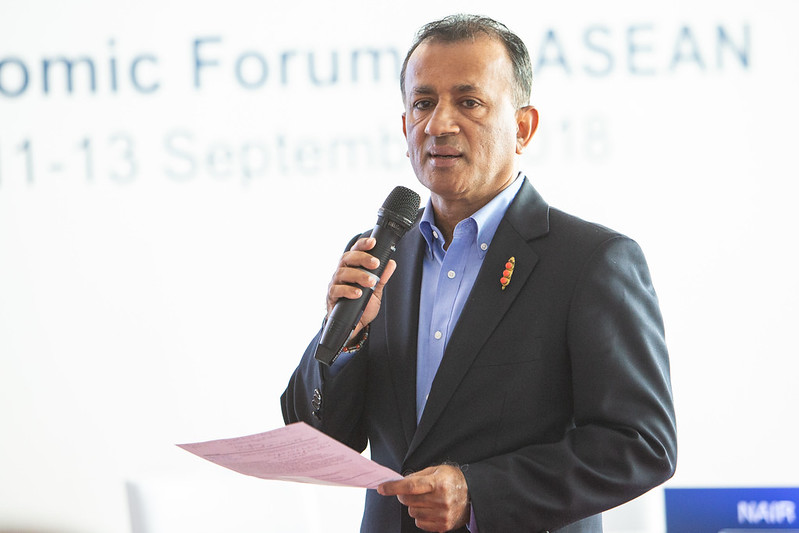
Meanwhile, leaders and thinkers from the global majority are placed literally and figuratively on the side panels. Consider Indonesia’s president, Prabowo Subianto, presenting “Prabowonomics” – a domestic program focused on clean governance, poverty eradication and stability. This should be central to any honest conversation about how the future global economy will be shaped, not least because countries like Indonesia will be decisive in determining whether we can achieve sustainable development without repeating the western model of ecological destruction. Yet such contributions barely register in the international coverage of Davos. They are too serious, too grounded in the real struggles of the majority, and they do not flatter western self-images or pander to their fears.
President Prabowo spoke of feeding nearly 60 million people every day – children, pregnant mothers, the elderly living alone – through a free meal program that will soon surpass McDonald’s global daily output. He spoke of seizing millions of hectares of illegally held land from oligarchs. Of confronting corruption “directly, firmly and openly.” Of building a country where, as he put it, “the poor and the weak can smile and can laugh.” But the western press was captivated by the theatre of Trump versus Carney, by the Greenland saga, by tariff threats and diplomatic snubs. Real policy from the leader of the world’s fourth most populous nation was treated as filler. Background noise. Not the main event.
Consider who was missing entirely. Brazil – the largest economy in Latin America, a G20 member, a founding BRICS nation, home to over 200 million people – had no meaningful presence at the heart of this year’s forum. President Lula did not attend. Neither did his Finance Minister. Brazil’s only representative from the first tier of government was the Management Minister. And yet Davos carried on, undisturbed, confidently discussing “the future of the world” while treating an entire continental power as optional. You cannot claim to speak for the global economy while sidelining a nation that represents 200 million people. Or rather, you can – but only if you believe those 200 million do not really count.
This marginalisation is reinforced by the way Davos talks about “risk”. Migration, climate disruption, and fragile states are framed primarily as threats to western stability, to western borders, to western supply chains.
People pushed from their homes by wars they did not start or by climate damage they did not cause are reduced to flows and numbers that must be managed. The underlying question is not: what does justice require? It is: how do we protect “our” way of life from “their” instability which in truth “we” often helped to sow and trigger, as in the case of Iran?
Trump’s blunt civilisational rhetoric and Davos’s smooth risk language serve the same purpose. They both turn non-western lives and territories into objects of management by western institutions. One does it with crude talk of civilisations and failed cultures. The other does it with charts, acronyms and soothing phrases about resilience. Both rest on the assumption that western interests are the organising principle of global order.
None of this is accidental. It flows from history, as does who owns, funds, and runs the forum. The leadership is drawn overwhelmingly from western institutions and their allies. The numbers speak for themselves. Two-thirds of the WEF’s Board of Trustees come from North America and Europe. There is not a single African. Half are corporate executives. Twenty-two of the 24 were educated at American or European universities. Ten attended the same institution: Harvard. There is one representative who could be said to speak for civil society. There are no trade unionists, no farmers’ organisations, no indigenous voices, no one who might speak for the billions who will live with the consequences of decisions taken in rooms they will never enter.
Tokens from the global majority are given patronising “Global South” roles. The corporations that pay to shape the agenda are headquartered mainly in the rich world and their “subordinates” in the non-western world, always keen to burnish their legitimacy and credentials through association with the empire. The media that decide which sessions matter are rooted in western narratives about progress, security, and modernity.
Under these conditions, the embrace of Trump is not a mistake. It is a symptom. If the world is serious about a truly global forum, the WEF would not be hosted at a comfortable ski resort meeting place to draw a self-selecting elite. It would not be hosted in a hostile, cold environment but in the warmer regions, home to the global majority. It would be a place where western leaders and financiers are finally forced to attend as equals, listen, at length, to those who have lived with the consequences of their decisions. It would be one of many platforms, not the apex of a hierarchy that presumes a right to speak for the world.
But we shouldn’t expect the patrons and disciples of Davos to bring about any change. That will have to be birthed by the rest of the world. Part of that process would involve the leaders and elites from Asia, Africa, Middle East and Latin America shunning events like WEF, redirecting their funds and convening elsewhere to discuss the global agenda as seen through a new multipolar lens.
And this is no longer a pipe dream. It is already underway. BRICS has grown to eleven members. It now represents over a quarter of the global economy and nearly half the world’s population. At the 2025 summit in Rio, Brazil’s President Lula declared what many have long known: “We are witnessing an unprecedented collapse of multilateralism.” If international governance cannot reflect the multipolar reality of this century, he said, then it falls to BRICS to build something that does. The New Development Bank, currency swap agreements, regional trade forums – all of this is being constructed precisely because institutions like the WEF have refused to change. The Global Majority is no longer waiting for permission. They are building their own tables, with free-range, farm-to-table seasonal menus.
The WEF now boasts that around half of attending leaders this year came from the Global South. This is presented as progress. But attendance is not influence. Presence is not power. When the agenda is drafted in Washington and Brussels, when the cameras follow western leaders, when the real business is conducted in private rooms at the finest hotels, the rest are extras in a production designed to legitimise conclusions already reached.
The question is not whether leaders from Asia, Africa, and Latin America can get through the door. It is whether they will keep knocking on doors that were never built for them – or whether they will finally walk away and stick with building their own.
Until that change is brought about conclusively, the world’s majority should treat Davos as what it is: an exclusive club that has ingeniously positioned itself as the arbiter of what is good for the world, appears to look out at the rest of humanity and claims to speak in their name, but is purely driven by the desire to maintain the status quo of western dominance of all aspects of globalisation.
The first act of self-respect is to stop believing that claim. The US President, in his performance this year, did the world a favour: he made it undeniable that the claim is a lie.