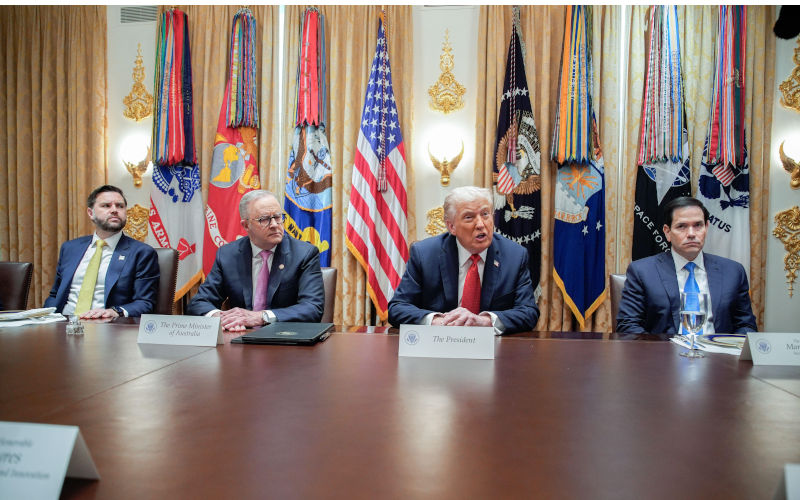
Australia’s Trump reprieve masks a deeper strategic dilemma
February 2, 2026
Australia may have escaped the worst of Donald Trump’s return to power so far. But beneath the surface, Washington’s shift towards spheres of influence is exposing serious weaknesses in Australia’s strategic posture.
As Australian Prime Minister Anthony Albanese seeks to maintain a careful balance between Washington and Beijing, Trump’s renewed emphasis on spheres of influence, coupled with his disregard for allied concerns, increasingly challenges the sustainability and effectiveness of Australia’s diplomatic straddle.
On the surface, Australia came through relatively unscathed from the Trump hurricane in 2025. It attracted a lower tariff than its Southeast Asian neighbours, received a presidential blessing on the AUKUS nuclear submarine deal and struck a critical minerals deal with Washington. But Australia’s ostensible reprieve masks deeper problems of its strategic exposure to an erratic and revisionist United States.
US President Donald Trump is unbound and on the loose, overturning long-held assumptions about the United States’ role in the world and acting in ways fundamentally at odds with international law.
This changed picture owes much to what French President Emmanuel Macron once referred to as the ‘beast of events’. Throughout 2025 the outlines of a new Australian diplomacy had begun to emerge. Following its return with a vastly improved parliamentary majority after national elections in May, Australian Prime Minister Anthony Albanese’s government asserted itself with somewhat more confidence on the world stage. A new defence treaty was signed with Papua New Guinea and Canberra spoke more frankly to both the United States and China. It might be termed the ‘Australian straddle’.
Albanese reminded Washington of a longstanding tradition in Australian foreign policy – that Canberra, knowing that great powers often play fast and loose with Australian interests, can express its independence both within and without the alliance. Throughout 2025, he stood firm on demands from the United States for greater defence spending, just as Trade Minister Don Farrell stressed that Australia wanted to do ‘more, not less’ business with China.
With Beijing, Albanese went beyond the policy of ‘stabilisation’, embracing wholehearted but selective engagement. He stood firm on foreign investment rules, ownership of Darwin Port and Chinese naval exercises conducted near Australia. During his six-day visit to Beijing, Albanese was clear: Australia has differences with China, but these should not define the relationship. In Beijing Albanese talked about building a ‘more comprehensive relationship’, this while Defence Minister Richard Marles and Foreign Minister Penny Wong remain trapped in the ‘stabilisation’ frame.
Australian policymakers grasp that most, if not all, countries in the region are still balancing in some way: wary of China, leery of Trump. And Australia’s ‘straddle’ may very well have the shortest of shelf lives, simply because the Trump administration’s callous approach to allies is ramping up again.
In 2026 and beyond, it is unquestionably how Australia handles Trump that will dominate foreign and defence policy debates. For at least the past 15 years, notwithstanding its broadly successful cooperation with ASEAN and Pacific partners, Canberra has bet its strategic house on US staying power in Asia. While it showed some signs of shoring up alternative partners when it revived the Keating–Suharto era security agreement with Jakarta, and Canberra has continued to develop relations with New Zealand, Fiji and Singapore, Australian strategic policy has largely continued to be dominated by how it fits into US grand strategy.
But the release of Trump’s National Security Strategy (NSS) in December 2025 repointed the American raft back to a world based on spheres of influence. With the emphasis on a US sphere of influence in the Western hemisphere, vividly illustrated in the snatch-and-grab raid on Venezuelan President Nicolas Maduro in early January, Trump’s statement implicitly endorses China and Russia having their own.
Australia’s response to Trump’s Venezuelan escapade was tepid, pressing for a ‘diplomatic’ solution. When Trump intensified the pressure on Denmark and other European allies in relation to his desire to annex Greenland, Australia again opted for the placidity of platitudes rather than a definitive position. It may be that Canberra’s underlying policy is to keep its head down for the remainder of Trump’s term, avoid frightening the bosses in Washington or Beijing, not get out ahead of other middle powers in calling for bolder movement and try to muddle through.
On the other hand, this is a new world Australia must live with and learn to negotiate. But for the moment, its leaders are still mouthing the shibboleths from the lost world of a ‘rules-based order’: Foreign Minister Penny Wong even evokes the language of the United States’ unipolar moment in the 1990s, describing its leadership as ‘indispensable’. These ministers appear to be clinging to a world that no longer exists.
We still do not know the precise contours of the United States’ China policy, yet Trump’s NSS leaves Australia on the periphery in dealing with China. Canberra has been spared Trump’s torture, but the document’s heavy emphasis on defending the ‘first island chain’, running from Okinawa through Taiwan to the Philippines, implies Australia will continue providing bases to backstop these defences and assist in any future war over Taiwan.
The ‘first island chain’ essentially refers to Taiwan since, as the NSS explains, ‘Taiwan provides access to the Second Island Chain and splits Northeast and Southeast Asia into two distinct theatres’. So if the first island chain is to be defended, then Taiwan is to be defended.
The NSS makes a clear statement to China, even if not as frank or brazen as elsewhere. It implies that Taiwan cannot be defended without the support of bases in Japan, South Korea and the Philippines, meaning there is no US military preponderance in Asia without its allies. This also suggests China’s campaign against Japanese Prime Minister Sanae Takaichi has backfired, strengthening Japanese public support for mobilising over a war in Taiwan.
Australia’s US bases are not critical to the support of Japan and Taiwan, but they are a key staging post for US forces. If Trump’s strategic direction endures, a future Australian government may confront the choice of whether to deny support to the United States. Such a decision would fundamentally recast Australia’s relations with both Washington and Beijing. This is the true dimension of Australia’s strategic dilemma.
Republished from the East Asia Forum, 26 January 2026

