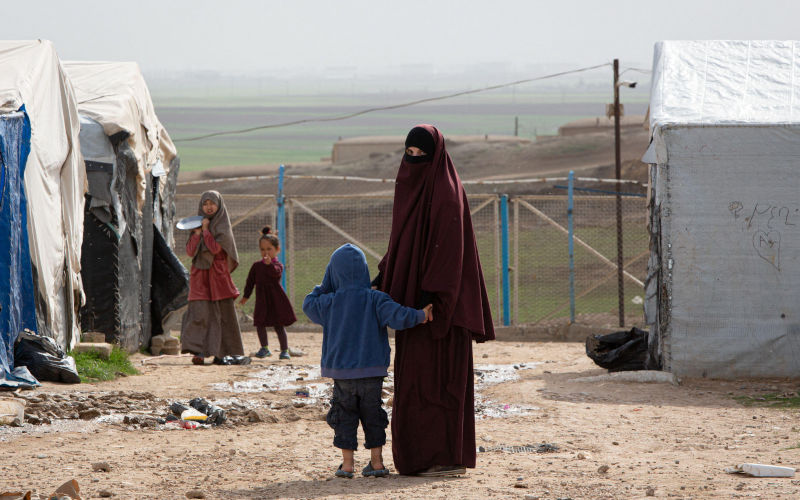
Values, ethics, fear – Australian women and children in the Al Roj Camp
February 24, 2026
Politicians frequently appeal to Judaeo–Christian values, yet retreat from them when fear dominates debate. The test is whether those values guide policy when it is hardest to apply them.
We live in a world of deep skepticism. Skepticism and fear are driven by perceived security threats, economic duress and general uncertainty. It is fuelled by mainstream media, social media and ‘influencers’ ready to offer simplistic solutions. It is fed by politicians who politicise fear for partisan political advantage. In this context, what value system can we rely on to draw us to safer ground?
Those on the right, insist our way of life is founded on Judaeo/Christian values and ethics, with acceptable moral behaviour being weighed in relation to these values.
I have no difficulty with this position, in fact endorse it. The ethic is relational; properly understood and acted upon, it sets individuals in a broad communal context, local, national, and global. It is bewildering that the consequence of this value system is deemed ‘left wing’, or ‘woke’ by the very people who claim it to be their foundation. So, Angus Taylor, David Littleproud or even Anthony Albanese, when you talk about Australian values, or Labour values, or Coalition values, what are you talking about and what are the implications of those values when legislated as policy? What ethical setting is guiding your rejection of 11 Australian women and their 24 children from retuning to Australia?
If you will allow me, may I articulate Judaeo/Christian values as I understand them, while humbly recognising they are often badly exhibited by Jewish and Christian institutions and individuals whose responsibility it is to live and proclaim them.
Human dignity: Every person is seen as valuable, made in the image of God, and deserving of respect
It is a matter of fact that these 34 human beings are Australian citizens and as such are Australia’s responsibility, for their redeeming and restitution, as was the case with David Hicks and Julian Assange. It is also a matter of fact that the international norm and expectation is that nations will take back their citizens from overseas no matter their behaviour, at the request of nations in which they reside. It has been the expectation of the Kurds and the US and now the Syrian government that these people return to Australia. Australia acts on the same premise, even with a friendly country such as New Zealand, when one of their citizens has been guilty of a criminal act on Australian soil. To be a nobody is to have no dignity. National identity is sought and claimed by every human being.
Our justice system, properly applied, must both protect dignity and apply justice. Each of the 11 women must be treated fairly and considering the known circumstances surrounding their misadventure. Australian security should make this determination, not politicians and certainly not the shrill voices of biased media operators.
Love of neighbour: Ethical behaviour is guided by the principle of loving others as oneself, including acts of kindness, charity, and forgiveness
It is the case that all of us make poor decisions, and that we are more likely to make these poor decisions when we are young. It is also the case that when we are young, good or poor decisions depend on the company we keep, and the experiences we have lived through. We are all dependent on forgiveness and a new start. I understand most of the women were young teenagers when they departed Australia.
Redemption and restitution of the other is a responsibility of all who have power or influence over, or for, others – governments, employers, parents, security forces. The urgency of acting for the children is pressing. It is not possible to care for the children without their mothers.
Justice and fairness: Upholding justice, protecting the vulnerable, and striving for fairness are fundamental duties
It is partly true that we reap what we sow. However, it is also true that we are all victims of movements, changes, forces which impinge upon us and over which we have little or no say or control. The more vulnerable our situation, the more likely we will be manipulated. Striving for justice and fairness is at the heart of the Judaeo/Christian ethic. On this account there can be no question the children should be given the opportunity to build lives of dignity, fulfilment and service. The longer they are left where they are the more inevitable it becomes that they will be radicalised, pursuing a path of disorder and the need for personal vengeance. It may well be the case that the administration of justice requires some of the women to face criminal charges. So be it. Let the law take its course.
Honesty and Integrity
There is little honesty or integrity from politicians and some sections of the media in relation to these 34 Australians. Statements from politicians are made based on achieving immediate political gain or investment in future political advantage. Statements from some sections of the media are made based on an exclusive ideology, pandering to racist opinions, and have nothing to do with ethics or morality.
Matters of security should be weighed by Australian security agencies. Matters of law should be determined by human rights lawyers. It is not the role of politicians.
Politicians on both sides are now making shrill hyperbolic statements that diverge from their earlier more measured statements.
ISIS is a cruel, evil ideology. We should be honest enough to recognise it emerged from the catastrophic bedlam that followed our ill-advised participation in the Iraq war.
The Judaeo/Christian ethic is not primarily individualistic, but relational. Freedom is not the absence of limits, but the embrace of limits which leads to harmony and fairness. How we fit in the place where we live, with the people who are our neighbours – matters. As Desmond Tutu said, “We are the sum total of all the lives which intersect with our own”.
Central to this ethic is a deep sense of universal sacredness, an understanding that we all need to walk lightly. Believing everything exists to serve humanity is dangerous hubris.
Populous politics (reactive propositions based in emotion rather than rationality) leads inevitably to divisiveness. Policy formulated in this manner is dangerous and reaps a harvest of short-termism with errors that are very hard and expensive to correct.
Policy should be articulated and defended from a value system. The fate of 34 Australians currently rests on the very shaky ground of emotion stirred to fever pitch by the Bondi massacre.