
Water bankruptcy is no longer a future threat
February 25, 2026
Across large parts of the world, water demand now permanently exceeds supply. This is not a temporary crisis but a condition of irreversible scarcity driven by overuse, climate change and population pressure.
The clearest sign that the human population has outrun the Earth’s ability to support us comes when key resources begin to collapse under the unrelenting pressure of our demands.
In a powerful new paper, Kaveh Madani of the UN University Institute for Water, Environment and Health has declared regions of the planet either water-bankrupt, or approaching bankruptcy.
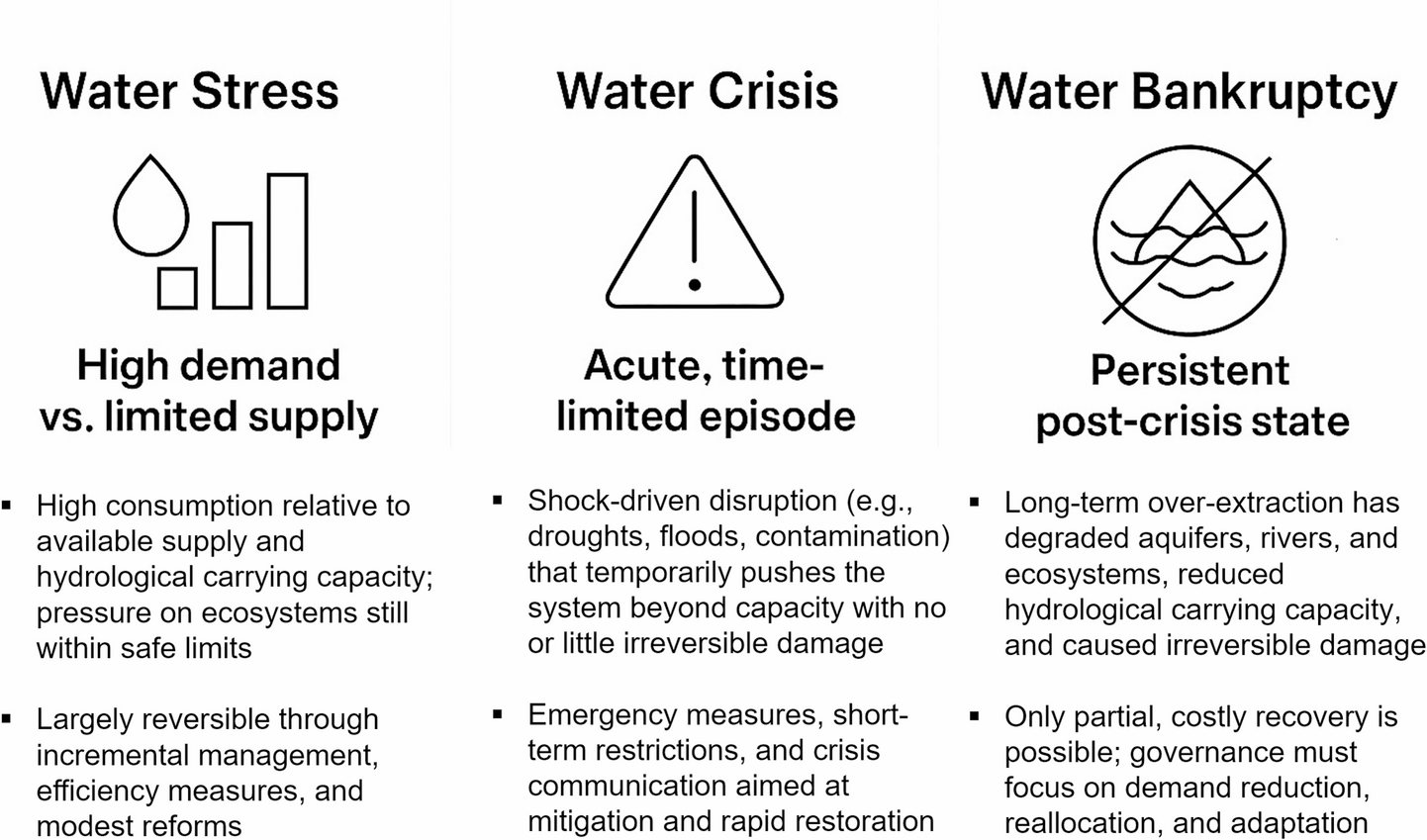
Water bankruptcy, he says, is a stage beyond ‘water stress’, ‘water crisis’ or ‘water emergency’, which are the familiar descriptors of a dearth in water supplies to meet the immediate needs of a region or a megacity.
Bankruptcy occurs when demand for water permanently exceeds local supply from rivers, lakes, rainfall and groundwater. It is a time “when the crisis never ends”, Madani says.
The term “crisis” is generally understood to mean a temporary disaster inflicted by such factors as drought, flood, storm, pollution or other impact that can be resolved or will self-correct in time. A water-bankrupt nation, city or region is out of water for the long haul.
“Globally, many lakes, rivers, and wetlands have shrunk or dried up, groundwater levels have fallen, land has subsided … due to aggressive over-extraction, and desertification, biodiversity loss, wildfires, and sand and dust storms have intensified,” he says. At the same time glaciers have melted and ice storage is depleting globally.
These are they are the cumulative result of decades of human overuse of surface and groundwater resources, pushing systems beyond their limits and into perpetual failure.
The word “crisis” is thus no longer useful in describing what is happening with water use at global and regional level, which is far worse, Madani argues. Most people (including governments) assume a crisis is a passing shock. Water bankruptcy, however, cannot be repaired – unless one eliminates the human demand that is causing it.
There are many factors that lead to water bankruptcy, notably unrestrained urban demand, prodigal misuse by consumers and industry, leakage and wastage, bad water management by authorities, poor infrastructure, pollution by industry, ruthless mining by private corporations etc. Currently, the two most prominent causes are agriculture (which devours 70 per cent of the world’s fresh water) and climate change (which is, in turn, about 30 per cent driven by agriculture). Thus, behind the world’s emerging water catastrophe is the insatiable human jawbone and the need to keep it champing.
To feed just one average person per day takes 950 litres of water, 12 kilos of lost soil, 1.6 litres of fossil fuel, 1g of highly toxic pesticide and 4.9 kilos of carbon emissions. Multiply these numbers by 8,300,000,000 people and then by 365 days in the year, and you will begin to sense the problem. Water is merely the resource that is running out fastest, but soil and a safe climate for food production are not far behind.
Madani does not specify which regions of the planet are in water bankruptcy, presumably for fear of offending the offending nations, a major stifle in the censorship of all UN reports. However, the answer is readily to be found in a great many other studies: the Middle East-North African (MENA) region is almost out of water now. So is Central Asia. The northern half of the Indian subcontinent, northern China and Central America are all approaching criticality. Large parts of South America, southern and sub-Saharan Africa and Australasia are at risk. In all some 25 countries, home to a quarter of the human population are in dire water trouble.
However, many countries not regarded as arid face increasing difficulty in managing their water, if not bankrupt. Britain’s rivers for example “are plagued by sewage, chemical, nutrient and plastic pollution” and by the 2050s the country may face a shortfall of five billion litres a day. New Zealand, once a water-abundant country, is running short because it has decided to turn its rivers into milk and cheese to feed China. Many Pacific island states and major river deltas, home to 500 million globally, are losing their fresh groundwater due salt intrusion caused by sea-level rise.
At the same time the greatest freshwater resource on Earth – groundwater (estimated at 20m cubic kms) – is running out because humans are extracting it faster than it can recharge. Virtually no country measures its groundwater resources accurately, and consequently all turn a blind eye to extraction exceeding supply. Meanwhile most of the world’s glaciers will vanish as the planet hits +2 degrees, by the mid-century – and the mighty rivers they supply, like the Indus and Ganges, will dry up or run only seasonally.
Half the world’s 100 largest cities are already facing high levels of water stress. Some 38 of these are located in regions of “extremely high water stress”, according to the World Water Security Atlas (Feb 2026) . Many of these giant conurbations qualify as ‘megacities’, whose populations range from 10 to 42 million. They include Beijing, Shanghai, Tianjin, New York, Los Angeles, Mexico City, Lima, Sao Paulo, Rio de Janeiro, Cairo, Moscow, Teheran, Lahore, Delhi, Bangalore, Mumbai, Dhaka, Jakarta and Manila, all facing acute scarcity by mid-century.
Several cities are already looking down the barrel at ‘day zero’ when there is simply no more water available for their citizens. At that point they have no alternative than to forcibly depopulate the city – thereby throwing increased stress on those cities worldwide that will have to soak up a flood of ‘water refugees’. This is the true meaning of water bankruptcy – and the way it spreads from country to country.
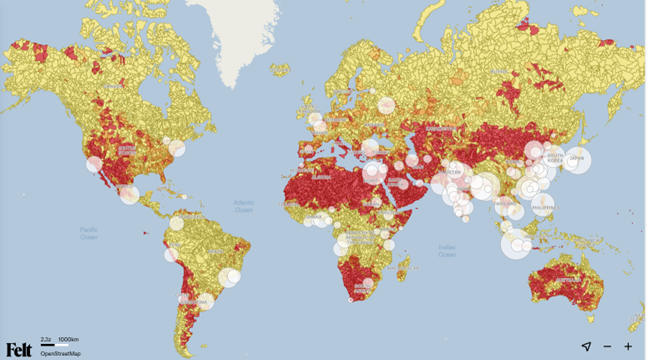
The World Bank Group’s Global Water Monitoring Report states bluntly that world freshwater reserves have fallen dramatically in the past 20 years. The Group estimates the Earth is losing about 324bn cubic metres of freshwater a year, enough for 280 million people, or a country the size of Indonesia. The losses are striking at every major river basin on every continent.
Observing the planet from outer space, the unblinking eyes of satellites expose an alarming trend of ‘continental drying’: a persistent long-term decline in freshwater availability across vast landmasses. “Not only are droughts and deluges becoming more unpredictable, but the total amount of freshwater available for use has also significantly declined,” the World Bank says.
Pursuing the banking analogy, the report calls for a radical improvement in the way water is managed and saved within the environment, especially in the soil and its subsurface.
The problem is that humanity has become used to thinking about money in terms of an ever-elastic amount of debt that can be extended and renegotiated at will. But water, unlike money, is finite. When it runs out one cannot simply print more of it out of thin air, as central banks do to soothe financial markets. Money has encouraged humans to think in unreal ways about real resources. Money is a fantasy held only by humans. Water is a finite necessity for all life, ours included.
Unless humans very quickly learn to think of water as finite, and to realise our numbers have outrun the supply, then global water bankruptcy awaits us all. And that is very much worse than fiscal bankruptcy.