UN defends Rapporteur after coordinated European pressure campaign
February 17, 2026
UN warns of attacks on independent experts after European states target rapporteur over disputed Gaza remarks and sanctions.
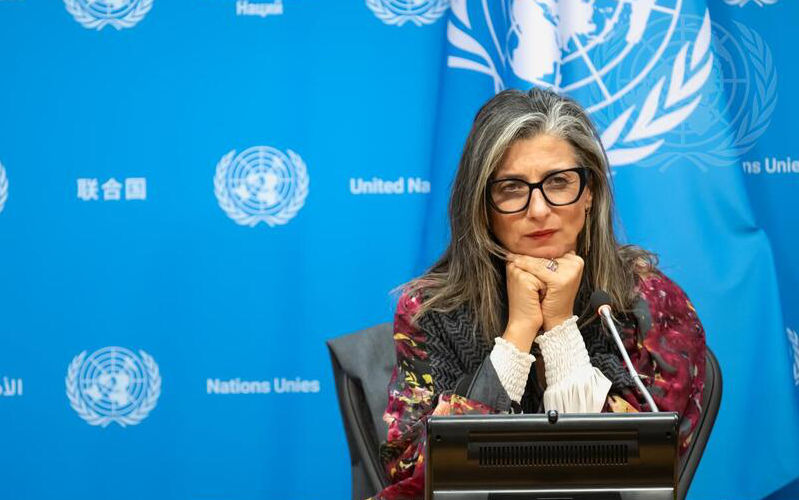
The United Nations has defended its Special Rapporteur on Palestinian rights, Francesca Albanese, after several European governments demanded her resignation over remarks about Israel that she denies making.
A spokesperson for the UN human rights office warned that the controversy reflects a broader pattern of pressure on independent investigators.
“We are very worried. We are concerned that UN officials, independent experts and judicial officials, are increasingly subjected to personal attacks, threats and misinformation that distracts from the serious human rights issues,” UN human rights office spokesperson Marta Hurtado told reporters.
The statement followed criticism by Germany, France, Italy and the Czech Republic, whose officials claimed Albanese described Israel as a “common enemy of humanity.”
However, a transcript of her 7 February remarks in Doha reviewed by Reuters did not contain such wording.
UN special rapporteurs operate under the Human Rights Council but act independently from the UN Secretariat, tasked with documenting violations and reporting them publicly.
European officials intensified their criticism throughout the week.
Germany’s foreign minister called Albanese’s position “untenable,” while France’s foreign minister accused her of making “outrageous and reprehensible remarks” against Israel. The Czech foreign minister publicly repeated the disputed quote and urged her removal.
Diplomats told Reuters there is no precedent for removing a rapporteur mid-mandate, although a formal motion could theoretically be introduced at the 47-member Human Rights Council. Such an effort is considered unlikely to pass due to support within the body for Palestinian rights monitoring.
Albanese’s current mandate runs until 2028.
Albanese rejected the accusations and accused European governments of targeting her rather than addressing violations in Gaza.
“Three European governments accuse me – based on statements I never made – with a virulence and conviction that they have NEVER used against those who have slaughtered 20,000+ children in 858 days,” she wrote on X.
She was referencing figures provided by the Palestinian Health Ministry regarding casualties in Gaza.
In additional remarks, she argued that the controversy has shifted focus away from her reports documenting Israeli conduct in Gaza and the occupied West Bank.
Her position, she said, remains grounded in her UN mandate to monitor and report human rights conditions.
The dispute escalated further after the administration of US President Donald Trump imposed sanctions on Albanese, freezing her assets.
The move followed letters she sent to US companies accusing them of contributing to “gross human rights violations” linked to Israeli actions in Gaza and the West Bank.
The sanctions marked a rare step against a UN-mandated investigator and deepened concern within human rights circles about political pressure on international accountability mechanisms.
A lie was exposed. Instead of retracting it, the SYSTEM that enabled the genocide, attacks the messenger. France knows it stepped in something foul, but pride forbids correction: the archives are ransacked for any stray word. Others repeat the falsehood. The Inquisition is back. https://t.co/DeYmXN3Mgl
— Francesca Albanese, UN Special Rapporteur oPt (@FranceskAlbs) February 13, 2026
The controversy has effectively turned into a dispute over the role of UN investigators themselves.
While critics argue she exceeded neutrality, UN officials stress that rapporteurs are meant to document abuses and cannot be removed for unpopular findings.
The debate now centres less on what she said — since the disputed quote is unsupported by transcripts — and more on whether international scrutiny of Israeli conduct should face political consequences.
Albanese is expected to present her next report on Palestinian rights before the Human Rights Council in Geneva next month, where the issue is likely to resurface.
The diplomatic dispute unfolds as the war in Gaza has produced one of the highest civilian death tolls in recent modern conflicts.
According to Gaza health authorities cited by international agencies, more than 72,000 Palestinians have been killed since the start of the genocide. Tens of thousands more have been wounded, many with permanent disabilities.
Women and children account for a large proportion of the casualties. Medical and humanitarian organisations have repeatedly warned that entire families have been erased from civil registries, while thousands remain missing under rubble.
Hospitals have collapsed under bombardment and siege conditions, forcing surgeries without anaesthesia and leaving large numbers of injured untreated. UN agencies have reported the destruction of most housing units in the enclave and the displacement of the overwhelming majority of the population.
Aid groups also warn of starvation conditions caused by restricted access to food, water and medical supplies, alongside outbreaks of disease linked to the breakdown of sanitation infrastructure.
It is within this context – mass civilian casualties, displacement and widespread destruction – that Albanese’s reporting and subsequent political backlash have emerged.
Republished from _Palestine Chronicle_ 13 February 2026